After July's Turmoil, Obama Needs 'a New Chapter' in August


President Obama once looked to the August congressional recess as the moment to gain a decisive advantage in the fight to overhaul the nation's health-care system. Instead, he needs to use the month to rebalance his presidency.

July proved the most difficult month of his young administration. His approval ratings dropped. Disapproval of his major initiatives rose sharply. Neither the House nor the Senate met his deadline to pass a version of health care. Finally, the White House and its allies at the Democratic National Committee ended up in a high-pitched argument over whether citizens protesting health care were expressing real or manufactured anger.

That raises the stakes for August. As Democratic pollster Stan Greenberg put it: "Everybody understands they [Obama and his Democratic allies] have to be in a new chapter when they come back at the end of August."

White House officials took hope from the first week of August that they might be seeing a turn in their fortunes. They cited as evidence the confirmation of Sonia Sotomayor to the Supreme Court, the apparent killing of Taliban leader Baitullah Mehsud in Pakistan, the release of two American journalists from North Korea and a better-than-expected jobless report. It will take more than a week of such news to turn around public perceptions.

Administration officials were braced for a worse unemployment report on Friday. Now they are nervously awaiting the release of the midyear economic review from the Office of Management and Budget, which may show how much deficit projections have deteriorated from forecasts earlier this year. The White House line is that the economy has avoided the worst, thanks to the president's policies. How long it will take for a real recovery to begin -- and for public attitudes to shift -- is another matter.

Republican pollster Bill McInturff points to several factors that underscore the predicament for Obama. First is the likelihood that consumer confidence will not rebound swiftly, even if the Dow continues to rise and the recession appears to be weakening. In years past, it has taken two to nearly four years for consumer confidence to rebound after it has dipped as low as it did in this recession. "We have a long, long way to go before people start feeling better about the economy," he said.

McInturff's second observation is that declining confidence in the president's economic policies has affected attitudes about the rest of Obama's agenda and his overall leadership. Much attention has been focused over the past few weeks on the health-care battle, but McInturff sees the landscape differently. "We're not having a health-care fight," he said. "There is a broad and underlying unease about the state of the economy and the country. . . . I think the Obama administration needs to understand that health care is interwoven with these broader concerns."

Obama's team hopes that the less-bad jobless report and the recent gross domestic product report that showed the rate of decline slowing considerably in the second quarter will help create more public optimism. If McInturff is right, that may take longer than White House officials had hoped. Nor is it certain that better feelings about the economy will lessen opposition to the Democrats' health-care initiatives.

What Obama should do, in the estimation of some of his allies, is use August to accomplish several things. One is to reunite the Democratic Party on health care. For the past two months, Democrats have carried on a very public debate over the issue; that has slowed the pace of reform and has affected confidence in the president's leadership.

Obama needs his party's lawmakers to return to Washington after Labor Day ready to move on health care. If failure is not an option, as so many Democrats say, August will have to be a time in which consensus takes shape. Obama still holds out hope of enacting health care with the help of some Republicans, but without a united Democratic Party there is virtually no hope for success.

"A Democratic Party that is united and making progress will have a major impact on his standing," Greenberg said.

The month has begun with a noisy, partisan fight -- not so much about the details of health-care policy but about who is behind the protests at town-hall meetings. It's easy for both sides to fall into this battle and even easier, it seems, for the rhetoric to get beyond overheated.

If the opposition represents mostly an ideological fringe, that will become clearer soon. If the most boisterous opponents represent a broader sense of discontent, Obama will have a bigger problem to deal with. By all indications, a mighty public relations battle will unfold in August, along with whatever happens at the town halls. But the president might benefit most from helping to cool temperatures.

Obama has dealt with adversity before. His early months as a candidate were anything but smooth. Two years ago this month, he was on the defensive. His foreign policy pronouncements were drawing attacks from his rivals. He lagged significantly behind Hillary Rodham Clinton in the national polls. His message was still a work in progress. His campaign operation appeared to be sputtering.

Obama went to work. He ordered his team to step up. He found a sense of exhilaration from the foreign policy debate and refused to let his advisers give ground. He worked and reworked to hone a sharper message. He reassured the doubters among his campaign contributors and others, who were calling for a new strategy. By late fall 2007, the elements of what became his successful campaign came together.

The problems of today are different, of course. But the lesson from Obama's experience as a candidate is that he is capable of mid-course corrections -- particularly in addressing his own shortcomings and in redoubling his determination to succeed. That's what the month of August may tell everyone about him.

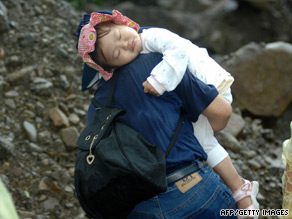
Taiwan mudslide survivors found


About 700 people feared dead following a mudslide in Taiwan have been found alive, officials reported Wednesday.

The mudslide engulfed several remote villages after Typhoon Morakot pummelled the island with more than two metres of rain over the weekend.

Officials said many people from the villages appear to have made it to higher ground before the mud and rock covered their homes.

Survivors began to be spotted in Shialo Lin, which was most catastrophically hit by the mudslide, on Tuesday, said relief operations spokesman Maj.-Gen. Hu Jui-chou.

Shiao Lin and its surrounding villages remain cut off from the outside world because the rain washed out roads and bridges in the area.
Military airlifts

About 120 army helicopter flights have ferried at least 300 of the survivors to safety in the southern town of Kaohsiung, which has been the focal point of relief operations.

People from the flooded area of Kaohsiung County in Taiwan walk on a damaged road on Wednesday after Typhoon Morakot.People from the flooded area of Kaohsiung County in Taiwan walk on a damaged road on Wednesday after Typhoon Morakot. (Reuters)At least 200 of the people were airlifted from Shialo Lin, officials said.

Hu said efforts to get people out of the devastated regions have been complicated by continued bad weather in the area.

Some people who do not appear to need immediate medical assistance are being left on the ground and food and supplies are being air-dropped, officials said.

Many of the airlifted mudslide survivors are arriving at hospitals with injuries, said Albert Yu, communications manager with World Vision Taiwan.

"Right now they're in shock. They've lost their homes, they've possibly lost their livelihoods," Yu said.
Typhoon aftermath

Morakot struck the Philippines, Taiwan and China and left at least 93 people dead, most of them in Taiwan. The typhoon and its aftermath are also believed to have killed millions of livestock.

There is no way of knowing how many people may be buried in the mud in Taiwan, said Cishan police Chief Lee Chin-lung.

"We've got some people out," Lee said. "But it is extremely hard to know how many remain there."

Taiwan's population register says that Shiao Lin has 1,300 inhabitants, though many, Lee said, were believed to be living elsewhere.

Some rescued villagers said that as many as 600 people may have been buried alive when the mudslide hit.

On Tuesday, the National Fire Agency put that number at 100, without offering any evidence to support the claim.

Desmond Tutu: my tribute to Burma's opposition leader, Aung San Suu Kyi


In the week when Amnesty International awarded Burma's opposition leader Aung San Suu Kyi its highest accolade, Ambassador of Conscience, a fellow Nobel laureate pays tribute

This article was written in response to a feature about Aung San Suu Kyi by Adrian Levy and Cathy Scott-Clark which was published on 11 November 2008I think of my sister Nobel laureate Aung San Suu Kyi every day. Her picture hangs on the wall of my office, reminding me that, thousands of miles away in Asia, a nation is oppressed. Every day I ask myself: have I done everything I can try to end the atrocities being committed in Burma? And I pray that world leaders will ask themselves the same question. For if they did, the answer would be "no", and perhaps their conscience will finally force them to act.

Humankind has the ability to live in freedom and in peace. We have seen that goodness has triumphed over evil; we have witnessed political transitions in South Africa, and elsewhere, evidencing that we live in a moral universe. Our world is sometimes lacking wise and good leadership or, as in the case of Burma, the leadership is forbidden to lead.

Aung San Suu Kyi has now been detained for more than 13 years. She recently passed her 5,000th day in detention. Every one of those days is a tragedy and a lost opportunity. The whole world, not just the people of Burma, suffers from this loss. We desperately need the kind of moral and principled leadership that Aung San Suu Kyi would provide. And when you add the more than 2,100 political prisoners who are also in Burma's jails, and the thousands more jailed in recent decades, the true scale of injustice, but also of lost potential, becomes heartbreakingly clear.

Like many leaders, Aung San Suu Kyi has had to make great personal sacrifices. It is cruel enough to deprive an innocent person of her freedom. Burma's generals are crueller still. They try to use her as leverage to make her submit to their will. They refused to allow her husband to visit one last time when he was dying of cancer. She has grandchildren she has never even met. Yet her will and determination have stayed strong despite her being kept in detention for so many years.

More than anything, the new trial and detention of Aung San Suu Kyi speaks volumes about her effectiveness as a leader. The only reason the generals need to silence her clarion call for freedom is because they fear her and the principles she stands for. She is the greatest threat to their continuing rule.

The universal demand for human freedom cannot be suppressed forever. This is a universal truth that Than Shwe, the dictator of Burma, has failed to understand. How frustrated must he be that no matter how long he keeps Aung San Suu Kyi in detention, no matter how many guns he buys, and no matter how many people he imprisons, Aung San Suu Kyi and the people of Burma will not submit. The demands for the freedom of Aung San Suu Kyi and all political prisoners of Burma grow louder and echo around the world, reaching even his new capital hidden in central Burma. Words, however, are not enough. Freedom is never given freely by those who have power; it has to be fought for.

The continuing detention of Aung San Suu Kyi and Burma's other political prisoners is a crime and an indictment of an international community that often substitutes the issuance of repeated statements of concern for effective diplomacy. The UN treats the situation in Burma as if it is just a dispute between two sides, and they must mediate to find a middle ground. The reality is that a brutal, criminal and illegal dictatorship is trying, and failing, to crush those who want freedom and justice. The international community cannot be neutral in the face of evil. That evil must be called what it is, and confronted.

Change is overdue to the framework within which the international community approaches Burma. Twenty years of trying to persuade Burma's generals to reform has not secured any improvement. Forty visits by UN envoys have failed to elicit any change. The warm embrace of the Association of South East Asian Nations (Asean) did not improve the behaviour of the regime towards Burma's citizens whether Christian, Buddhist or Muslim. The regime rules with an iron fist and those under its rule have suffered long enough.

Aung San Suu Kyi and her supporters have time and again offered to dialogue with the regime. They offered a path of reconciliation and non-violent transition. Even as Aung San Suu Kyi stood before the regime's sham court, facing five years' imprisonment, we heard her voice loud and strong. She said: "There could be many opportunities for national reconciliation if all parties so wished."

Burma's generals must now face the consequences of their actions. The detention of Aung San Suu Kyi is as clear a signal as we could get that there will be no chance of reform and that the regime's "road map to democracy", including the call for elections, in 2010, is an obstacle to justice.

A new report from Harvard Law School, Crimes in Burma, commissioned by some of the most respected jurists in international law, has used the UN's own reports to highlight how Burma's generals have committed war crimes and crimes against humanity.

Burma's generals are criminals, and must be treated as such. Than Shwe should be held accountable for abominable atrocities: his soldiers rape ethnic women and children, they torture, mutilate and murder at will. In eastern Burma, more than 3,300 ethnic villages have been destroyed, more than in Darfur. Civilians are deliberately targeted and shot on sight.

Than Shwe spurned the compassion of those willing to provide assistance following Cyclone Nargis. Instead, he conducted a referendum and he declared his undemocratic constitution the victor while victims perished from the cyclone's devastation. These are war crimes and crimes against humanity. Than Shwe and the rest of the generals cannot be allowed to go unpunished. The UN must establish a commission of inquiry, with a view to compiling evidence for prosecution. Failure to do so amounts to complicity with these crimes.

An international arms embargo must also be imposed immediately. Those countries supplying arms to Burma are facilitating these atrocities. Countries across the world must declare their support for a global arms embargo, making it impossible for China to resist such a move at the Security Council.

Aung San Suu Kyi and the people of Burma deserve nothing less than our most strenuous efforts to help them secure their freedom. Every day we must ask ourselves: have we done everything that we can? I pledge that I will not rest until Aung San Suu Kyi, and all the people of Burma, are free. Please join me.

Desmond M Tutu is the former Archbishop of Cape Town and recipient of the Nobel peace prize

Jackson's autopsy results sealed


Post-mortem tests on Michael Jackson are complete but the results are being kept under wraps until a police probe into his death is finished.

Toxicology tests have now been concluded but Los Angeles coroner Ed Winter has declined to say when they will be announced.

They are expected to show that Jackson was on heavy medication when he died.

The police investigation so far has let to raids on the premises of the star's doctor, Conrad Murray.

Dr Murray assisted officers in the searches last month, which resulted in the seizure of items including various medications and computer hard drives.

Film deal

He has not been named as a suspect, but court records have confirmed him as a subject in the manslaughter investigation of Jackson, who died suddenly on 25 June.

Meanwhile, a plan to release a film based on the singer's last rehearsals in Los Angeles for his series of concerts at the O2 arena in London has been approved by a Los Angeles judge.

The proposal had been the subject of numerous objections by Jackson's mother Katherine, including concerns that his three children would appear in the movie.

But AEG Live have said they are not included in the footage.

The film is due to be released in October, with the singer's estate expected to receive abount 90% of the proceeds.

The release is expected to be shown in 3D and will also include interviews with Jackson's friends and collaborators.

Michael Lynton, head of Sony Pictures Entertainment, said: "This historic recording of the last time he sang and danced on stage shows the legendary artist in an incredibly powerful way, with crystal clear images and sound."

President Obama welcomes debate on health care, not yelling - spokesman


Cole/AP

President Obama has had friendly receptions in Portsmouth, N.H. before, but expects a more critical crowd at a Town Hall meeting on health care on Tuesday.
Take our Poll
Town hall turbulence

Do you think the town halls are hurting or helping Obama?

Hurting. They're just a forum for protestors.

Helping. He's getting his message to real people.

I'm not sure.
Related News
Articles

* Crouch: In health care debate, the GOP is pushing fiction as fact
* Prez launching offensive on health care
* Palin fears Obama's 'death panel,' but wants to dialogue to be civil
* Zuckerman: Drowning in debt
* Obama fires back at Palin over 'death panel' slam
* Obama approval rating dips over U.S. economic woes: poll
* Dems promise to push health care through with or without GOP support

Washington - President Obama expects a confrontation Tuesday with anti-health reform protesters at a New Hampshire town hall - and he's ready for it.

"There's actually a pretty long tradition of people shouting at politicians in America," Obama spokesman Bill Burton said.

"Now, if you just want to come to a town hall so that you can disrupt and ... scream over another person, he doesn't think that that's productive," added Burton.

Several health-centric town hall events hosted by members of the House and Senate in recent days have devolved into shouting fests. One White House official predicted "it will happen" to Obama, too, during his forum in Portsmouth.

Ultimately, White House aides believe they can turn the tide in their favor by deploying Obama heavily over the summer. "People recognize the system's broken, and while they're frustrated they do want somebody to fix it," the official added. "We feel pretty good about our chances."

Members of the anti-tax-and-spend Tea Party Coalition have publicly vowed to protest outside and inside the event at Portsmouth High School.

"I'm not a shouter, I'm just passionate," said Jack Kimball, 62, a Portsmouth tea partyer who owns a cleaning business. "We're going to be outside the town hall because we're concerned not just about health care anymore - it's about the growth of government."

A Democratic operative believes a backlash is building against the anti-Obama shouters. "To the extent people are aware that protesters are orchestrated to disrupt, it's helpful. Real people are being drowned out by an orchestrated campaign," the official said.

Some three-quarters of the tickets to the event were distributed to members of the public via the White House Web site, making it easy for potential protesters to pick up tickets, an aide explained.

The other 25% went to political cronies and Obama supporters, the aide said.

Secret Service agents and local police will be at the ready to restrain anyone who disrupts the event.

Demonstrators are usually removed and not allowed back in, but some recent town hall protests have become violent, so agitators may find themselves facing charges.

Health reform foes get two more chances to face off with Obama beginning Friday. He will hold town halls in Montana and Colorado during a four-day Western swing.
Ads by Yahoo!

Plastic Surgeon in Bangkok
Plastic surgery by a board-certified plastic surgeon in Bangkok.
(www.surgery-thailand.com)

Football Scouts Needed:
Train to scout professional football players in your area.
(www.SportsManagementWorldWide.com)

hydroponics supply green house supply
Organic Hydroponic Gardening. Complete systems. hydroponics supply green house supply.
(www.hydrogardenshop.com)

* Email
* Print
* Rss

Share
* Yahoo! Buzz
* Digg
* StumbleUpon
* Facebook

See all share links >>

* Del.icio.us
* Mixx
* Reddit
* Propeller
* Newsvine
* Furl

Discuss this Article
0 comments [See All Comments] [Discussion Guidelines]

To post comments, REGISTER or LOG IN

Click Here to see all comments or to Report Abuse

* Discuss
* Email
* Print
* Share

Hide

* Digg
* Facebook
* Del.icio.us
* Yahoo! Buzz
* Mixx
* Reddit
* StumbleUpon
* Propeller
* Newsvine
* Furl

*
Related Articles
*
Related Topics

* City gears for swine flu return
* Williams: Obama, teach N.Y. a lesson
* Prez launching offensive on health care
* Hil: 'My husband is not the Secretary of State, I am'
* No bigger residents than when President Obama and first fam visit Martha's Vineyard

* Barack Obama
* Protests and Demonstrations
* Politics
* Local Politics
* U.S. Politics
* Bill Burton
* Portsmouth
* U.S. Government
* U.S. Congressional News
* United States

Today's Top Picks
White House: Bring on health care debate, but leave yelling at home

President Obama expects a confrontation with anti-health reform protesters at a N.H. town hall - and he's ready for it.
Palin marital problems behind resignation, says Levi

Sarah skipped out as Alaska's governor due to marital problems she and hubby Todd have had "from day one," Levi Johnston said.
Michael Jackson film gets green light from judge

Audiences will get to see the King of Pop perform one more time.
When will these girls learn? 'Twilight' star latest embroiled in nude pic scandal

Photos showing Ashley Greene baring all for the camera were leaked onto the Internet.
Blue Jays drop Yankees 5-4

A sloppy play by both Sergio Mitre and Robinson Cano and a home run by Lyle Overbay sank the Yankees in a 5-4 loss.
Click to learn more... Quantcast
Best Of NYDN.com
WATN: The Outsiders
WATN: The Outsiders

Tom Cruise, an outsider? Believe it. And Patrick Swayze, Ralph Macchio, Matt Dillon...see what everyone from the 80s classic is up to now.
Dance with us, Paula, ABC begs

Add ABC to the list of networks who want Paula Abdul to save them the next dance.
MJ's daughter is mine, claims actor

British child star Mark Lester says he's the father of Michael Jackson's daughter, Paris.
Lark's looking more LaToya than Lisa Turtle

Actress Lark Voorhies, aka Lisa Turtle on the '90s hit "Saved by the Bell," was looking more like LaToya than one of the Bayside gang.
At age 43, Cindy still looks super

See how the supermodels have aged. Cindy, Naomi, Tyra, Christie, Elle...

* Most Read
* Most Discussed
* Most Emailed

1. Sarah Palin has marital woes, almost-son-in-law Levi Johnston says
2. President Obama welcomes debate on health care, not yelling - spokesman
3. Long Island sex slave ring lured illegal immigrants with waitress jobs
4. Hil: 'My husband is not the Secretary of State, I am'
5. 'Dead' baby wakes up in time for his own funeral wake
6. Pratt student still in coma a week after savage beating at hands of teen thugs
7. Pitchman Billy Mays' wife lashes out at autopsy report that said he used coke
8. Obama fires back at Palin over 'death panel' slam
9. Everyone's turning up Sarah! The best Palin look-alikes
10. Animal cruelty, animal torture charges for Brooklyn man who threw dog off roof

Quantcast

Scores Dead and Hundreds Feared Missing From Typhoons


BEIJING — The toll from the already deadly Typhoon Morakot in the Pacific threatened to soar on Tuesday, as huge mudslides buried a rural village in south-central Taiwan and at least six apartment buildings in coastal China, leaving hundreds of people missing.
Skip to next paragraph
Multimedia
Deadly Typhoons in AsiaPhotographs
Deadly Typhoons in Asia
Related
Quake Strikes Central Japan Early Tuesday (August 11, 2009)
Enlarge This Image
Taiwan Military News Agency, via Reuters

Unverified reports by residents suggested Monday that Hsiao-lin, a village in southern Taiwan, was buried in a mudslide, leaving as many as 600 people missing. More Photos »
Enlarge This Image
Reuters

An elderly man was carried after being rescued from Hsiao-lin. Typhoon Morakot has unleashed record rains on Taiwan. More Photos >
The New York Times

A quake jolted eastern and central Japan early Tuesday. More Photos >

The Taiwan mudslide, triggered early Sunday by as much as eight feet of typhoon-spawned rain, was said by local residents to have buried as many as 600 people in the village of Hsiao-lin, but the figure could not be quickly verified.

In Pengxi, a mountain-ringed town in coastal China about 270 miles southwest of Shanghai, a landslide buried six four-story apartment buildings as residents slept at 10:30 p.m. Monday, local time. Rescuers pulled four survivors and two bodies from the debris, but were unable to say how many others were missing.

The slides threatened to sharply increase the death toll from a string of typhoons that have ravaged Pacific Asia in recent days. Typhoon Morakot is reported to have killed 8 people in China and at least 36 in Taiwan and the Philippines, with dozens more there reported missing.

Typhoon Etau, which struck Japan’s west coat on Monday, has killed 13 people and left 10 others missing, news agencies reported.

Initial reports from Hsiao-lin were sketchy. A spokesman for the National Fire Administration, Liang Yu-chu, said that 45 people had been pulled alive from the mudslide, but that no dead had been found.

“The whole village was buried in the landslide, so it’s hard to be certain,” Mr. Liang said. “They’re still searching.”

Early Tuesday, an earthquake with a 6.5 magnitude struck Japan, jolting eastern and central parts of the country and rattling houses in Tokyo. The quake, which prompted a warning — later canceled — of a modest tsunami, came a day after a 6.9 earthquake was reported in the same area.

A significantly larger earthquake was reported early Tuesday in the Andaman Islands, in the Bay of Bengal, one of the areas ravaged by the 2004 tsunami. That earthquake, with a preliminary magnitude of 7.7, prompted a tsunami watch for India, Myanmar, Indonesia, Thailand and Bangladesh that was later canceled.

The typhoon that hit Taiwan unleashed record rains from Friday to Sunday, causing what officials said was the worst flooding in half a century. The number of known dead in Taiwan was 15, with 32 severely injured. Those figures did not include potential landslide victims.

Morakot, which means emerald in Thai, struck the Philippines last week, killing 21 people, including a French tourist and two Belgian tourists, according to officials there. Others were reported missing.

Taiwan’s central government had warned earlier of landslide dangers after Morakot battered the island, dumping record rains across the south.

Helicopters took rescuers into the landslide site, in Kaohsiung County, and officials said accurate information on the situation was likely to emerge before daylight on Tuesday. Rescue efforts were complicated by continuing rain.

More than 170,000 people remained without power on Monday, the government said.

Lawmakers Scrap Plans to Buy Fancy Jets Amid Criticism, Dem Leaders Say They Won't Request Jets Used to Ferry Senior Government Officials


(AP) House Democratic leaders said Monday that they will not force the Pentagon to buy four new passenger jets used to ferry senior government officials.

Democrats have been criticized for adding $330 million to the Air Force's 2010 budget to buy the jets even though the Pentagon didn't request the money.

Two of the planes would be the C-37 — the military equivalent to the fancy Gulfstream 550 — and cost taxpayers $130 million at a time when lawmakers have made villains of bailed-out auto executives who rely on corporate jets to travel.

"If the Department of Defense does not want these aircraft, they will be eliminated from the bill," said Rep. John Murtha, a Pennsylvania Democrat who chairs the panel that approved the additional spending.

A spokesman for House Speaker Nancy Pelosi said she supported the decision, which was expected to face resistance in the Senate.

It's not unusual for Congress to ignore the Pentagon's budget proposal and add money for certain programs, particularly if the purchase might benefit their constituents.

The $636 billion defense spending bill passed last month by a 400-30 vote included money for cargo jets that Defense Secretary Robert Gates said weren't needed and an alternative engine for the next-generation F-35 Joint Strike Fighter that the Pentagon said was a waste of money.

The bill also included almost $200 million to buy three C-37 jets, two more than the Pentagon requested. While the jet is not as fancy as the Gulfstream 550, it is considered a cushy ride that is typically reserved for VIP government officials, including members of Congress.

The House measure directed that the two C-37 jets be located at Andrews Air Force Base in the Washington suburbs — a favored departure point for congressional trips.

The House also added money for two C-40 jets, which are similar to the Boeing 737. Whereas the Pentagon plan would have spent $220 million, the House wanted to spend $550 million.

The added spending, first reported this month by the Capitol Hill newspaper Roll Call, prompted a swift backlash by budget watchdogs.

Murtha denies that the money was added to give lawmakers a nicer ride when traveling with the military, as lawmakers often do to visit troops overseas or for security reasons. In a statement released Monday, Murtha said that the planes are primarily used by executive branch officials.

Murtha said the newer jets were needed to replace older aircraft with safety and maintenance issues that cost a lot more to operate.

Obama Braces for Health Care Town Hall in N.H.


WASHINGTON -- President Barack Obama is altering his message on his overhaul of the U.S. health care system, readying a fresh pitch designed for those who already have insurance.

The White House is retooling its message amid polling that shows Americans -- especially those who already have coverage -- skeptical of the Democratic proposals to expand coverage to millions. Instead, Obama will use a potentially boisterous town hall-style meeting in New Hampshire to highlight how his proposals would affect workers whose employers provide their health insurance. The United States, unlike other developed nations, lacks universal health care; most working Americans get health insurance through their employers.

The shift comes as critics of the president's plan have grabbed headlines by disrupting town hall meetings and the White House expects Tuesday's event to have a hiccup.

Concerns over Obama's proposal are heating up meetings, chat rooms and radio shows, driving his poll numbers down and threatening the future of his top domestic priority. While Congress is in recess for the month of August, lawmakers are hearing from constituents worried about divisive issues such as the government's role in health care and the costs of an overhaul.

"There's a lot of fear out there," said Rep. Carol Shea-Porter, a New Hampshire Democrat.
To calm that fear, Obama plans to spend the month highlighting the upside of health overhaul for Americans already with insurance, starting in a state with 89 percent of its residents enjoying health coverage.

In New Hampshire, Obama will speak directly about his proposal to ban insurance companies from denying individuals coverage because of pre-existing conditions. During a Friday trip to Montana, he will talk about how his plan would block companies from dropping an individual's coverage if he or she becomes ill. And in Colorado the president will talk about how the Democrats' plan would end high out-of-pocket costs in some policies.

His allied Democratic National Committee began running television advertising that asks, "What's in it for you?" and then highlights those goals. Officials said the ad started running Monday night in Washington and on cable; it would follow as early as Tuesday in states Obama planned to visit, including New Hampshire.

About 1,800 people are expected for that midday event in the Democratic-leaning Seacoast region of the Granite State. Of those, 70 percent were given tickets based on a random lottery -- a potentially dicey crowd in a state known for its grass-roots political activism.

"Participating in government here in New Hampshire is like putting on socks for the average American," said Ray Buckley, the chairman of the New Hampshire Democratic Party.

Outside, a dozen grass-roots organizations plan a counter rally.

"We are against the blind-faith, fast-tracking approach being advocated by special-interest supporters of the bill, congressional representatives, as well as the president," said George Lovejoy, a former state senator and chairman of the New Hampshire Advantage Coalition.

In an e-mail to Obama supporters in New Hampshire, an aide invited supporters to counter the counter-protesters and called them organized by "Washington insiders, insurance companies and well-financed special interests who don't go a day without spreading lies and stirring up fear."

Republicans say the heated debate is a sign of widespread public dissatisfaction with Obama's ideas. But with some of the anxieties spilling into angry disruptions and even threats, Democrats have accused Republicans of orchestrating the events to sabotage legislation. In an article published Monday, House of Representatives Speaker Nancy Pelosi and Majority Leader Steny Hoyer wrote: "Drowning out opposing views is simply un-American."

Obama and his aides stayed away from such provocative language.

"We are having a vigorous debate in the United States, and I think that's a healthy thing," Obama said, repeating that thought three times. But, he said, the dynamic will change once the recess ends and the lawmakers -- and the debate -- return to Washington.

Aboard Air Force One, White House spokesman Bill Burton further sought to distance Obama from the "un-American" comment: "Well, I think there's actually a pretty long tradition of people shouting at politicians in America."

Meanwhile, the White House returned to campaign mode, starting with sending members of the Cabinet to key states. The tech-savvy Obama team directly responded to what it considers misinformation through its Twitter and Facebook accounts online, as well as a new page of the White House's Web site.

Organizing for America, Obama's political operation, also urged supporters to visit the offices of members of Congress to express their support for overhaul.

Myanmar's Suu Kyi still a potent force for change


BANGKOK -- Myanmar pro-democracy leader Aung San Suu Kyi is back where the ruling generals want her: inside a crumbling mansion, lonely and isolated from the world.

But a fleeting emergence into public view showed that Suu Kyi's steely grace and charisma, along with her popularity, are intact. She remains a potentially potent force for change in a country that has seen virtually no deviation from harsh military rule for nearly half a century.

For now, the 64-year-old Nobel Peace Prize laureate, arguably the world's most famous prisoner, will likely return to her daily meditation, listening to radio news broadcasts and waiting for the occasional censored mail, including letters from two sons she last saw a decade ago.

What continues to keep Suu Kyi tenacious and focused on bringing democracy to Myanmar are her deep Buddhist faith, rigorous self-discipline and the guiding influence of her parents, those close to her say. The only apparent chink in her armor is a fondness for dark chocolate.

Although set within the teeming city of Yangon, her police-ringed home might just as well be on another continent, removed from a downtrodden populace and a junta that extended her 14-year detention for another 18 months on Tuesday.

Suu Kyi was found guilty of violating the terms of her house arrest by harboring an American, John Yettaw, who swam across a lake to sneak uninvited into her compound. The 53-year-old man was sentenced Tuesday to seven years, including four years' hard labor.

During her 86-day trial, diplomats and supporters were impressed by Suu Kyi's grace under pressure, rebuking those who called Yettaw a fool, sharing her birthday chocolate cake with prison guards and thanking envoys for their support.

"Despite almost two decades of extraordinary pressure - more than half of it in detention - and agonizing personal sacrifices, she looked in remarkable shape," wrote British Ambassador Mark Canning. "Calm, dignified, upright, exuding quiet authority but no hint of bitterness toward the prosecution side."

Josef Silverstein, professor emeritus at Rutgers University and an expert on Myanmar, also called Burma, says that while she may never lead the country, she will always be influential.

"Don't write her off. If she is allowed to live, she has an important role to play in Burma's drama," he says.

Suu Kyi has sometimes been described as an accidental leader, having returned to her homeland in 1988 after two decades abroad to nurse her dying mother just as an uprising erupted against the military regime.

Daughter of the country's independence hero, Gen. Aung San, Suu Kyi was thrust into the forefront of the 1988 demonstrations until the military crushed them brutally and clamped her under house arrest.

But as a teenager Suu Kyi had developed an intense interest in her father who was gunned down by political rivals when she was just a toddler, seemingly absorbing his fierce sense of nationalist mission, military-like discipline and a stubborn streak.

Suu Kyi lived with her mother in India, attended Oxford University, then worked for the United Nations in New York and Bhutan.

Despite the long absence, Aung Din, executive director of the U.S. Campaign for Burma, said Suu Kyi had planned to come back one day to "complete her father's unfinished work, building a democratic country."

"While Suu Kyi's extreme fortitude can be considered an aspect of her natural character, without question her life has been shaped by her parentage," says Justin Wintle, author of the Suu Kyi biography "Perfect Hostage."

Close friends expect this grit to persist through the next phase of her incarceration in her mother's once grand two-story mansion, now gone to seed.

According to one, Su Su Lwin, Suu Kyi adheres to a strict daily routine, rising about 5 a.m., doing meditation and exercise, reading a great deal.

"She doesn't do anything excessively. She lives a very simple life," Su Su Lwin says. "She eats very little. She does like dark chocolate but even that she eats with a limit. She loves to dress up very nicely and neatly but she doesn't like extravagance."

Before her trial, Suu Kyi wasn't allowed telephone or Internet communications, but could get newspapers and listen to the radio. With no satellite dish on her compound, she was only able to watch state-run television.

Her contact with the outside world is unlikely to increase.

She last saw sons Alexander and Kim in 2000, the year after her husband - British academic Michael Aris - died of cancer. The sons, now both in their 30s, have been stripped of their Myanmar citizenship and barred from the country.

Suu Kyi was first arrested in 1989 and barred from contesting general elections called by the junta in May 1990. But her name inspired the opposition campaign and her party scored a landslide victory that the regime never recognized.

Suu Kyi has been offered an exit from her isolation: the junta gave her permission to leave the country when her husband died. But she refused, fearing she would never be allowed to return.

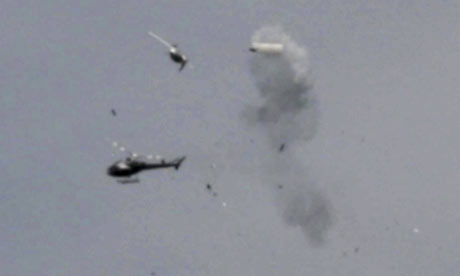
Nine killed in mid-air crash over New York


A helicopter carrying five Italian tourists collides with a small plane above the Hudson river in New York. Photograph: Fox News Channel/Reuters

Nine people were killed today after a sightseeing helicopter carrying Italian tourists collided in mid-air with a small plane near New York and crashed into the Hudson river.

Eyewitnesses saw a wing come off the plane during the collision just after noon US time and watched as the helicopter "fell like a stone" into the river.

Five Italian tourists and the pilot were aboard the helicopter; in the plane, along with the pilot, there were two passengers, one of whom was a child. Another pilot on the ground at the heliport saw the plane approaching and tried to radio an alert to the helicopter above. But the warning was either not heard, or failed to get through in time.

The collision took place just south of the stretch of river where a US Airways jet that had run into trouble after apparently hitting a flock of geese was ditched in January by its pilot, who was hailed as a hero for saving the lives of all 150 people on board.

Two bodies were recovered but there was no hope of finding survivors, said New York's mayor, Michael Bloomberg, who described the incident as "not survivable".

He said that police had found one piece of wreckage in the murky waters of the Hudson and that the search would probably continue for a few days.

"This has changed from a rescue to a recovery mission. There's not going to be a happy ending," he added.

The plane, which was a single-engine Piper PA-32R-300, had taken off earlier from Teterboro Airport in New Jersey and was flying south along the river when it appeared to lose control as it banked steeply and struck the helicopter close to the shore line of Hoboken, New Jersey.

The helicopter, operated by Liberty Helicopter, the largest sightseeing and charter helicopter operator in the north-east US, had taken off moments earlier from West 30th Street in Manhattan.

Hundreds of people on both sides of the mile-wide river watched as the two aircraft appeared to break apart, with the rotary blades detaching from the helicopter, opposite the west side of Manhattan.

On the waterfront at Hoboken, people scattered as pieces of the debris fell from the sky while a wheel from one of the aircraft lay on Hoboken's Sinatra Drive.

"I saw the plane coming down and the helicopter coming across," said Hilda Igartua, 53, of Union City, New Jersey, who added that the plane's trajectory did not change after the collision but the helicopter came apart and spun down in pieces.

"We saw the helicopter propellers fly all over," said Katie Tanski, of Hoboken.

Melissa Green, 33, and her husband were in a park along the river on the New York side and heard the crash. "We turned around and saw these two mushroom splashes," Green said.

"What was really weird is there was no wreckage, nothing. I hope they find the people, but I don't know. They just disappeared," she explained.

"First I saw a piece of something flying through the air. Then I saw the helicopter going down into the water," she said, adding that the crowd in the park seemed too stunned to react. "I thought it was my imagination."

The weather at the time of the collision was clear and mild. Vessels including water taxis diverted to the scene of the accident along with fire boats and Coast Guard rescue teams but both of the aircraft sank quickly under a strong current.

Police divers were carrying out a search of the river as an investigation was launched by the Federal Aviation Administration.

The accident happened in a busy general aviation corridor over the river that is often filled with sightseeing craft on sunny days.

Pilots have some freedom to pick their own route, as long as they stay under 300m and do not stray too close to Manhattan's skyscrapers.

Accidents are not frequent, but happen every few years. Cory Lidle, a pitcher for the New York Yankees baseball team, and his flight instructor died in 2006 when their plane hit a skyscraper while flying along a popular sightseeing route.

Two years ago, a Liberty helicopter fell 150m to the ground during another sightseeing trip. The pilot was credited with safely landing the aircraft in the Hudson and helping evacuate the seven passengers.

In 1997, a rotor on one of its sightseeing helicopters clipped a Manhattan building, forcing an emergency landing. No one was hurt.

* Print thisPrintable version
* Send to a friend
* Share
* Clip
* Contact us
* larger | smaller

Email
Close
Recipient's email address
Your first name
Your surname
Add a note (optional)

Your IP address will be logged
Share
Close

* Digg
* reddit
* Google Bookmarks
* Twitter
* del.icio.us
* StumbleUpon
* Newsvine
* livejournal
* Facebook
* Mixx it!

Contact us
Close

* Report errors or inaccuracies: reader@observer.co.uk
* Letters for publication should be sent to: letters@observer.co.uk

* If you need help using the site: userhelp@guardian.co.uk
* Call the main Guardian and Observer switchboard:
+44 (0)20 3353 2000
*
o Advertising guide
o License/buy our content

World news

* New York ·
* Plane crashes ·
* Italy ·
* United States

Travel
More news

Related
8 Aug 2009

Nine feared dead in mid-air collision between helicopter and plane over New York
13 Feb 2009

Buffalo plane crash victims include 9/11 widow
13 Feb 2009

Buffalo plane crash kills 50
13 Feb 2009

New York state plane crash victim was 9/11 widow

* Print thisPrintable version
* Send to a friend
* Share
* Clip
* Contact us

One million flee as deadly storm slams into China


BEIJING, China (CNN) -- A deadly typhoon that slammed into China's coastal provinces and Taiwan over the weekend has displaced nearly one million people and left dozens missing, state-run media reported Monday. High winds and torrential rain from Typhoon Morakot hit coastal provinces Fujian and Zhejian hardest, and caused the worst flooding in decades in Taiwan -- where flood waters as high as seven feet were reported, China Daily said.

The typhoon swept across the Philippines and Taiwan's Hualien region before crashing into eastern China, claiming nearly two dozens lives along the way, the newspaper reported.

The storm -- measuring about 1,600 kilometers (about 1,000 miles) across -- continued to pummel coastal China on Monday, but forecasters said it is unlikely that Morakot would reach Shanghai, the country's largest city, which sits farther north along the coast.

Government officials expect the typhoon to cause more than 8.5 million yuan ($1.2 billion) in damages, the newspaper said.

The storm made landfall in the coastal area of Beibi town, Xiapu county, in Fujian province, about 4:20 p.m. Sunday (4:20 a.m. Sunday ET), according to China's state-run Xinhua news agency.

Morakot's winds were clocked at 118 kilometers per hour (73 mph) in its eye, according to the province's meteorological bureau, as cited by Xinhua.

Video from Taiwan showed a six-story hotel crashing into the floodwaters coursing below. The well-known hot springs resort had evacuated before the collapse.

At least 12 people were killed, 32 wounded and 56 unaccounted for, according to the Taiwanese government.

Government officials said Monday that 1.5 million homes were without electricity, and 440,000 were without water.

In China, five houses were destroyed as the front of the typhoon brought flooding rains to Wenzhou city in neighboring Zhejiang province just after 8 a.m. Sunday, Xinhua said. Three adults and a 4-year-old boy were buried in debris about 8 a.m. Rescuers could not save the child, the city's flood-control headquarters told the news agency.

A "red alert" -- the highest degree in danger levels -- was issued in Zhejiang, where more than 35,000 vessels were called back from sea, China Daily reported, citing provincial flood control officials.

More than 300 homes collapsed, and more than 16,000 hectares (39,500 acres) were flooded, Xinhua said. The city's airport was closed and 56 roads were rendered impassable.
Don't Miss

* Typhoon Morakot lashes Taiwan
* Weather Forecast: Shanghai
* Weather Forecast: Taipei

As the eye of the storm reached Beibi, the sky turned completely dark, and people caught in rainstorms staggered as they used flashlights to see, Xinhua reported. Trees were uprooted and torn apart by damaging winds.

Farmers tried to recapture large numbers of fish, flushed from mudflat fish farms by high winds, Xinhua said.

Nearly 1 million people were evacuated from Fujian and Zhejiang provinces as Morakot approached. Late Friday, the storm lashed Taiwan, killing two people, wounding 15 and cutting power to about 650,000 households, according to Hong Kong's Metro Radio.

Meanwhile, another typhoon hit western Japan on Monday, with 13 people confirmed dead. Twenty others were missing, police said.

Among the victims of Typhoon Etau was a 68-year-old woman who died when a landslide caused a hill to collapse on her home in Okayama prefecture, police said.

U.S. to Hunt Down Afghan Drug Lords Tied to Taliban


WASHINGTON — Fifty Afghans believed to be drug traffickers with ties to the Taliban have been placed on a Pentagon target list to be captured or killed, reflecting a major shift in American counternarcotics strategy in Afghanistan, according to a Congressional study to be released this week. United States military commanders have told Congress that they are convinced that the policy is legal under the military’s rules of engagement and international law. They also said the move is an essential part of their new plan to disrupt the flow of drug money that is helping finance the Taliban insurgency.

In interviews with the Senate Foreign Relations Committee, which is releasing the report, two American generals serving in Afghanistan said that major traffickers with proven links to the insurgency have been put on the “joint integrated prioritized target list.” That means they have been given the same target status as insurgent leaders, and can be captured or killed at any time.

The generals told Senate staff members that two credible sources and substantial additional evidence were required before a trafficker was placed on the list, and only those providing support to the insurgency would be made targets.

Currently, they said, there are about 50 major traffickers who contribute money to the Taliban on the list.

“We have a list of 367 ‘kill or capture’ targets, including 50 nexus targets who link drugs and the insurgency,” one of the generals told the committee staff. The generals were not identified in the Senate report, which was obtained by The New York Times.

The shift in policy comes as the Obama administration, deep into the war in Afghanistan, makes significant changes to its strategy for dealing with that country’s lucrative drug trade, which provides 90 percent of the world’s heroin and has led to substantial government corruption.

The Senate report’s disclosure of a hit list for drug traffickers may lead to criticism in the United States over the expansion of the military’s mission, and NATO allies have already raised questions about the strategy of killing individuals who are not traditional military targets.

For years the American-led mission in Afghanistan had focused on destroying poppy crops. Pentagon officials have said their new emphasis is on weaning local farmers off the drug trade — including the possibility of paying them to grow nothing — and going after the drug runners and drug lords. But the Senate report is the first account of a policy to actually place drug chieftains aligned with the Taliban on a “kill or capture” list.

Lt. Col. Patrick Ryder, a Pentagon spokesman, would not comment on the Senate report, but said that “there is a positive, well-known connection between the drug trade and financing for the insurgency and terrorism.” Without directly addressing the existence of the target list, he said that it was “important to clarify that we are targeting terrorists with links to the drug trade, rather than targeting drug traffickers with links to terrorism.”

Several individuals suspected of ties to drug trafficking have already been apprehended and others have been killed by the United States military since the new policy went into effect earlier this year, a senior military official with direct knowledge of the matter said in an interview. Most of the targets are in southern and eastern Afghanistan, where both the drug trade and the insurgency are the most intense.

One American military officer serving in Afghanistan described the purpose of the target list for the Senate committee. “Our long-term approach is to identify the regional drug figures,” the unidentified officer is quoted as saying in the Senate report. The goal, he said, is to “persuade them to choose legitimacy, or remove them from the battlefield.”

The officials spoke on condition of anonymity because they were discussing delicate policy matters.

When Donald H. Rumsfeld was defense secretary, the Pentagon fiercely resisted efforts to draw the United States military into supporting counternarcotics efforts. Top military commanders feared that trying to prevent drug trafficking would only antagonize corrupt regional warlords whose support they needed, and might turn more of the populace against American troops.

It was only in the last year or two of the Bush administration that the United States began to recognize that the Taliban insurgency was being revived with the help of drug money.

The policy of going after drug lords is likely to raise legal concerns from some NATO countries that have troops in Afghanistan. Several NATO countries initially questioned whether the new policy would comply with international law.

“This was a hard sell in NATO,” said retired Gen. John Craddock, who was supreme allied commander of NATO forces until he retired in July.

Jaap de Hoop Scheffer, the secretary general of NATO until last month, told the Senate committee staff that to deal with the concerns of other nations with troops in Afghanistan, safeguards had been put in place to make sure the alliance remained within legal bounds while pursuing drug traffickers. Afghanistan’s president, Hamid Karzai, is also informed before a mission takes place, according to a senior military official.

General Craddock said that some NATO countries were also concerned that the new policy would draw the drug lords closer to the Taliban, because they would turn to them for more protection. “But the opposite is the case, since it weakens the Taliban, so they can’t provide that protection,” General Craddock said. “If we continue to push on this, we will see progress,” he added. “It’s causing them problems.”

In a surprise, the Senate report reveals that the United States intelligence community believes that the Taliban has been getting less money from the drug trade than previous public studies have suggested. The Central Intelligence Agency and the Defense Intelligence Agency both estimate that the Taliban obtains about $70 million a year from drugs.

The Senate report found that American officials did not believe that Afghan drug money was fueling Al Qaeda, which instead relies on contributions from wealthy individuals and charities in Persian Gulf countries, as well as aid organizations working inside Afghanistan.

But even with the new, more cautious estimates, the Taliban has plenty of drug money to finance its relatively inexpensive insurgency. Taliban foot soldiers are paid just $10 a day — more if they plant an improvised explosive device.

Not all those suspected of drug trafficking will end up on the Pentagon’s list. Intelligence gathered by the United States and Afghanistan will more often be used for prosecutions, although American officials are frustrated that they still have not been able to negotiate an extradition treaty with the Afghan government.

A major unresolved problem in the counternarcotics strategy is the fact that the border between Afghanistan and Pakistan remains wide open, and the Pakistanis are doing little to close down drug smuggling routes.

A senior American law enforcement official in the region is quoted in the report as saying that cooperation with Pakistan on counternarcotics is so poor that traffickers cross the border with impunity.

“We give them leads on targets,” the official said in describing the Pakistani government’s counternarcotics tactics, adding, “We get smiles, a decent cup of tea, occasional reheated sandwiches and assertions of progress, and we all leave with smiles on our faces.”

GI Joe: The Rise of Cobra plunders US box office


It may be preposterous but that didn't stop US and international audiences lapping up the macho action and putting 2009 back on track for a record yearThe winner
The unutterably horrible and preposterous GI Joe: The Rise of Cobra dominated proceedings with all the accompanying macho fanfare one would expect from a film with no heart based on Action Man figures. Paramount's little soldiers of fortune plundered roughly $56m (£33.6m) from their initial three-day sortie in the US and on that showing could coast past $100m before the end of next weekend. Yikes, what has the world come to? The movie pretty much smothered the competition across the globe, too, racking up just over $44m according to early estimates from the studio. Sienna Miller, Jonathan Pryce and Dennis Quaid will no doubt be thrilled with themselves, as will Stephen Sommers, who directed the first two Mummy movies and badly needs a hit after the train wreck that was Van Helsing. The coming weeks will reveal whether GI Joe has staying power to indeed become a success – the early indicators are that it has, heaven help us.The loser
Funny People may have debuted in first place last weekend but it was a shaky start and the vulnerability has come home to roost, if vulnerability is indeed capable of roosting. Universal must have thought it had a gold-plated hit on its hands with the latest Judd Apatow comedy but it was sorely mistaken. Now, the movie's really pretty good in places but suffers from a major death theme and that 140-minute running time, which is the real killer here. I hear studio executives quite rightly balked at the length, but apparently they won't argue with a rainmaker such as Apatow, so the running time remained. Let this be a lesson: audiences don't have time for long movies unless they're full of exploding robots or young wizards. Funny People's ticket sales tumbled 65% in its second weekend, managing $7.9m for a $40.4m running total, which is a serious number in a terminally bad kind of way.

The real story
GI Joe: The Rise of Cobra has saved the summer. After a string of limp performances in recent weeks, summer box office bounced back to within 1% of ticket sales from summer 2008. After disappointments such as Funny People, Bruno (currently languishing below 20th place on less than $60m after only five weekends), Year One, The Taking of Pelham 123 and Land of the Lost, now the talk is back on about the record box-office year that 2009 could become. A lot will depend on upcoming releases such as The Twilight Saga: New Moon, The Box, Shutter Island, Old Dogs, the re-releases of Toy Story and Toy Story 2 in 3D, and year-end fare such as Avatar, A Christmas Carol, 2012 and Sherlock Holmes. And let's not forget Harvey Weinstein's lavish Nine from Rob Marshall, which will be a make-or-break release for the mogul when it arrives in November. At the end of the day I believe the remainder of this year will be very strong and, for what it's worth, 2009 will set a new high in ticket sales.

The dark horse
Fox Searchlight's quirky romcom 500 Days of Summer is wearing its Sundance credentials on its sleeve and is conspicuously indie in feel. Clever Searchlight for getting the marketing right and positioning this as an alternative to all the blood, guts and starry comedies. The distributor expanded into a further 551 cinemas this weekend, raising the number to 817. The result of the steady build-up and strong word of mouth is that in its fourth weekend the movie finally broke into the top 10, with a running total of $12.3m and has a real shot at crossing $20m.

The future
Remember the mystery that surrounded Cloverfield when it came out early last year? Nobody really knew what it was about or who the film-maker was (although JJ Abrams's patronage didn't hurt) and it went on to become a bona fide hit? The same thing has been happening in recent weeks with the sci-fi movie District 9, which is produced by Peter Jackson and directed by Neill Blomkamp, the man Jackson originally hired to direct his doomed Halo adaptation. It's pretty darn good, this one, and if it catches on may become one of the sleeper hits of the summer. District 9 goes up against Warner Bros' weepie The Time Traveler's Wife starring Eric Bana and Rachel McAdams, a comedy from Summit called Bandslam, and another comedy from Paramount Vantage called The Goods: Live Hard, Sell Hard.

North American top 10, 7-9 August 2009
1. GI Joe: The Rise of Cobra, $56.2m
2. Julie & Julia, $20.1m
3. G-Force, $9.8m. Total: $86.1m
4. Harry Potter and the Half-Blood Prince, $8.9m. Total $273.8m
5. Funny People $7.9m. Total: $40.4m
6. The Ugly Truth, $7m. Total: $69.1m
7. A Perfect Getaway $5.8m
8. Aliens in the Attic, $4m. Total: $16.3m
9. Orphan, $3.7m. Total: $34.8m
10. 500 Days of Summer, $3.7m. Total: $12.3m.
Jeremy Kay Posted by Jeremy Kay Monday 10 August 2009 10.31 BST guardian.co.uk

* Print thisPrintable version
* Send to a friend
* Share
* Clip
* Contact us
* larger | smaller

Email
Close
Recipient's email address
Your first name
Your surname
Add a note (optional)

Your IP address will be logged
Share
Close

* Digg
* reddit
* Google Bookmarks
* Twitter
* del.icio.us
* StumbleUpon
* Newsvine
* livejournal
* Facebook
* Mixx it!

Contact us
Close

*
Contact the Film editor
film.editor@
guardianunlimited.co.uk

* Report errors or inaccuracies: userhelp@guardian.co.uk
* Letters for publication should be sent to: letters@guardian.co.uk

* If you need help using the site: userhelp@guardian.co.uk
* Call the main Guardian and Observer switchboard:
+44 (0)20 3353 2000
*
o Advertising guide
o License/buy our content

Film

* Action and adventure

Culture
Series

* Box office analysis: US

More from Film blog on
Film

* Action and adventure (Film blog)

Series

* Box office analysis: US

More blogposts

Related
8 Jul 2009

Harry Potter and the Half-Blood Prince is box office magic, even before release
21 Nov 2008

Film review: Body of Lies
5 Sep 2008

Quantum of Solace: a Coke Zero for you, Mr Bond?
2 Sep 2008

Do you have a question for Daniel Craig?

* Next
* Previous
* Blog home

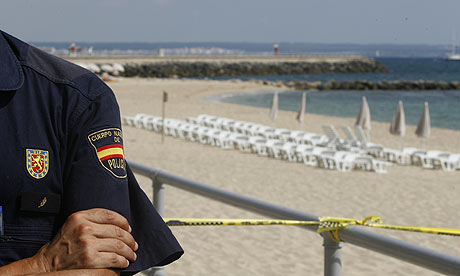
Eta blamed for bombs targeting tourists in Mallorca


Two small bombs blamed on the Basque separatist group Eta exploded today on the Spanish resort island of Mallorca, causing no injuries.

The blasts occurred just over a week after Eta killed two police officers in Mallorca, in attacks aimed at striking fear among tourists at the height of the summer holiday season.

One bomb exploded in the La Rigoleta restaurant on the Can Pere Antoni beachfront in Palma de Mallorca, and the second in an underground passage at the central Plaza Mayor square, the government said. A third device was detonated in what media reports said was a controlled explosion by police.

A beachfront hotel in Palma de Mallorca was searched for a possible fourth bomb.

Earlier today, Eta claimed responsibility for four other bombings this summer that killed three people – including the two police officers in Mallorca on 30 July– and injured dozens more.

Spain's state-run broadcaster TVE said one of the bombs that exploded was in a beach bag hidden in the ceiling of a women's bathroom in the restaurant.

The restaurant was evacuated after two phone calls to a taxi company in mainland Spain's northern Basque region warning of the bombs, El País newspaper said. Mallorca is one of Europe's main tourist destinations. In June, about 2.6 million passengers used Mallorca airport while 22 million passed through it last year.

In past years, Eta has often targeted Spain's tourist industry with small bombs during peak summer holiday months, in an effort to disrupt trade and force the government to negotiate with it.

Spain has vowed to crush Eta since the group ended what it had said was a permanent ceasefire with a bombing that destroyed a Madrid airport parking garage and killed two people in 2006.

In a statement published today in the Basque newspaper Gara the group claimed responsibility for attacks that left three people dead and 60 injured in June and July. The attacks coincided with Eta's 50th anniversary.

In a 29 July attack, Eta said it detonated explosives packed into a van parked near a Civil Guard barracks in the northern city of Burgos, injuring 60 people.

Eta has killed more than 825 people since 1968, when it started a violent campaign for an independent Basque state.

Fatah elects new leaders, hopes to end internal strife


BETHLEHEM, West Bank — Palestinian president Mahmud Abbas's Fatah faction was electing new leaders for the first time in 20 years on Monday, in the hope they can invigorate a party weakened by internal rifts and its rout from the Gaza Strip by its Hamas rivals.

Ballot counting that had been scheduled to start on Monday morning was delayed to enable more Gaza member to call in their votes and was expected to start in the late afternoon or evening, officials said.

About 2,000 delegates cast their ballots at a party congress in the occupied West Bank city of Bethlehem, the first ever in Palestinian territory.

But dozens of Fatah members had to vote by telephone as arch-rival Hamas, the Islamist rulers of the Gaza Strip, prevented them from leaving the Palestinian enclave to attend the gathering.

Participants were anxiously awaiting the outcome of the vote to renew the 21-member Central Committee and the 120-strong Revolutionary Council, the main governing bodies of the party founded by iconic Palestinian leader Yasser Arafat in the late 1950s.

"I am convinced there will be changes within the leadership and that the Palestinian people will feel this change in the near future," said Abbas aide Nimmer Hammad.

"Fatah today is no longer fractured and weak," he said of the once-dominant party that has been hit hard by infighting and corruption allegations.

Fatah, which controls the Palestinian Authority, exercised undivided power among Palestinians before it was trounced by Hamas in a 2006 parliamentary election.

Its power base has been limited to the Israeli-occupied West Bank since Fatah forces were routed from Gaza when Hamas violently seized power in the coastal strip in 2007 after days of deadly street battles.

The congress has re-elected Abbas as head of the secular movement and renewed its charter, effectively endorsing his political programme.

It underlined its commitment to a negotiated peace with Israel but stressed that the Palestinian people have a "right to resistance to occupation."

Inclusion of the clause prompted angry responses from Israeli ministers, who said the charter meant there was no real desire to reach a compromise with Israel.

But the reaction was ridiculed by anti-settlement group Peace Now, which said Fatah's failure to recognise Israel as a Jewish state, adopt Hebrew as its national language or sing the Israeli national anthem at its congress was "a blow to the champions of peace."

"Those hoping the Palestinians were on the verge of joining the World Zionist Organisation and pledging allegiance to the State of Israel may be disappointed," said Yariv Oppenheimer, who heads Peace Now.

Hew said an honest look at the convention shows signs of a "new Palestinian willingness to make peace with Israel."

The congress has been marked by bitter rows, with numerous delegates blaming the current leadership for the party's failures, and expressing anger at the lack of accountability over the past 20 years.

But former Palestinian internal security chief Jibril Rajub was upbeat.

"This congress amounted to some kind of peaceful revolution as it will democratically bring radical change to the Fatah leadership," he told AFP.

Rajub, top negotiator Saeb Erakat and Fatah's West Bank secretary general Marwan Barghuthi, who is in prison in Israel, are among the leading contenders for positions on the Central Committee which runs the party's day-to-day operations.

Fatah's former strongman in Gaza, Mohammed Dahlan, is also a hopeful even though he has fallen into disgrace after the Hamas takeover of Gaza.

Divers Resume Search in NYC Midair Collision


Divers returned to the Hudson River Monday to resume their search for bodies and wreckage, two days after a midair collision between a sightseeing helicopter and a small private plane killed nine people.

National Transportation Safety Board Chairwoman Debbie Hersman declined to speculate about the cause of the crash, the worst air disaster in New York City since a commercial jet crash in Queens killed 265 people in November 2001. The investigation is expected to take months.Divers recovered seven bodies over the weekend, one passenger on the plane and all six people aboard the helicopter. On Sunday, a U.S. Army Corps of Engineers crane lifted the twisted wreckage of the helicopter from 30 feet of water near the New Jersey shore. A sonar scanner found the Piper Lancer nearby and more plane parts were found farther away under about 50 feet of water.

The prop plane carrying two brothers and a teenage boy crashed shortly before noon into the rear of a Eurocopter AS-350 that had set off on a 12-minute jaunt over Manhattan with five Italian tourists and Jeremy Clarke, a 32-year-old pilot.

The impact ripped off one of the Piper's wings and sent both aircraft plunging into the Hudson River, not far from the spot where US Airways pilot Chesley Sullenberger executed his successful water landing of Flight 1549 in January.

Neither craft in Saturday's crash was equipped with the data recorders installed on commercial planes. So investigators will closely examine eyewitness accounts and photographs of the crash to determine how it happened. Ms. Hersman said Sunday that evidence suggested that the helicopter, operated by New Jersey-based Liberty Helicopters, was gaining altitude when the collision occurred. That suggests the helicopter may have been flying in a blind spot for Steven Altman, the pilot of the Piper Lance and one of the brothers aboard.

But it doesn't explain the central question of federal investigators: Why weren't the two pilots aware of each other?

The pilots were operating under 1,100 feet in an area that typically isn't managed by air-traffic controllers. Pilots must rely on visual flight rules that are often referred to as "see and avoid."

They share a common radio frequency and are supposed to announce their location and intended path. Use of the radio frequency is voluntary, however, and it was unclear whether the two pilots involved in the crash had followed the guidelines.

A 2006 crash in Manhattan that killed New York Yankees pitcher Cory Lidle and his flight instructor led the Federal Aviation Administration to prohibit some private planes from flying along the East River. New York-area lawmakers said Sunday that tighter controls were also needed along the west side of the city. "I have long believed that virtually unregulated general aviation flight traffic over the Hudson River poses a serious safety and security risk," Sen. Charles Schumer (D., N.Y.) said in a statement. "At the conclusion of this investigation, the FAA, along with the NTSB and other relevant agencies, must take a long look at toughening up flight restrictions and monitoring of the Hudson River airspace in order to avoid another tragedy."

Rep. Jerrold Nadler (D., N.Y.) and other local lawmakers plan Monday to call for tougher oversight from the West 30th Street Heliport, from where the Liberty helicopter took off.

Ms. Hersman of the NTSB said the board would examine the safety of operations in New York and issue recommendations to FAA regulators if necessary. The FAA has yet to implement more than a dozen NTSB recommendations that are intended to bolster safety in the "on-demand" segment of aviation that includes tourist helicopters and charter planes.

FAA spokeswoman Laura Brown said the agency will "be looking at all the issues involved in this accident to see if there's anything we need to change."

Among the victims onboard the Liberty helicopter, according to the Associated Press, were Michele Norelli, 51, and his son, Filippo Norelli, 16; Fabio Gallazzi, 49, his wife, Tiziana Pedroni, 44, and their son, Giacomo Gallazzi, 15. In the Piper were Mr. Altman, 60, of Pennsylvania, his brother Daniel Altman, and Daniel's son, Douglas Altman, 16.

Hunt for NY crash bodies goes on


Divers return to the murky waters of the Hudson River on Monday to continue the search for bodies and wreckage following Saturday's mid-air crash.

A helicopter and a small plane carrying a total of nine people hit and crashed into the river near New York City.

The bodies of two people and the plane's wreckage remain unrecovered.

The investigation into the crash is expected to take months, but there have already been calls for safety regulations to be re-examined.

The skies immediately above the Hudson River are crowded - largely with helicopters carrying tourists.

Wife 'refused to fly'

Divers have recovered the bodies of seven victims of the crash, leaving two unrecovered - the plane's pilot and an adult passenger.

Map

The wreckage of the helicopter has been removed, but plane parts remain under water. They have been located with a sonar scanner and engineer crews expect to retrieve them on Monday.

The victims of the crash were two families.

Michele Norelli, 51, was visiting with family members from Italy, reported AP news agency.

He was celebrating his 25th wedding anniversary, and was on the helicopter flight with his teenage son and other family members, as well as pilot Jeremy Clarke.

But his wife, Silvia, was afraid to fly and stayed on the ground, a family friend told AP.

In the plane were Daniel Altman and his son Douglas, from Pennsylvania, along with pilot Steven Altman, AP said.

Safety review call

The investigation into the crash - New York's worst air disaster for eight years - has begun and is expected to take months.

Neither aircraft was required to carry flight data or cockpit voice recorders.

Witnesses said the small plane approached the helicopter from behind and clipped it with a wing.

Deborah Hersman of the National Transportation Safety Board (NTSB) said the plane had taken off from Teterboro Airport but responsibility for tracking it had been handed over to controllers at Newark airport.

The pilot had been told to contact the Newark control tower but had not done so, she said.

The crash has renewed calls for a review of safety in the zone about 1,000 feet (305m) above the Hudson River.

Some pilots told the New York Times that they had to be extremely vigilant when flying in the crowded zone.

Typhoon Morakot wreaks havoc across Asia

China relocated around one million people as Typhoon Morakot slammed into the coast after wreaking the worst storm havoc in half a century across Taiwan.

Torrential rain and high winds ploughed across the island of Taiwan, toppling buildings, including a hotel that tumbled into a surging river. The six-storey hotel, in Taitung County, eastern Taiwan, collapsed and plunged into a river early yesterday after floodwaters eroded its base. All 300 people in the hotel were evacuated from the building and uninjured.

Officials said that 12 people had been killed on the island, including one woman whose car was swept by a raging river, and at least 50 were still missing.

As Typhoon Morakot, which means emerald in Thai, made landfall in China, officials said that they have moved nearly one million people from the most dangerous locations on the route of the storm, which was packing wind speeds of up to nearly 73mph (118 km/h).
Related Links

* After the deluge, warm weather is on the way

* Typhoon forces evacuations in China

* Heavy rains cause mudslides in Brazil

One Taiwanese woman was in tears, reporting that her daughter and husband had plunged into a river in a flash flood. “My daughter call me twice saying, ‘We’re being washed away! Hurry, hurry!’ Then I lost them,” the distraught woman told reporters.

Officials said that the typhoon, hitting Taiwan at the height of the season, had dumped a record 2.5m (100in) of rain on the southern part of the island.

Chinese coastguards ordered all fishing boats to return to shore as the storm swept in. The devastating winds toppled houses in the coastal manufacturing hub of Wenzhou, killing a child and injuring four adults when houses collapsed under the force of the storm.

The worst damage was across Taiwan, where a typhoon in August 1959 killed 667 people. Gale-force winds were expected to batter the island for at least three days and waves were forecast to reach as high as seven metres. China had recalled more than 35,000 boats to port as the storm approached.

— At least 12 people were killed and ten others remain missing in western Japan today after Typhoon Etau slammed into the country bringing heavy rain that triggered floods and landslides.

The typhoon left 12 people dead in the Hyogo prefecture and many others missing in Hyogo, in the western part of Japan's main island. Around 2,200 people were evacuated from homes and stayed at public schools in the area.

Israel bombs Gaza tunnel in retaliatory strike


GAZA (Reuters) - Israeli warplanes bombed a tunnel under the Gaza Strip border with Egypt on Monday, the first such attack in almost two months, the Israeli military said.

Witnesses and officials of the Islamist group Hamas which rules the enclave confirmed the pre-dawn strike. There were no reports of casualties.

Gaza's smuggling tunnels, which still number in the hundreds despite air attacks and an Egyptian crackdown in which some have been blown up or flooded, are a frequent target for Israeli retaliation for attacks by Gaza's armed Palestinian groups.

Monday's raid was launched in response to recent mortar and rocket attacks, an Israeli military spokeswoman said. It was the first aerial bombardment of the Gaza Strip since June 18.

The aircraft had targeted a tunnel under the border at Rafah which was suspected of being used to smuggle explosives into Gaza from Egypt, she added.

On Sunday, two mortar rounds were fired near Israel's fortified Erez border crossing as a number of medical patients going for treatment in Israel were being ferried out by ambulance.

The rounds exploded about 300 meters from the Erez wall in Palestinian territory and no one was hurt.

On the day before, a rocket fired from Gaza exploded in open ground on the Israeli side of the border.

Some smaller Gaza militant groups say Hamas has been trying to stop them firing rockets and mortars at Israel, which has control of the delivery of fuel and food aid to the 1.5 million Palestinians living in the enclave.

Hamas wants Israel to lift its blockade and open the border crossings. Israel says Hamas must first release captured Israeli soldier Gilad Shalit, whom it has held for three years.

Israel launched a ground and air offensive in Gaza in December, in which some 1,400 Palestinians were killed. Israel said it was a response to daily rocket fire by Gaza militants directed at southern Israeli towns.

Thirteen Israelis were killed in the 22-day conflict.

Israel has frequently attacked tunnels it says are used to bring in weapons or materials to build weapons, though such raids have been fewer in the past couple of months.

The spokeswoman said some 240 rockets had been fired by Gaza fighters since the end of the offensive on January 18. (Reporting by Nidal al-Mughrabi; Writing by Allyn Fisher-Ilan, editing by Douglas Hamilton)

Iraq bomb attacks kill 41 and wound 150 in Baghdad and Mosul


At least 41 people were killed and nearly 150 wounded in bomb attacks near the northern Iraqi city of Mosul and in the capital Baghdad on Monday, police said. In the deadliest single attack, two booby-trapped lorries exploded before dawn in the village of Khaznan, east of Mosul, leaving 25 people dead and 70 others wounded.

Thirty-five houses were destroyed in the village, which is home to members of the tiny Shabak community, a sect of Kurdish origin. Mosul has seen frequent attacks despite a marked decline in violence elsewhere in the country and US commanders describe it as the last urban bastion of al-Qaeda loyalists in Iraq.

Iraq's second city with a population of about 1.6 million, Mosul is mainly Sunni – both Arab and Kurdish – but it also has significant Christian and Shiite Turkmen minorities.

In Baghdad, two car bombs went off as day labourers were gathering in the early morning hours looking for jobs.

The first bomb exploded at Hay al-Amel, in the west of the capital, killing nine people and injuring 46.

The second bomb attack in Shurta Arbaa in the north of the city killed seven people and wounded 35 others.

On Friday, a powerful car bomb blast killed at least 37 Shiite Muslims near a mosque in Mosul in a wave of attacks that also killed 10 people in Baghdad, threatening to plunge the country into a new bout of sectarian conflict.

Despite a marked reduction in violence in recent months, attacks against security forces and civilians remain common in Baghdad, Mosul and the ethnically divided northern oil city of Kirkuk.

The number of violent deaths fell by a third last month to 275 from 437 in June, following the pullout of US forces from urban areas.

The Shabak community numbers about 30,000 people living in 35 villages in the province of Nineveh, and many want to become part of the autonomous Kurdish region of northern Iraq.

They follow a faith that is a blend of Islam, Christianity and other religions. The Shabak community was persecuted under ousted Iraqi dictator Saddam Hussein and after the US-led invasion of 2003 they were targeted on a number of occasions by al-Qaeda attacks.