Hamid Karzai expected to gain first-round victory in Afghanistan election


Preliminary results of last week’s Afghan presidential contest are expected to show today that President Karzai is heading for a comfortable first round victory, amid widespread allegations of electoral fraud.

But it could take several weeks before an official final result is declared because Dr Abdullah Abdullah and other opponents have filed more than 1,000 complaints, which must be investigated first.

The prospect of political limbo is raising concerns just as the US is trying to increase its civilian and military presence. US military commanders in Afghanistan were reported yesterday to have told Richard Holbrooke, the US special envoy for Afghanistan and Pakistan, that they needed more troops to defeat the Taleban.

The Independent Election Commission (IEC) said it was planning to release preliminary results from several provinces, covering roughly 10 per cent of the total vote, and hoped to have a national result in the first week of September. The results are rumoured to show that Mr Karzai is in the lead, having won about 70 per cent of the votes in the first batch.However, the figures do not become official until another body, the Electoral Complaints Commission (ECC), has processed all allegations and investigated the most serious ones.

The ECC said it had received 1,157 complaints as of last night and had categorised 54 of them as high priority. It expects to receive many more. Some of the worst complaints relate to the southern province of Helmand, where British forces launched Operation Panther’s Claw in June to help to prepare for the vote. Precise details of the complaints are not yet available, but The Times has discovered more serious discrepancies in figures being reported by election officials in Helmand.

Engineer Abdul Hadee, the local IEC chief, told The Times on Thursday that fewer than 50,000 people voted in Helmand. On Sunday, he raised that estimate to 110,000. Yesterday, he insisted that more than 150,000 people had voted, saying that the previous figures were based on incomplete information. Abdul Ahad Helmandwal, a local tribal elder and representative of Mr Karzai’s campaign, said that turnout in Helmand was 300,000 and most had voted for the President.

At least two presidential candidates say that Helmand was the site of some of the worst fraud – largely because poor security meant monitors could not visit many polling stations.

An aide to Dr Abdullah said he had filed 198 complaints. “There’s been big fraud in Helmand,” he said, accusing electoral officials there of doubling the real turnout figure. He said that figures compiled by his monitors showed Dr Abdullah leading with more than 1.5 million votes — roughly 57 per cent of those counted so far.

A spokesman for Ashraf Ghani, another candidate, said his team had filed 52 complaints, including one about large-scale ballot box stuffing in Lashkar Gah, the capital of Helmand.

“What we are happy about is that so many other candidates are also lodging complaints,” he said. “This is the only legal option we have — we don’t want our supporters on the streets.”

Michael Jackson's death caused by powerful sedatives


The Los Angeles county coroner has ruled Michael Jackson's death was caused by a lethal combination of powerful sedative drugs.

Conrad Murray, a cardiologist who treated Jackson for insomnia, told a Los Angeles police official that he had injected Jackson with propofol in the hours before his death on 25 June in a rented mansion in Los Angeles. The drug is an anaesthetic used during surgery, and is typically administered intravenously in a hospital setting.

In a sworn affidavit, Los Angeles detective Orlando Martinez said that Murray admitted to giving the 50-year-old singer a veritable cocktail of drugs to help him sleep the night before he died.

Murray had been Jackson's personal physician for about six weeks, and told investigators that another doctor had introduced Jackson to propofol, which investigators said the pop star obtained using several aliases.

Martinez said that the Los Angeles County chief coroner Dr Lakshmanan Sathyavagiswaran reported Jackson had a lethal level of propofol in his blood.

Murray told police he used it to help Jackson sleep, and that he worried Jackson had become addicted to it. He said he tried to wean Jackson off the drug, which Jackson called his "milk". Murray said Jackson had injection marks on his hands and feet.

Murray said he was monitoring Jackson's pulse and oxygen levels as he administered the sedatives during the night, and that Jackson remained awake despite several injections of drugs. Jackson requested and demanded an injection of propofol, Murray said.

Murray told investigators that about 10:30am on 25 June, Murray left Jackson for less than two minutes to use the restroom, and that Jackson was not breathing when he returned. Murray began CPR, injected more drugs, and another aide summoned help.

Federal drug enforcement agents were unable to find records of Murray's purchase of propofol and have sought medical records from a handful of other physicians who had treated the singer.

Martinez also stated that in April, Jackson offered to pay another physician any price to obtain propofol. The physician declined. Murray has gone into virtual hiding since Jackson's death. In his only public statement, he said in a video posted on YouTube that he had told the truth and "the truth will prevail".

China reaffirms econ policy


BEIJING - CHINA will stick to its current macroeconomic policies because the economy, while doing better, is still not yet on a solid footing, Premier Wen Jiabao said on Monday.

In a statement on the government's website, www.gov.cn, Mr Wen said Beijing would ensure a sustainable flow of credit and a 'reasonably sufficient' provision of liquidity to support an economy that he said was facing fresh difficulties.

'We must clearly see that the foundations of the recovery are not stable, not solidified and not balanced. We cannot be blindly optimistic,' Mr Wen was cited as saying after a trip at the weekend to Zhejiang province. -- THOMSON REUTERS

Lockerbie move 'not terror boost'


The release of the Lockerbie bomber has not given "succour to terrorists", Gordon Brown's spokesman has said.

He acknowledged that the decision, made by the Scottish government, created "strong feelings" among relatives of those killed in the 1988 attack.

The prime minister has been criticised for refusing to comment on the release of terminally ill Abdelbaset Ali al-Megrahi on compassionate grounds.

But his spokesman said it remained a decision for the Scottish government.

Last week Scottish Justice Secretary Kenny MacAskill allowed Megrahi to be released after serving eight years of his life sentence for the bombing of a US-bound Pan Am flight, in which 270 people were killed.

'Very difficult'

There was fury from families of the victims and US politicians after Megrahi, who has prostate cancer, returned to his native Libya to huge celebrations.

Justice policy in Scotland is a devolved matter, meaning the Scottish - rather than the UK - government is in charge of it.

However, there has been some criticism that Mr Brown did not intervene to try to persuade Mr MacAskill against Megrahi's release, given the international implications. Asked about the message that the decision had sent out, Mr Brown's spokesman said: "I don't see how anyone can argue this has has given succour to terrorists."

Pressed over the possible damage to UK-US relations, the spokesman said: "Clearly the prime minister recognises this was a very difficult decision and was clearly an extremely sensitive one, and that there will be very strong feelings from the families."

Challenged over why Mr Brown would not comment, the spokesman repeatedly said that it was a matter for the Scottish justice secretary.

He said: "It would be wrong to reverse that and take a public decision after the decision. It was and remains a decision for the Scottish justice secretary."

He added: "He [the prime minister] found the scenes at Tripoli airport thoroughly distasteful and fully supports what the foreign secretary and Alistair Darling have said, and will continue to work with the Libyans to ensure that those things are not repeated."

Liberal Democrat leader Nick Clegg said: "Although the decision to release Megrahi was a Scottish one for which Gordon Brown was not personally responsible, the fallout puts the UK at the centre of an international storm.

"In these circumstances, it is absurd and damaging that the British prime minister simply remains silent in the hope that someone else will take the flak."

BBC political correspondent Norman Smith said Mr Brown would gain little from commenting on the issue, with the danger that he would upset the US government if he backed the release, or alienate the Libyan government if he criticised it.

S'pore flu cases fall


THE worst of Influenza A (H1N1) in Singapore appears to be over. The number of people going to clinics because of the flu has fallen below the epidemic level - 16,655 - for the first time in weeks.The latest figures from the Ministry of Health show a 25 per cent dive in polyclinic attendances for upper respiratory tract infections - to 15,486 last week from 20,435 the week before. At the peak two weeks ago, the clinics treated 24,477 cases in a week.

In a normal week, the polyclinics see around 13,340 patients with coughs, colds, the flu or flare-ups of chronic illnesses such as asthma. They make up one in five of the 75,000 patients seen at polyclinics for all ailments every week.

Although the falling numbers could signal the end of the first wave of H1N1, a Health Ministry spokesman said the situation was being monitored. Surveillance data shows H1N1 cases still make up half of all people suffering flu-like symptoms.

The private clinic chain, Raffles Medical Group, has noticed a significant drop in the number of patients with flu-like symptoms.

Dr Wong Wei Mon, who runs a Raffles Medical clinic in Ang Mo Kio, said he was seeing 10 per cent to 20 per cent fewer cases and expected the numbers to fall further: 'You can really feel the difference now.' However, Dr Wong said: 'Nobody knows how the H1N1 situation is going to pan out.

'But with the haze making a comeback, respiratory diseases could still be around, even though flu cases might drop.'

National University Hospital's infectious diseases head Paul Ananth Tambyah had previously told The Straits Times that, going by other pandemics, the rate of infections could be expected to slow as more people became exposed to the virus and developed immunity to it.

He added that, with well-established tests available and the experience of having dealt with the first wave of infections, Singapore was prepared to face the second one as countries in the northern hemisphere entered the traditional winter flu season.

When the second wave does hit, doctors should know how to handle the patients they get.

'Cash for Clunkers' Environmental Benefits Are in Doubt


"Cash for Clunkers" has generated a surge in car and truck sales, as well as a comparable increase in complaints about the program. But whether or not the program -- which is due to end at the end of the day today -- meets environmental goals of reducing gasoline consumption and greenhouse gas emissions has received less attention. "As an environmental program, Cash for Clunkers is basically overpaying for the environmental benefits," said Christopher Knittle, an economics professor at the University of California at Davis who analyzed the Cash for Clunkers impact on the environment.

It is yet another concern about a program that, despite its popularity and success, has been criticized from the beginning.

Cash for Clunkers or Complaints?

In late July, when the Car Allowance Rebate System or "CARS" began, surprising demand from consumers led to complaints that the initial $1 billion was not enough. After much debate, with some members of Congress worried that the goal of replacing gas guzzlers with high-mileage cars was not being met, an additional $2 billion was approved. Then there was grumbling about dwindling supplies of vehicles for sale. General Motors, Ford and other automakers responded by announcing they would increase production. Furthermore, the Transportation Department reassured consumers and dealers that purchased vehicles, even if they were not yet on the lot, would be eligible for the rebate.

Finally, several dealers moaned that it was taking the government too long to reimburse them. Under the program, an estimated total of 750,000 new cars will have been purchased by the end of the day today but some analysts have calculated that the government has paid dealers for less than 10 percent of the rebates due. To address the growing pile of dealer submissions, the Transportation Department has tripled the workforce processing the claims to nearly 1,200 (including staff from the press office). Early reports indicated that dealers submitted incomplete and inaccurate forms that required fixes to ensure that taxpayer dollars were not being wasted.

Despite the complaints, however, the program achieved the goal of stimulating car sales.

"It has been successful beyond anyone's imagination," said President Obama Thursday during an interview with radio talk show host Mike Smerconish.

J.D. Power and Associates estimated that total sales in August will surpass the one million mark for the first time in a year thanks in large part to the clunkers program. Edmunds.com estimated that August sales will be near 1.2 million.

In June, before CARS began, nearly 860,000 vehicles were sold.

"This is a wildly successful program," said Transportation Secretary Ray LaHood on ABCNews.com's "Top Line" late last week. "In four days, when we had $1 billion. we sold 250,000 cars. Now, who's to say that's not successful?"

Malaysia delays caning beer woman


The caning of a Malaysian woman for drinking beer has been delayed until after Ramadan, officials have said.

Kartika Sari Dewa Shukarno pleaded guilty to the offence under Malaysia's Islamic law and was to have received six strokes of a rattan cane this week.

She will be the first woman in Malaysia to be punished in such a way, but has not appealed against her sentence.

Malaysia's majority Malays are subject to Islamic laws, while the large Chinese and Indian minorities are not.

Confusion

A van picked her up from her northern Malaysian home on Monday, to put her in detention so that she could be caned sometime this week.

But an official in charge of religious affairs, Mohamad Sahfri Abdul Aziz, intervened at the last minute, reportedly for compassionate reasons on the advice of the attorney general.

It was initially reported that her sentence had been overturned and Ms Kartika would not be caned.

The caning is now to be carried out around mid-September after Ramadan, the Islamic holy month of fasting and prayer, ends.

There has also been confusion about Malaysia's rules governing the conditions of caning.

Prison rules require anyone who is to be caned to be in detention first.

But legal experts had said at the weekend that it was not right to detain Ms Kartika as she had not been given a jail sentence by the Islamic court.

Ms Kartika, a 32-year old trained nurse and mother of two, asked last week that her caning be administered in public.

She had told reporters she was calm about the prospect and was willing to be caned because she respected the law.

Islamic authorities claim that the purpose of the caning is to educate rather than punish.

Amnesty International had urged authorities to revoke the sentence and abolish the practice of caning.

What is your response to the decision to cane Ms Kartika? Send us your comments using the form below.

3 NATO troops killed in southern Afghanistan


KABUL — Three NATO troops — two from Estonia and one from the United States — were killed in attacks in southern Afghanistan as fraud charges continued to pour in Monday from last week's turbulent presidential vote.

The American service member died in an insurgent attack Sunday, the U.S. military said without providing details. Estonia's Defense Ministry said two soldiers were killed after their unit stumbled on a roadside bomb in southern Helmand province.

It was the 37th death for the U.S. military in Afghanistan since the beginning of August, a month that has seen a jump in attacks and violence as the country prepared for its second-ever direct presidential election last week.

Though millions of Afghans went to the polls, turnout was dampened by Taliban threats leading up to the balloting. Those who voted did so amid rocket attacks in the south, a gunbattle in the capital, and fighting that trapped people inside stations in the east.

Allegations of fraud and intimidation have streamed in since election day. The independent Electoral Complaints Commission said Monday that it has so far received about 45 complaints that could affect the outcome of the election if proved valid.

The most common was ballot-box stuffing. Both President Hamid Karzai and leading challenger former Foreign Minister Abdullah Abdullah have accused each other of fraud.

The United Nations urged candidates and the Afghan people to wait for fraud charges to be investigated before doubting the legitimacy of the election.

"There's no doubt that there have been irregularities during the polling day," said Kai Eide, the U.N.'s top official in Afghanistan.

"I appeal to the candidates and to their campaigns, and also to the voters, to demonstrate the patience and calm that is required" while independent monitors investigate allegations, he said.

Eide also responded to reports that the U.N. had called the election a success by reiterating his statement that it was "an important achievement" for the people of Afghanistan.

"It is too early to use words that go beyond that," Eide said.

U.S. commanders predicted a deadly summer after President Barack Obama ordered 21,000 more U.S. troops to Afghanistan to turn the tide against a resurgent Taliban and shift the focus in the fight against Islamist extremism from Iraq.

July was the deadliest month for American forces in Afghanistan since the beginning of the conflict, with 44 dead. Estonia has 289 soldiers in Afghanistan and the recent deaths mean the small European country has lost six soldiers there.

With the security situation in Afghanistan appearing increasingly difficult, many are suggesting that U.S. commanders may request thousands more troops.

On Sunday, Adm. Mike Mullen, the chairman of the Joint Chiefs of Staff, described the situation in Afghanistan as "serious and deteriorating," but refused to say whether additional forces would be needed.

"Afghanistan is very vulnerable in terms of (the) Taliban and extremists taking over again, and I don't think that threat's going to go away," he said on CNN's "State of the Union."

Copyright © 2009 The Associated Press. All rights reserved.

Thousands forced to flee homes as wildfires threaten Athens


Thousands of residents have evacuated the leafy suburbs of northern Athens as a rampaging forest blaze continues to defy the efforts of legions of firefighters.

Shortly after noon yesterday, the local authorities of Aghios Stephanos and Old Pendeli, both within a half hour's drive of the centre of the Greek capital, ordered inhabitants to abandon their homes — many of them expensive, recently built villas — as the flames tore in from where the fire started near Marathon, late on Friday evening.

Strong northerly winds blowing uninterruptedly for the past few days have fed the flames as they continue to devour many acres of pine woods in the green hills north of Athens. After an extended dry summer, the resin-filled pines have been burning like torches, resulting in huge flames that so far have destroyed at least 30 homes. There have been some hospitalisations but no deaths.

No tourist areas are reported to be in danger, even though yesterday the Interior Ministry said that at least 65 fires had broken out around Greece, fanned by persistent winds. The great majority were brought under control. Cries of terror and despair, mingled with the shouted orders from blackened firefighters and the roar and crackle of the flames, have dominated Greek television news over the weekend. It has proved a sickening reminder of the great fires of late summer 2007 in southwestern Greece, which killed at least 40 people and devastated enormous swaths of the Peloponnese olive groves and vineyards.

The sky over Athens has been covered with a pungent grey-brown blanket of smoke for two days and there is no getting away from the smell of burning and the thin rain of ash, even many miles away.

Last night several thousand people, including Kevin Spacey, the Hollywood actor, sat through a performance of Shakespeare's The Winter's Tale at the ancient theatre of Epidavros, 85 miles southwest of Athens, with the distinct odour of burning in the air.

Local officials at Grammatiko, a community near Marathon, said they were convinced that the blaze had been started deliberately. They cited eyewitness reports of suspicious activity near woodland where the fire first appeared.

Lavish Apartments Turned Recession Bargains


Champagne wishes and caviar dreams are a bit closer for many Americans today -- at least when it comes to real estate. That luxury $15 million apartment that you once might have dreamed of is now on sale for $12 million. Okay, so it's still not within the reach of most working families today but for those who have a few million sitting around, there are some fantastic deals to be found.

Take New York. The median price for a Manhattan apartment fell 19 percent over the last year, to $795,000, its lowest level since the second quarter of 2007, according to a recent report by Halstead Property.

Luxury homes there suffered the most, with an 82 percent decline in closings for more than $10 million at cooperative apartment buildings.

Florida -- one of the first states to see its housing market collapse -- is also offering some great deals. What was once hot and trendy in Miami and Palm Beach is now priced to sell.

ABC News asked local real estate agents in the two areas for a sampling of some of the best luxury bargains on the market today. Here they are:

1 Lexington Ave., New York: These days, a beautiful duplex home in New York's Gramercy Park originally designed by Eric Kohler may be a real bargain at $3.595 million. Originally listed at $5.3 million in October 2007, the co-op apartment features three bedrooms, two-and-a-half bathrooms (the master and second bathrooms come complete with radiant heat flooring) and an outdoor terrace. Other amenities include soundproof windows, floor-to-ceiling French doors and a windowed breakfast room.

502 Park Ave., New York: How does a $20 million price cut sound to you? Pretty impressive, right? Well, this Park Avenue penthouse will still set you back $31 million, but at least that's a lot cheaper than the original asking price. Broker Adam Modlin told the New York Post that "you have to do something dramatic, like a $20 million price cut, to get people's attention." After 54 weeks on the market, maybe that's the case, but this four-bedroom penthouse developed by Donald Trump boasts a giant outdoor terrace and 6,200 square feet of living space.

901 Brickell Key, Miami: A 50-percent-plus price drop is questionably insane, especially for this amazing two-story Miami penthouse. Incredible views over the bay, the Miami River and the sprawling city make this 4,418 sq. ft apartment a steal. Down to $1.95 million from an initial $4.2 million, this space doesn't just have wrap-around balconies; it boasts an entire private deck with ample room for activity. Exquisite stone flooring and a fully-equipped luxury kitchen are simply accents to this spacious high-rise penthouse, which also features space for five vehicles.

* 1
* | 2
* | 3
* | 4
* | 5
* | 6
* | 7

Luxury Getaways for the President: Martha's Vineyard and Beyond


What can tens of thousands of dollars buy for a family vacation? In the case of the nation's first family, think of a secluded, waterfront property complete with horse paddocks, a boat house and an apple orchard. Those are just a few of the amenities offered by the Blue Heron Farm, the 28.5-acre Martha's Vineyard estate where President Obama, his family and, of course, the Secret Service will spend part of the president's summer vacation next week.

Tom Wallace, of Wallace and Company Sotheby's International Realty, said the property, which is home to a five-bedroom main house, also features a Cape Cod guest house, a swimming pool and a half-court basketball court. The Obamas will have their pick of activities on the property, ranging from kayaking on the West Tisbury Great Pond to a simple game o"It's the type of place that once you get there, it's not something you want to leave," Wallace said. "It's very tranquil, great place for a family vacation. The kids will absolutely have a ball, as I'm sure [Obama family dog] Bo will also."

Wallace declined to say how much the Obamas were spending on the rental, but Caroline Taylor, another Martha's Vineyard realtor, estimated that the property would go for $35,000 to $50,000 a week.

The Obamas will pay for at least a portion of the rental, but taxpayer funds will be used to pay for Secret Service and staff housing on the property.

Martha's Vineyard is a summer resort island off the coast of Massachusetts. Some Vineyard estates, particular those in the towns of Edgartown and Chilmark, home to Blue Heron Farm, rent for even more -- as much as $75,000 a week or higher. But you wouldn't know it by just driving around the island, Taylor said.

"They're just hidden," she said. "They're off of insignificant dirt roads. If you follow down a driveway and wind around, you see all these private homes that are absolutely stunning."

Chilmark, in particular, is known as a secluded area that has attracted celebrities like Jake Gyllenhall, Larry David, Ted Danson and Mary Steenburgen.

Obama, First Family Head for Martha's Vineyard


The first family is leaving the White House and Washington behind and trading in the suits and skirts for flip flops and sunglasses and some fun in the sun on Martha's Vineyard in Massachusetts.

The vacation marks the first full week off for President Obama since he took office in January and the first real family vacation for the Obama family.

First lady Michelle Obama and daughters Malia, 11, and Sasha, 8, have accompanied the president on jaunts overseas, but they have mostly kept their own schedule on those trips, taking in the sights and sounds of Europe while the president attended events and meetings.

Except for a few weekends at Camp David, and quick trips to Chicago and New York City, the president has stayed close to the White House so next week could be a true vacation, a break from policy and politics, if world events cooperate with his vacation plan.

Obama has no public events on his schedule for the week and aides said he was not planning to meet with staff on health care. The White House will rely on surrogates to keep the message going while the president is out of the public eye.

Swiss banking secrecy weakens?


GENEVA - FOR more than 60 years, the Swiss have nurtured banking secrecy to the extent that it has become an unshakeable part of Switzerland's image like chocolate, watches, cowbells and Heidi.But many bankers, lawyers and analysts in the country believe a deal struck with the United States to relieve pressure on the flagship bank, UBS, has blown a hole in the wall of secrecy, even if it remains enshrined in Swiss law.

'The UBS disaster is a catastrophe for the Swiss financial centre... because everyone will rush for the breach,' said Mr Patrick Segal, director of Edmond de Rothschild Private Bank.

Unlike most major economies, banking secrecy grants account holders in Switzerland complete privacy, keeping their banking details out of bounds for any authority - even the Swiss taxman.

It can only be lifted for legally-sanctioned investigations into criminal offences, and that, under local law, rules out the lesser offence of tax evasion.

Last Wednesday, the Swiss and US governments revealed their 'treaty' settlement to end a lawsuit against financially-troubled UBS over charges that its bankers used Swiss secrecy to help US taxpayers fraudulently evade taxes.

While Swiss President and Finance Minister Hans-Rudolf Merz described the deal as a 'win-win situation' for both states, the details set off alarm bells in the industry.

It included an arrangement to disclose details on an unprecedented number of UBS accounts - 4,450 - through an established process to deal with tax fraud, which is regarded as a crime in Switzerland.

But the scope was tantamount to a 'fishing expedition' that used to be frowned upon in the Swiss rulebook, setting a new precedent, experts warned.

'Nobody can see legally how... this treaty wouldn't apply to other banks,' said lawyer Enrico Monfrini, who helped Nigeria recover hundreds of millions of dollars hoarded abroad by late dictator Sani Abacha. -- AFP


Ads by Google

Cheap Lucerne Hotels
Compare Hotels In Lucerne. Find The Cheapest Hotels Online.
CheapEurope.com/Lucerne

Major Swiss Bank Account
We manage your account opening fast All inclusive arrangement service!
www.swiss-privacy.com

Swiss Numbered Account
New, Swiss Account Manual, Open Account in a Few Days, Only $149
aSwissAccount.com

Citibank RCA
Manage your Indian Accounts with a Citibank NRI Account. Apply Now!
www.Citibank.co.in

International University
Accredited foreign university. Earn your bachelors & masters degree.
www.OnlineForeignDegrees.com


email print larger smaller discuss

Wildfires bear down on Athens Wild fire and smoke illuminate the sky behind the ancient Acropolis on August 23, in Athens, Greece. Authorities have de


A raging fire bore down on Athens' northern suburbs Sunday, prompting panicked residents to battle the flames with tree limbs and buckets, and police to order 10,000 people to evacuate one town immediately.

Frightened inhabitants of Agios Stefanos gathered in the town's main square in early afternoon as flames closed in on the town centre and police with loudspeakers directed everyone to leave immediately on the main highway to Athens, 23 kilometres to the southwest.

Other residents tried desperately to save their homes with hoses, buckets and branches. Planes swooped low over the town to pour water on the flaming houses.

“I call on all residents to follow the instructions of the police as to where they will go,” an emotional Agios Stefanos deputy mayor Panayiotis Bitakos told Skai TV. “We had been begging the authorities since early in the morning to send forces ... It is too late now. Too late.”

By mid-afternoon, the town was empty save for a few volunteers who were aiding firefighters. Houses smouldered and burned-out cars littered the streets.

Planes and helicopters, which had suspended operations overnight, attacked the blaze again at dawn. But with gale-force winds propelling the flames, the fire spread unchecked. TV showed airplanes and helicopters dumping water on a forest outside Agios Stefanos — and the fire re-igniting moments after they left.

The forests around Athens' northern suburbs have helped the fire leap to new areas.

“The pine cones are like projectiles — they cover long distances, too, and spread the fire around,” said Avraam Pasipoularidis, mayor of the northern suburb of Drossia. “Everything around me is burning.”

The fires ignited late Friday; by Sunday they were reported across an area more than 40 kilometres wide. They started in the mountains near the town of Marathon, from which the modern long-distance foot race takes its name. The army removed anti-aircraft missiles from a nearby military base as the flames approached.

Municipal officials said the fire was threatening the archaeological site of Rhamnus, home to two 2,500-year-old temples.

A state of emergency was declared Saturday in greater Athens: These are the most destructive fires in Greece since blazes killed more than 70 people in 2007.

Residents fled on foot, by motorbike and in cars, amid blackouts and cuts in the water supply. No casualties had been reported as of early Sunday afternoon.

TV stations broadcast frantic calls for help from people of different areas, with many complaining that no firefighting equipment had reached them.

A resident of Drossia pleaded with TV station Mega for help, saying far was within 40 metres of his home and he had no water with which to fight it.

Authorities evacuated two large children's hospitals, as well as campsites and homes in villages and outlying suburbs threatened by blazes that scattered ash across Athens. The flames also approached a large monastery on Mt. Penteli.

Officials said help was on the way.

“There are 14 planes — with two of these coming from Italy — and nine helicopters fighting the fire, alongside hundreds of firefighters, volunteers and soldiers,” fire brigade spokesman Yiannis Kapakis told reporters.

“These will soon be joined by two planes from France and a helicopter from Cyprus. Cyprus will also send four fire engines and 60 firefighters,” he added.

Elsewhere in Greece, serious fires were reported on the islands of Evia and Skyros in the Aegean Sea and Zakynthos in the west. Another large fire that started Saturday in the town of Plataea, 63 kilometres northwest of Athens, was spreading unchecked in western Attica.

A total of 83 fires have broken out across Greece since 6 a.m. Saturday, Mr. Kapakis said.

Barack Obama attacks decision to free Lockerbie bomber


Barack Obama last night denounced Scotland's release of the convicted Lockerbie bomber Abdelbaset al-Megrahi as a mistake, and revealed the US had opened talks with Libya urging the regime to keep the terminally-ill man under house arrest until his death.

Megrahi, who is thought to have only three months to live, was freed on compassionate grounds yesterday. But as the Afriqiyah Airways jet taking him home to Tripoli took off from Glasgow airport at 3.26pm, it left in its wake a torrent of international condemnation.

Obama led the strong US criticism of the decision. "We have been in contact with the Scottish government, indicating that we objected to this," he said. "We thought it was a mistake."

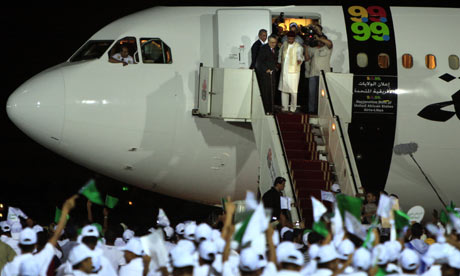
Despite Obama's warnings that Libya should not give Megrahi a hero's welcome, thousands of young men were on hand at the military airport in Tripoli where his plane landed. As he disembarked, cheering supporters, some wearing T-shirts bearing his picture, threw flower petals in the air and waved Libyan and miniature Scottish flags, while Libyan songs played in the background.

Wearing a dark suit and burgundy tie, Megrahi left the plane with the Libyan leader Colonel Gaddafi's son, Saif, who raised his hand to the crowd before they left. Megrahi was reportedly on his way to meet his 95-year-old mother.

Earlier on, in a carefully choreographed day, it took just 67 minutes to free the man who it had taken more than a decade to catch and convict for plotting Britain's worst terrorist atrocity, the bombing of Pan Am flight 103.

At 1pm, the Scottish justice secretary Kenny Macaskill told a press conference of his decision to free Megrahi because spreading prostate cancer is killing him.

At 2.29pm, the white A300 airliner touched down in Glasgow while at Greenock prison, Megrahi, frail and bowed by his illness, walked slowly into a prison van, his face swathed in a white scarf.

At 2.37pm, a small convoy of six police vehicles flanked by a police outriders swept him under the prison's arch. About 80 local residents had gathered outside the gate. Some shouted abuse while some cheered ironically, as the convoy passed.

Roads were closed as the convoy was shepherded through Greenock by its outriders and down the M8 to Glasgow airport, shadowed by a small squadron of police and TV helicopters.

At 3.09pm, Megrahi stepped from the van onto the airport tarmac, his face obscured by a white baseball cap and the scarf. After a handshake with prison guards, Megrahi leaned on a walking stick and pulled himself up the aircraft steps.

Megrahi had repeatedly denied his guilt – protesting his innocence again in an emotional statement yesterday – but he left Scotland a convicted mass murderer, after dropping his appeal against conviction in order to expedite his release.

In his hand he held papers that threatened "recall to custody" if he did not comply with the terms of his release, including giving monthly health updates andbeing interviewed by a supervising officer. Last night, Scottish opposition politicians said the terms were unenforcable.

American relatives of those killed in the bombing condemned the release. Showing Megrahi any compassion was "utterly despicable", said Kara Weipz, 36, whose brother Rick was killed in the atrocity.

"The interests of justice have not been served by this decision," said Eric Holder, the US attorney general, who helped investigate the bombing originally. "There is simply no justification for releasing this convicted terrorist whose actions took the lives of 270 individuals."

But Macaskill, the Scottish justice secretary and former criminal defence lawyer who issued Megrahi's release papers, said his decision was a moral act.

"In Scotland, we are a people who pride ourselves on our humanity. It is viewed as a defining characteristic," he told a packed press conference in Edinburgh.

"The perpetration of an atrocity and outrage cannot and should not be a basis for losing sight of who we are, the values we seek to uphold, and the faith and beliefs by which we seek to live. Mr al-Megrahi did not show his victims any comfort or compassion. [But] compassion and mercy are about upholding the beliefs we seek to live by, remaining true to our values as a people, no matter the severity of the provocation or the atrocity perpetrated.

"For these reasons alone, it is my decision that Mr al-Megrahi be released on compassionate grounds and allowed to return to Libya to die."

Macaskill released medical reports on Megrahi's condition. His cancer, diagnosed in September 2008, failed to respond to hormone treatment. The cancer hit nine out of 10 on the "Gleason score" of severity. The official medical report stated that Megrahi's condition had "declined significantly" earlier this month. "The clinical assessment, therefore, is that a three month prognosis is now a reasonable estimate for the patient."

Megrahi issued a statement stressing his innocence, saying his conviction was "a disgrace" and his imprisonment had been a "horrible ordeal". "I am obviously very relieved to be leaving my prison cell at last and returning to Libya, my homeland," he continued. "Many people, including the relatives of those who died in, and over, Lockerbie, are, I know, upset that my appeal has come to an end; that nothing more can be done about the circumstances surrounding the Lockerbie bombing.

"I share their frustration. I had most to gain and nothing to lose about the truth coming out – until my cancer diagnosis. To those victims' relatives who can bear to hear me say this: they continue to have my sincere sympathy for the unimaginable loss they have suffered. To those who bear me ill will, I do not return that to you."

Obama said he had contacted families of the deceased and indicated to them that the release was inappropriate. He added: "We have been in contact with the Scottish government indicating we object to this. We thought it was a mistake. We are now contacting the Libyan government to make sure that if this transfer has taken place, he is not welcomed back in some way but should instead be under house arrest."

N. Korean Delegation Meets With President Lee Myung-bak in Seoul


TOKYO, Aug. 23 -- In another signal that relations between the two Koreas are on the mend, a North Korean delegation met Sunday in Seoul with South Korean President Lee Myung-bak and delivered a personal call for improved ties from leader Kim Jong Il.

It was the first high-level meeting between the countries in nearly two years and the atmospherics of the 30-minute session, which a spokesman described as "very serious and gentle," suggested that North Korea is retreating from a campaign of insults, threats and saber-rattling that it launched when Lee assumed the presidency 18 months ago.

"Simply put, we can say that there has been a paradigm shift," an official from Lee's office told Yonhap, the South Korean news agency.

That shift, of which there have been multiple signs in recent weeks, has tamed the bellicose dynamics of what had been an eight-month stretch of almost non-stop provocations by North Korea, which had tested a nuclear bomb, launched missiles and repeatedly declared its readiness for "all-out war."

For reasons that are not well understood, the North has embarked in August on something of a charm offensive. It has released two U.S. journalists, freed a South Korean worker, agreed to resume family reunions with the South and promised to restart cross-border businesses.

North Korean diplomats also sought a meeting last week with New Mexico Gov. Bill Richardson, who said the isolated country is "now prepared to have a dialogue with us."

The North Korean delegation that visited Lee on Sunday had come to Seoul to pay respects to former South Korean President Kim Dae-jung, who died last week and whose efforts to unite the Korean Peninsula won him the Nobel Peace Prize.

Tens of thousands of mourners gathered outside parliament Sunday afternoon for his state funeral. Kim, who was tortured and imprisonment during his decades as an opposition leader, was a passionate advocate of Korean unification and participated in a summit with Kim Jong Il in Pyongyang in 2000.

At the meeting with Lee, the North Korean delegation conveyed their leader's wishes for progress in relations with South Korea, according to spokesman Lee Dong-kwan.
ad_icon

In response, President Lee called for a resumption of dialogue between the two countries and told the North Koreans that there is no issue that the two sides cannot resolve, if they talk with sincerity, the spokesman said.

The senior member of the North Korean delegation at Sunday's meeting was Kim Ki Nam, secretary of the Workers' Party and a key aid to Kim Jong Il.

When Lee came into office in early 2007, he infuriated North Korea by changing a decade-old policy of unconditional aid that began under Kim Dae-jung as part of his "Sunshine Policy" for reducing North-South tension.

The South had provided North Korea with massive gifts of food and fertilizer, while asking no questions about where the aid went or who benefited from it.

Lee has insisted that he would only resume the aid program -- which amounts to about 5 percent of the North's gross domestic product -- if deliveries could be monitored. There are widespread reports that earlier aid was diverted to the military and sold by elites in the government.

A possible reason for North Korea's new flexibility in relations with South Korea is lack of food.

The North suffers from chronic food shortages, and U.N. food agencies have said that about 37 percent of the country's 23.5 million people will need aid this year.

Food-supply problems may have increased in recent weeks, as North Korean state television has reported that flooding damaged crops.

Earlier this year, the North severely restricted the ability of U.N. agencies to distribute food inside the country.

'Tea Party' Organizers Plan Anti-'Obamacare' Rallies Across the Country


If Democratic lawmakers thought all the furor over President Obama's health care plan expressed this month at town hall meetings was dying down, they might be in for a surprise Saturday.

That's when citizens are planning anti-"Obamacare" rallies across the country Saturday in all 435 congressional districts.

And their message is clear: We will not stand for socialized, government-controlled health care.

The same groups who made the "tax tea parties" possible in April are behind this weekend's movement. American Liberty Alliance, FreedomWorks and Americans for Prosperity are working with The Sam Adams Alliance, among others, to stage the rallies.

Click here for more information on the rallies.

They come as town hall clashes between Democratic lawmakers and protesters of Obama's health care plan have captured national attention. Some Democrats have dismissed those protesters as "mobs" organized by special interests. But many protesters have said they attended the town halls out of genuine concern.

Now they can express their concerns at Saturday's rallies.

"Obviously the idea behind this was to have a unified day for those concerned about government-controlled health care to talk outside their representatives' offices," said Paul Miller, spokesman for The Sam Adams Alliance, a Chicago-based political organization which is one of several groups promoting the event through new media.

Miller said this is a personal issue for many opponents, including himself, a 22-year cancer survivor. Miller, who was diagnosed with a rare cancer at the age of 14 and had his right arm amputated to save his life, says he would not have received the same specialized and speedy medical care if the government was in control.

"There isn't this great conspiracy to say there shouldn't be health care reform," Miller told FOXNews.com. "People just want to make their own decisions and keep their insurance if they like. When government's get involved, they never do anything right."

Eric Odom, executive director for American Liberty Alliance, the lead group behind the tea parties and the new rallies told FOXNews.com that the rallies differ from the tea parties in that they are being organized from the bottom up.

"We didn't want to try and do what we did on April 15 because the logistics was a nightmare," he said, explaining that local organizers now have more control over the rallies and have only received basic information from the top.

"People at the local level have taken it and created their own animal with it," he said. "This is more bottom heavy."

Odom shrugged at the fact that most of the lawmakers won't be present at their offices on a Saturday because he said the ultimate goal is to get more people politically engaged.

"This Saturday is symbolic," he said, adding that his group will e-mail information to rally-goers on how to air their concerns to their representatives. "Most of these people have never done anything political in their lives."

Phil Kerpen, director of policy for Americans for Prosperity, cautioned that it's "impossible to predict" the turnout at these rallies "because it's very decentralized."

"It could be another big success," he said, or the crowds could be scaled back. Kerpen said the packed town halls this month don't provide much indication either.

"I think there's no better place to make your voice heard and make an impact when you get face to face with your congressman," he said. "The impetus is greater to show up there than here."

Jacki Schechner, spokeswoman for Health Care for America Now (HCAN), a coalition of groups supporting Obama's health care plan, said the rallies are a waste of time.

"There is no government-controlled health care on the table," she said. "They're protesting something that doesn't exist.

"There's a lot of people out there feeding lies and misinformation and trying to get people hyped up about something that doesn't exist. They're wasting their energy."

Odom found irony in the objections raised by proponents of health care reform.

"It's interesting that the world's most professional organizers are upset that we're organizing communities," he said.

But Odom said he hasn't gotten a lot of pushback.

"Surprisingly, I don't think they take this very seriously," he said. But he said what separates his organizers from many of Obama's supporters, including Health Care for America Now (HCAN), is the passion.

"For them it's business as usual. It's what they're paid to do," he said.

Schechner said the differences between the two sides goes beyond money.

"We didn't pop up over night," she said, noting that the group's campaign began last summer. "We don't scream. We're not angry."

She rejected the notion that community organizers who are paid lack passion. "There are different kinds of passion," she said.

Schechner added, "I don't discount their passion. I don't ever want to undermine their passion. But I really wish they would take a moment to really understand what this legislation is about, because a lot of people would be helped by it."

But Kerpen said it's clear that Obama's plan would lead to a government takeover.

"Read the legislation that's been proposed," he said, adding that the House bill has been "designed as an achievable way to reach a single-payer system," in which the government acts as the sole middle man with greater leverage to negotiate prices. "A lot of people are playing games, as we would expect them to."

Karzai campaign declares victory in vote


The leading rivals in Afghanistan’s presidential election both claimed they were headed for victory on Friday, raising the risk of a dispute over the results that could undermine US President Barack Obama’s attempts to portray the polls as a success.

Aides to President Hamid Karzai, who has led Afghanistan since 2001, and Abdullah Abdullah, a former foreign minister viewed as his closest challenger, both said their analysis of voting showed their candidates were headed for an outright majority.US officials were already bracing themselves for a contested result from the ballot, which was marred by dozens of attacks by militants and what observers described as a significantly lower turnout than the last presidential polls in 2004.

”We always knew it would be a disputed election,” said Richard Holbrooke, Mr Obama’s envoy to Afghanistan and Pakistan. “I would not be surprised if you see candidates claiming victory and fraud in the next few days.”

The Independent Election Commission said on Friday it was too early for any candidate to claim to have won.

Preliminary returns from Thursday’s poll are expected to start emerging over the weekend, although definitive results could take several weeks to compile. Afghanistan is due to hold a run-off in early October if no candidate wins a clear majority.

Mr Obama’s administration is banking on credible elections to show Afghans that the more than 100,000 Western troops in the country are helping Afghanistan achieve more accountable government and reverse gains made by Taliban insurgents in the past year.

That hope was undermined by scenes of deserted polling stations reported by observers in many areas where disenchantment with Mr Karzai’s progress in tackling poverty and insecurity, as well as fear of insurgents’ bombs, prompted many people to stay at home. At least 26 people are estimated to have been killed in a spate of attacks on polling day.

Analysts say any dividends Mr Obama’s administration may reap from the elections in its attempts to stabilise Afghanistan will hinge to a large extent on the ability of the country’s electoral complaints commission to resolve claims of fraud in a transparent manner.

Reports of attempts to stuff ballots and evidence that unusually high numbers of women voters were registered in some of Afghanistan’s more culturally-conservative areas have added to concerns over the scale of attempted rigging. Insecurity made independent monitoring impossible in many areas. Mr Karzai has sought to win outright partly through making deals with powerful warlords whose forces were accused of major human rights violations during years of civil war but who may be capable of delivering large blocs of voters.

Mr Abdullah is relying on a support from the ethnic Tajik minority in northern Afghanistan, where observers believe turnout was higher than in the east and south, the focus of the Taliban insurgency.

The International Republican Institute, a US organisation which monitors elections worldwide, said the threat of attack was the main factor ensuring that turnout had been significantly lower than in 2004.

“I went to over 20 [polling] stations yesterday and more than half of them, when I was there, were ghost towns,” said Richard S. Williamson, who led the IRI delegation.

“The insurgents didn’t win yesterday because millions went to the polls. They didn’t lose either.”

Copyright The Financial Times Limited 2009. You may share using our article tools. Please don't cut articles from FT.com and redistribute by email or post to the web.

At home with the Lockerbie bomber


Is he the evil perpetrator of the deadliest terrorist attack in British history, or a sick old man, a loving father and grandfather, who has suffered a terrible miscarriage of justice? Abdul Baset Ali al-Megrahi put on a virtuoso performance when The Times came calling yesterday.

His house, in the Dimachk area of Tripoli, was not hard to find. Policemen stood guard outside. The road was lined with the BMWs of smartly dressed friends and relatives who had come to pay their respects. The high outer walls were festooned with fairy lights and with pictures of the Lockerbie bomber as he looked when he left Libya more than a decade ago. In the garden stood a marquee where he had evidently been welcomed home the previous night.

We sent in our business cards and waited, more in hope than expectation. But ten minutes later we were ushered into the spacious hall of the distinctly plush villa where chandeliers hung above a marble floor — a far cry from the Scottish prisons where al-Megrahi has spent the past eight years. His family bought the house a couple of years ago with help from the Libyan Government.

The man himself was waiting in a reception room at the top of a wide and curving staircase; the curtains were drawn against the fierce afternoon sun and tropical fish swam in illuminated tanks. He looked weak and grey, far older than his 57 years and scarcely recognisable as the man I last saw at his trial in the Netherlands in 2001. He was supporting himself on a walking stick. Like everyone else he wore flowing Arab robes of spotless white — “not what I wore in prison”, he joked in a soft voice and fluent English. He was seeing us, he explained, “because you came to our house. It is our culture.”

We sat on sofas. No tea was offered because it is Ramadan. To be free, he said, was “something amazing. I’m very, very happy.” When the doctors had told him he had just a few months left to live “this was my hope and wish — to be back with my family before I pass away . . . I always believed I would come back if justice prevailed”.

His mother, 86, had not stopped crying, he said. “I told her, ‘You should laugh, not cry’. She doesn’t know I’m ill.” He asked us not to tell her.

Engineers have rigged up a video link next to a large black plasma television so that al-Megrahi could talk to prison officers in Scotland every two weeks — one of the conditions of his release.

As al-Megrahi was flying home in one of Colonel Muammar Gaddafi’s personal jets on Thursday, President Obama sought to add another condition. He said that al-Megrahi should live out his days under house arrest. Al-Megrahi laughed. “He knows I’m a very ill person. You know what kind of illness I have. The only place I have to go is the hospital for medical treatment. I’m not interested in going anywhere else. Don’t worry, Mr Obama — it’s just three months.”

He did not come across as bitter or angry but continued to insist on his innocence, as he has done from the day of his conviction. He abandoned his appeal, he said, not because he was guilty but to give himself the best possible chance of going home before he died. He had applied to be freed on compassionate grounds and also to be transferred to a Libyan prison under the terms of an agreement Britain and Libya signed in April. One of the conditions of the latter was that all legal proceedings had to be finished.

He denied reports that he had been pressured to drop the appeal by a Scottish or British government terrified that such a hearing would expose a grave miscarriage of justice, but he added: “If there is justice in the UK I would be acquitted or the verdict would be quashed because it was unsafe. There was a miscarriage of justice.”

Al-Megrahi promised that before he died he would present new evidence through his Scottish lawyers that would exonerate him. “My message to the British and Scottish communities is that I will put out the evidence and ask them to be the jury,” he said. He refused to elaborate.

Hurricane Bill Weakens to Category 1


(CBS/AP) Forecasters have downgraded Bill to a Category 1 hurricane as it nears the U.S. coast, but tropical storm watches and warnings are still in effect for the Massachusetts coast and parts of Canada.

Bill was churning up rough seas, creating dangerous rip tides and closing beaches to swimmers up and down the eastern seaboard, including President Obama's vacation spot, Martha's Vineyard.

It was expected to pass the mainland well off New England, but was still packing high winds and waves that had safety officials urging extreme caution.

On Saturday evening, Bill had maximum sustained winds near 85 mph and was about 300 miles south-southeast of Nantucket, Mass., and about 585 miles south-southwest of Halifax, Nova Scotia.

Bermuda is still recovering from torrential downpours that have battered the tiny island, as Hurricane Bill roared offshore, causing flooding and generating 35 foot high waves. The first hurricane of the season continues to move north off the U.S. coast today. Bill is not expected to hit land but is expected to create dangerous, deadly rip currents. Officials began closing beaches in its path Friday.

"Concern is if the surf is much bigger," one official said.

Winds clock in now at 105 mph, but the damage it caused earlier this week is still being felt up and down the coast.

"When the storm was well out over the Atlantic, it was a category 4. It takes a while for that wave action to eventually reach the coastline," said David Bernard, a meteorologist for CBS News station WFOR in Miami.

Waves may go up to 23 feet in Massachusetts.

The storm was expected to reach Canadian waters early Sunday, and the Canadian Hurricane Center on Saturday issued a hurricane watch for areas of Nova Scotia, where wind speeds could hit 74 mph with gusts of 87 mph.

At Robert Moses State Park in New York, the beach was shut down as the high tide submerged the sand, though the beach opened later Saturday for sunbathing. Along some beaches in Delaware and New Jersey, no swimming was allowed.

"It's just too dangerous right now," Rehoboth Beach Patrol Capt. Kent Buckson said.

At mid-afternoon Saturday, the storm was about 370 miles south of Nantucket and losing strength as it moved over cooler waters, according to the U.S. National Hurricane Center in Miami. But the storm was still carrying maximum winds of 100 mph.

A tropical storm warning was issued Saturday for Massachusetts, including the islands of Nantucket and Martha's Vineyard, meaning tropical storm-force winds of 40 mph or more could hit the coastline in the next 24 hours.

The worst of Bill was expected to pass about 150 to 200 miles east of Martha's Vineyard before President Obama's scheduled arrival on Sunday, and there was no word from the White House that the Obamas were changing vacation plans.

On Saturday, nearly all south-facing beaches on the island were closed to swimmers and large signs blocked roadways to shorefronts. Meanwhile, lifeguards used caution tape to rope off access points, and police patrolled the beach to enforce the closings.

"The concern we have now is that the riptides are very strong," said lifeguard James Costantini. "There's a very strong undertow."

Longtime Vineyard vacationer Jack DeCoste, 69, of Plymouth, Massachusetts, was unimpressed with the storm as he lounged in a beach chair in Edgartown.

"I don't think it's going to impact things that much," DeCoste said. "I think it'll be in and out of here fairly quickly."

The high waves that worried safety officials had surfers buzzing. Scott Fisher, 38, was at Nantasket Beach in Hull, where the morning's moderate waves were expected to build throughout the day.

"People wait all summer for this," he said.

In Canada, Marine Atlantic suspended ferry service between Port aux Basques, Newfoundland and North Sydney, Nova Scotia, beginning Sunday morning, saying the risks were just too high.

About 200 people were evacuated as a precaution from an offshore natural gas production platform off Nova Scotia, said Exxon Mobil spokesman Merle MacIsaac.

In Nova Scotia, provincial parks have been shut down and people advised to stay clear of beaches.

"The waves, they're very pretty to look at but very dangerous," Barry Manuel of the Halifax Emergency Management Office said Saturday.

The stormy conditions were expected to last through the weekend in the northeastern U.S.

"It takes a while for the ocean to relax" after strong storms, said Gary Conte, a meteorologist with the National Weather Service. "Until it does, riptides will make dangerous sport" for surfers and swimmers.

Hurricane Bill moved past Bermuda earlier Saturday, leaving behind sunny skies, debris and flooding, but no casualties.

The storm mostly spared the pink-sand shores, though it cut power to about 3,700 customers and flooded some roads along the northern coast. The airport was closed overnight and expected to reopen Saturday afternoon. All ferry service was canceled until Sunday.

Bermudians and tourists awoke to some water on the roads, rain and gusting winds.

"It was something to behold. I've never been in a hurricane before," said ESPN sportscaster Kenny Mayne, who hoped to return to the U.S. on Sunday.

A government spokeswoman said the British territory's hospitals had no storm-related patients.

© MMIX, CBS Interactive Inc. All Rights Reserved. This material may not be published, broadcast, rewritten, or redistributed. The Associated Press contributed to this report.