No settlement freeze - Netanyahu


He is quoted as saying he had told Washington he would instead consider "scaling down construction".

US Mid-East envoy George Mitchell is in the region to finalise terms for renewed peace talks.

The Palestinians have said they will not take part unless Israel stops all construction in its settlements.

The US hopes the Israeli and Palestinian leaders can meet on the sidelines of the UN General Assembly meeting in New York later this month.

After talks with Israeli President Shimon Peres on Sunday, Mr Mitchell said they were working hard to reach agreement on "many outstanding issues".

The US envoy had been set to meet Mr Netanyahu on Monday, but talks were delayed so both men could attend the funeral of an Israeli air force pilot.

Lt Assaf Ramon - son of Ilan Ramon, the Israeli astronaut killed in the 2003 Columbia space shuttle disaster - died when his fighter jet crashed in the West Bank on Sunday.

'Strike a balance'

Mr Netanyahu is reported to have laid out his position on settlement construction to the Knesset's Security and Foreign Affairs committee on Monday.


Israeli PM Benjamin Netanyahu on 14/09/09
Jerusalem is not a settlement, and construction there will continue as usual
Benjamin Netanyahu
Obama Mid-East plans in jeopardy
Send us your reaction

He told them that Mr Mitchell had requested a complete halt to the building work.

"We made clear that we will build 2,500 housing units which are already in construction," Mr Netanyahu is quoted as saying by a parliamentary official.

"A few days ago, we confirmed 450 additional housing units. I told the Americans that we shall consider scaling down construction."

He said Israel would strike a balance between offering a gesture that would help restart peace negotiations and ensuring a "normal life" for residents in the West Bank settlements.

He also said that any scaling down of construction would be "for a temporary period", not as yet agreed with the Americans.

"The Palestinians expected a complete halt to construction, a freeze, now it is clear that will not be," he went on to say. "Jerusalem is not a settlement, and construction there will continue as usual."

In a statement late Monday, Mr Netanyahu's office said no meeting for peace talks had been set.

But his office added he was ready to move forward a visit to New York, currently set for 23 September, if necessary to enable dialogue.

The US has been preparing a package for peace talks that would see Israel halt settlement construction and Arab nations that have no peace deal with Israel take the first steps towards recognising Israel.

Palestinian leader Mahmoud Abbas insists he will not meet his Israeli counterparts until there is a freeze on the settlement of occupied territory, which is illegal under international law.

When news emerged of Israel's plan to build 450 new homes last week, he said there was no point attending a summit with Mr Netanyahu.

Sabri Seidam, an aide to Mr Abbas, told reporters: "Israel has to stop stalling and focus on creating the atmosphere for a resumption of the peace process.

"Its sole track should lead to the establishment of the Palestinian state."

Regarding other Arab states' recognition of Israel, a former Saudi ambassador to the US, Turki al-Faisal, wrote in the New York Times that diplomatic ties could be renewed "only after they [Israel] have released their grip on Arab lands".

Mr Abbas and the Israel prime minister are due to hold separate talks with Mr Mitchell on Tuesday.

Norway government 'wins' election


An official projection with results in so far gives PM Jens Stoltenberg's Labour-led coalition about 87 seats in the 169-seat Norwegian parliament.

Two exit polls by domestic broadcasters NRK and TV2 suggest similar results.

If confirmed, it would be the first time a government in Norway has survived an election in 16 years, reports say.

A total of 85 seats are needed for an absolute majority.

"We can't say anything certain about the results," said Kristin Halvorsen, leader of the Socialist Left Party and coalition member.

"But victory seems within reach," she added.

Mr Stoltenberg, in power since 2005, has emphasised his success in guiding Norway through the economic crisis.

His main challenger Siv Jensen, of the right-wing Progress Party, campaigned on a platform of lower taxes.

She also wants to see tighter immigration, and stoked controversy by claiming Norway is being "Islamified".

More than 10% of Norway's residents have foreign origins. They include many asylum seekers from Afghanistan, Iraq, Somalia and Eritrea.

'Safe hands'

Mr Stoltenberg had said voting for the government was the safest option.

Siv Jensen (file)
Siv Jensen's party want to broaden privatisation in health and education

"The Labour Party has the best policies for stabilising the economy and protecting jobs," he said after casting his vote.

The world's fifth-largest exporter of oil experienced only a brief recession and has Europe's lowest unemployment rate.

The Progress Party pledged to spend more of the country's vast oil wealth at home and to broaden privatisation in both the health and education sectors.

Kennedy lived his dream until the very last journey


It was on the sunny spring day of Tuesday, May 20, 2008, that I emerged from a medicated drowsiness in a Boston hospital bed and looked up into the face of a doctor who explained to me in a sombre way that I was about to die, and that I had best begin getting my affairs in order and preparing my friends and family for the end.

As I lay in that hospital bed, my friends and neighbours on Cape Cod were just then getting their boats ready for the summer cruises and races. The Boston Red Sox were a good bet to defend their world championship. There was a presidential primary campaign in progress. My Senate colleagues were pushing forward on our legislative agenda.

No. As much as I respect the medical profession, my demise did not fit into my plans.

I was hardly "in denial" that I faced a grave and shocking threat to my life. The first symptoms of what would prove to be a malignant brain tumour had struck me three days earlier. They'd descended on me as I padded toward the kitchen of the Hyannis Port house that has been the centre of my life and happiness for most of my 76 years.

Suddenly I felt disoriented. I moved toward the door leading to the porch, where several chairs face the lovely prospect that I've known since childhood: a view to Nantucket Sound and the several masted boats at anchor in the nearby harbour. "Well," I told myself, "I'll just go outside and get some fresh air."

I didn't make it outside. Everything seemed hazy. I walked past the front door and into the dining room, where I lowered myself into a chair. That's the last thing I remember until I awoke in the hospital.

A biopsy the following Monday confirmed that I had a brain tumour - malignant glioma in my left parietal lobe. My wife Vicki and I privately were told that the prognosis was bleak - a few months at most.

I respect the seriousness of death - I've had many occasions to meditate on its intrusions. But I wasn't willing to accept the doctor's prognosis for two reasons. The first was my own obstinate will to carry on in the face of adversity, one of the many habits of discipline that my father instilled in me and all of my brothers and sisters. We were taught never to give up, never to passively accept fate, but to exhaust every last ounce of will and hope in the face of any challenge.

The second was the way the message was delivered. Frankly, it made me furious. I am a realist, and I have heard bad news in my life. I don't expect or need to be treated with kid gloves. But I do believe in hope. And I believe that approaching adversity with a positive attitude at least gives you a chance for success.

Approaching it with a defeatist attitude predestines the outcome: defeat. And a defeatist's attitude is just not in my DNA.

Anyway, I'd heard this brand of doomspeak before. As hard as it was to hear the news about my own illness, it was nothing compared to the body blows I'd suffered when two of my children had been diagnosed with particularly lethal forms of cancer.

When Teddy jnr, then 12, discovered the lump below his knee that turned out to be bone cancer back in 1973, our doctors warned us that very few people survived this form of the disease. We were determined that Teddy would be an exception. His leg had to be amputated and he endured two years of the most painful, taxing medication and therapy.

But as I write this, Teddy is a happily married 47-year old businessman and lawyer, and the father of two beautiful children.

And then in 2002 my daughter Kara was diagnosed with "inoperable" lung cancer. She faced slim odds of survival, the doctor told us. As with Teddy, the family refused to accept this prognosis.

Today, nearly seven years later, Kara is a healthy, vibrant, active mother of two who is flourishing.

And so, fortified with experience and our faith, Vicki and I began to develop a plan of action. "Let's just take it one step at a time," we told one another.

The first step was to sail. Sailing, for me, has always been a metaphor for life. But on Wednesday, May 22, the day I left Massachusetts General, as Vicki, the dogs, and I stepped aboard Mya, docked and waiting for us at the pier in Hyannis Port, our sail was more than a metaphor: it was an affirmation of life.

In consultation with a team of doctors we decided on a plan for surgery, followed by chemotherapy and radiation. The surgery accomplished everything the doctors had hoped. And as Vicki and I headed happily home to Hyannis Port a week later, we began planning our steps toward a secret goal that she and I had agreed upon the very day we committed to the surgery: if everything went as expected, we would travel to the Democratic National Convention in Denver and I would address the delegates.

Being able to speak at the Democratic convention in August, as I had done at so many conventions past, became my mission and stayed in the forefront of my mind during my radiation and chemotherapy treatments that summer. We flew to Denver on Sunday, August 24, the day before the convention opened, in a chartered jet.

Inside the private apartment in Denver that we had rented, my aides and I began a run-through of my speech on a teleprompter.

After a minute or two I held up my hand. "You know, I really don't feel well," I said. I felt a sharp pain in my side and we didn't know what it was. I was taken to a hospital.

Unbelievably, after making it through brain surgery, radiation, and chemotherapy and meeting my goal of being ready and able to address the delegates in Denver, I had been struck, out of the blue and for the first time in my life, with a kidney stone.

As the doctors prepared to administer a very powerful pain medication, my wife burst into tears.

"If you give him pain medicine, then you will have made the decision for him about speaking tonight. You can't take away his ability to make this decision for himself. He's worked too hard for this night."

After doing a back-of-the-envelope calculation on how long the medication would stay in my bloodstream, the doctors assured her that it would be out of my system in time for me to speak.

We were not vigilant enough.

A nurse gave me more pain medication when no one was looking. There it was, the sleep-inducing drug, coursing anew through my system. How long before it would lift?

"What do you think?" I asked Vicki drowsily.

"You can just go out and wave," she replied.

"Just go out there with the family and wave." But I had not come all the way to Denver just to wave.

The convention's opening gavel was scheduled for 6pm. Around 4.30, I awoke and told Vicki, "I probably ought to get up now and see if I can walk and not fall flat on my face." I made it from my bed to the end of the room. "I think I'll go back to sleep now," I said.

I didn't sleep long. We would have to leave for the centre no later than 6.30 if we had any hope of being on time. I can handle this, I kept telling myself. I can handle this.

My wife walked with me out onstage and to the podium, held my face, and kissed me. And then she went to sit with the rest of our family.

I could feel myself start to settle down.

And so on Monday evening, August 25, 2008, I fulfilled my personal dream that would never die.

"It is so wonderful to be here," I declared to the cheering delegates. "Nothing, nothing was going to keep me away from this special gathering tonight."

As I approached my conclusion, the final phrases of my speech demanded a high note - a bugle call. They were a conjoining of John F. Kennedy's words and my own.

I took a breath and gathered my strength, as Jack's words and mine converged: "And this November, the torch will be passed again to a new generation of Americans.

"And so with Barack Obama - for you and for me, for our country and for our cause - the work begins anew, the hope rises again, and the dream lives on."

As I grappled with the dire implications of my illness, I realised that my own life has always been inseparable from that of my family.

When I sit at the front porch of our Cape house, in the sunshine and sea-freshened air, I think of them often: my parents and my brothers and sisters, all departed now save for Jean and myself. And each alive and vibrant in my memory.

I remember how each of us, distinct and autonomous from one another though we were, melded wholeheartedly into a family, a self-contained universe of love and deepest truths that could not be comprehended by the outside world.

New York Residences Raided in Terrorism Probe


FBI agents and police on a terrorism task force raided residences in New York City before dawn Monday after a visit from a person believed to be linked to al-Qaida.The raids came after an individual under surveillance for alleged links to al-Qaida came to New York City over the weekend and left the area, Rep. Peter King, R-N.Y., said after receiving a briefing on the raids from federal law enforcement officials Monday.

No arrests were announced Monday but the investigation was still under way. Sen. Charles Schumer, D-N.Y., who was briefed by FBI Director Robert Mueller, said a terrorist attack was not believed to be imminent.

New York Police Department spokesman Paul Browne confirmed that searches were conducted in the borough of Queens by agents of a joint terrorism task force. He would not discuss the matter further.Two U.S. intelligence officials, who requested anonymity because they were not authorized to discuss the case publicly, said the target of any purported attack — or who would carry it out — remained unclear.

Authorities have not found any weapons ready for use — such as a bomb — that would indicate an attack was imminent, they said. Nevertheless, one of the officials called the threat very real and emphasized the urgency of the threat. Another person briefed on the matter, who was not authorized to discuss the case and requested anonymity, said the raids were the result of previous law enforcement surveillance of individuals.

The investigation was continuing.

Schumer said he couldn't discuss much of the case because many of the details were still classified.

"There was nothing imminent, and they are very good now at tracking potentially dangerous actions and this was preventive," Schumer said. He added that the law enforcement action was unrelated to President Barack Obama's visit Monday to New York.

Bobby Brown spat on me, Whitney Houston tells Oprah


Whitney Houston says ex-husband Bobby Brown was emotionally abusive during their marriage and at one point spat on her.

After a long absence from music, Houston is staging a career comeback with a new album last month and a two-part appearance on The Oprah Winfrey Show.

On Monday, Houston told Winfrey that Brown wasn't physically abusive but that "he slapped me once but he got hit on the head three times by me".

The 46-year-old singer says she "was horrified he spit on me, in my face" and that left her "very hurt, very angry".

Houston says she was attracted to Brown because he had control in their relationship.

Houston is one of the best-selling artists of all time, but her career stalled as she grappled with drug problems and a troubled marriage to Brown.

AP

Obama proposes sweeping reforms for banks


A year after the collapse of Lehman Brothers, President Obama told an audience of bankers that their industry could drag the United States into another recession if it did not submit to sweeping regulatory reform that would discourage bloated bonuses and end the era of banks that were “too big to fail”.

In a speech symbolising Washington’s new role as Wall Street’s policeman and underwriter, Mr Obama scolded companies that he said were ignoring the lessons of the financial crisis, and set out a four-point plan to prevent it happening again.

He promised a new consumer protection agency to end the mis-selling of loans and mortgages to American homeowners; an expanded role for the Federal Reserve in monitoring the country’s biggest banks and insurance companies; new rules requiring stronger capital ratios for all lenders; and the establishment of a “resolution authority” to protect customers — if necessary at shareholders’ expense — when big companies go to the wall.

“The reforms I’ve laid out will pass and these changes will become law,” Mr Obama said, in far more confident language than he has used on the healthcare issue that continues to hobble his domestic agenda.
Related Links

* Obama: we have averted a second Depression

* President defends tariffs on Chinese tyres

He has asked congressional Democrats to deliver a package of regulatory reforms by the end of the year and pledged yesterday to continue to lead a co-ordinated drive to close loopholes in international financial regulation at next week’s G20 summit in Pittsburgh. The President acknowledged that the process had begun at the last G20 summit in London in April but did not mention Gordon Brown by name.

Mr Obama reserved his strongest language for the issue of executive pay but appeared to accept that a mandatory cap would be counterproductive, if not politically impossible. He welcomed, and took much of the credit for, the first signs of financial recovery and the repayment of $70 billion (£42 billion) of federal guarantees to banks in recent months. However, he warned that “there are some in the financial industry who are misreading this moment. Instead of learning the lessons of Lehman and the crisis ... they are choosing to ignore them.”

He insisted: “We will not go back to the days of reckless behaviour and unchecked excess at the heart of this crisis, where too many were motivated only by the appetite for quick kills and bloated bonuses.”

Mr Obama later returned to the subject with a plea for immediate self-regulation.

Few chief executives of big banks were in his audience, but several senior executives who attended were careful to sound supportive despite his rebuke. Richard Parsons, chairman of Citigroup, said: “Compensation’s a hot button issue and he’s outlined a conceptual approach that’ll take people some time to get their minds around. The sensible ones among us are trying to rise to the President’s expectations.”

Gary Cohn, president and chief operating officer of Goldman Sachs, said that his bank was happy to discuss its compensation policy and had no objection to the proposal by the Securities and Exchange Commission to give shareholders a non-binding vote on executives’ pay.

Top militant Saleh Ali Saleh Nabhan 'killed' in helicopter raid on Somali village


A prominent terrorist sought in connection with the 1998 US Embassy bombings in East Africa was reported to be among the dead yesterday after helicopter gunships attacked a village in southern Somalia, killing at least two Islamist militants.

Residents and Somali Government sources said that Saleh Ali Saleh Nabhan, a militant with links to al-Qaeda, died in the raid.

Witnesses said that up to four helicopters swooped on a convoy of vehicles before opening fire. The attack took place close to the coastal town of Barawe, about 150 miles south of the Somali capital, Mogadishu, and deep inside territory controlled by al-Shabaab, an Islamist insurgent group.

After destroying one vehicle, white-skinned commandos — described as French or American — were seen getting out of the helicopters and seizing at least two survivors.Abdinasir Mohamed Adan, a local elder, said: “There was a military operation carried out by four foreign choppers in Erile village. A car was destroyed. We are also hearing that some of the vehicle’s passengers were taken on the choppers.”

Mohamed Ali Aden, a bus driver who passed the burnt-out car, said: “There was only a burning vehicle and two dead bodies lying beside it.”

Nabhan and other foreign fighters, many of whom have joined Somalia’s Islamist insurgents in recent months, were reported to have been in the car.

In Mogadishu, a Government source said: “Nabhan and four other foreign commanders of militant groups were killed.”

Intelligence and other sources in the Kenyan capital, Nairobi, told The Times that Nabhan may have been killed, but warned that other militants had been presumed dead in the past, only to resurface later.

“What I’m hearing is that an al-Shabaab convoy of one Land Cruiser, with important foreigners, supported by technicals [improvised battle wagons] was attacked,” said an intelligence source who had spoken with al-Shabaab leaders on the ground. He said that the Land Cruiser was destroyed and that Nabhan was thought to be among the passengers. Western diplomats were unwilling to comment before his body had been identified but, if true, his killing will be welcomed in Washington.

Nabhan is seen as one of the most high profile al-Qaeda linked terrorists operating in Somalia. In March 2008, the US Navy fired Tomahawk missiles at a village in southern Somalia where he was believed to be. This followed similar strikes in 2007.

The Kenyan-born 30-year-old is wanted by the FBI. Three Israelis and ten Kenyans died when three suicide bombers blew themselves up at Mombasa’s Paradise Hotel in 2002, after terrorists missed hitting a Tel Aviv-bound plane with surface-to-air missiles nearby. Nabhan is thought to have masterminded both attacks.

Nabhan is also wanted by Kenya for his role in the August 1998 bombings of US embassies in Nairobi and Dar es Salaam that killed more than 200.

Iran snubs Barack Obama's nuclear talks


Iran has dealt a blow to one of President Barack Obama's most ambitious diplomatic initiatives by dismissing demands to put its nuclear programme at the heart of direct talks with the United States. Less than 48 hours after Washington and its allies reluctantly accepted an offer of face-to-face negotiations from Tehran, Mahmoud Ahmadinejad, the Iranian president, insisted that the topic of greatest interest to the West would not be on the table.

"From the Iranian nation's viewpoint, the nuclear case is closed," he told Britain's ambassador to Tehran, Simon Gass. "Having peaceful nuclear technology is Iran's lawful and definite right and Iranians will not negotiate with anyone over their undeniable rights." n a rambling five-page document presented to western diplomats last week, Iran proposed negotiations on a wide array of economic and regional security issues but made no mention of its nuclear activities.

After responding with initial coolness, the United States defied expectations by taking up the offer to negotiate directly for the first time since Mr Obama came to power. The US president had promised during his election campaign to hold unconditional talks with Iran.

The decision initially appeared as though it could be vindicated after Iran's foreign minister, Manouchehr Mottaki, said he would not rule out discussing the nuclear issue, "should the conditions be right".

Despite opposition from American conservatives, the prospect of the first substantive negotiations between Washington and Tehran since the Iranian Revolution of 1979 suddenly seemed a realistic possibility.

But in his meeting with Mr Gass, who was presenting his credentials as Britain's ambassador, Mr Ahmadinejad scotched the hopes his foreign minister had raised.

He also indicated that the prospect of negotiations had made him no less combative by breaking with protocol to upbraid Britain.

"The Iranian people will never allow anybody to interfere in the country's internal affairs, and I hope the British government will repair its past mistakes," he told Mr Gass.

Iran will also come under the spotlight of human rights activists, some of whom have criticized Mr Obama for seeking direct talks with the regime, when a show trial for over 100 people accused of taking part in opposition protests after June's disputed election begins a new session.

Despite the intransigence it has encountered, the United States argues that it has no choice but to engage with Tehran.

Last month, international weapons inspectors concluded that Iran now had the capacity to produce one nuclear weapon if it were to further purify its existing stockpile of lowly enriched uranium, making the need for negotiations even more pressing.

Iran insists that its nuclear programme is entirely peaceful in intent and maintains that it has as the right to develop the technology to generate electricity.

But on Saturday police searching the laboratory building with bloodhounds found blood-stained clothes stuffed above a ceiling panel. Over the weekend,


The body of a graduate student was found in a wall duct in a laboratory building at Yale University on what should have been her wedding day.

The discovery followed a six-day search for Annie Le, 24, who was studying for a PhD in pharmacology. She had swiped her ID card to enter the lab about a mile from the main campus of the Ivy League university in New Haven, Connecticut, at 10am last Tuesday.

She left her handbag, containing her mobile phone and money, in her office at another Yale building three blocks away and was recorded entering the lab at 10 Amistad Street on CCTV.

Police viewed images from 75 CCTV cameras around the building but found no trace of her leaving after a fire alarm was sounded on Tuesday afternoon. Friends and family had thought Ms Le’s disappearance might be a case of a “runaway bride” who got cold feet over her Sunday wedding.

Airline bomb plotters jailed for life


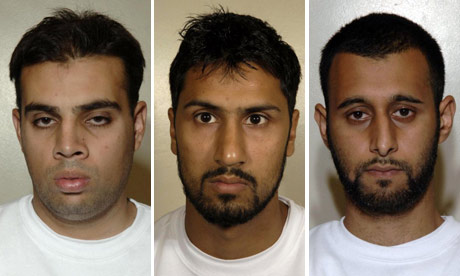
The ringleader of a British terrorist cell that planned to blow up at least seven transatlantic flights from London, murdering more than 1500 people, was jailed for life today.

Abdulla Ahmed Ali, Assad Sarwar and Tanvir Hussain were found guilty last week of conspiracy to murder by detonating liquid bombs on airliners flying from Britain to North America. Mr Justice Henriques ordered Ali, the self-confessed leader of the plot, to serve at least 40 years in prison. Sarwar, 29, was given a minimum sentence of 36 years and Hussain a minimum of 32 years.

Henriques said the men were guilty of "the most grave and wicked conspiracy ever proven within this jurisdiction".

"The intention was to perpetrate a terrorist outrage that would stand alongside the events of September 11 2001 in history," he said.

The plan involved putting liquid explosives into empty bottles of Lucozade and Oasis, colouring the liquid so it appeared to be the same as the original. The bombs would have bypassed airport security, and tests by government scientists showed they were capable of blowing a hole in the skin of an aircraft.

The investigation and trials are estimated to have cost £35m. Uncovering and ultimately destroying the cell, based in east London and High Wycombe in Buckinghamshire, was the biggest counter-terrorism operation in UK history, involving hundreds of police officers and MI5 agents.

Another man, Umar Islam, 31, was found guilty last week of an alternative charge of conspiracy to murder. The jury was unable to reach a verdict about his involvement in the airline plot. He was also due to be sentenced today.

The Director of Public Prosecutions, Keir Starmer, is seeking a retrial of three other men on charges of conspiracy to murder. The jury cleared Ibrahim Savant, 28, Arafat Waheed Khan, 28, and Waheed Zaman, 25, of involvement in the airline plot but failed to reach verdicts on the conspiracy to murder charges.

All of the men who stood trial, bar Donald Stewart-Whyte, who was acquitted of all charges, were previously tried last year. The first jury convicted Ali, Sarwar and Hussein of conspiracy to murder but stopped short of concluding that they had targeted planes. After a lengthy retrial, a new jury convicted them after 54 hours of deliberations.

The plot was disrupted on 10 August 2006, leading to chaos at airports and restrictions on the amount of liquids travellers could carry aboard, which remain in force.

Lessons to Be Learned One Year After Financial Crisis Began


On the morning of Saturday, Sept. 13 last year, Treasury Department official Tony Fratto was talking to a friend of his at a major New York City investment firm. The offices at every big bank in the city, Fratto's friend told him, were packed with staffers trying to figure out their firms' counterparty risk to Lehman Brothers. "To me, that was just jaw-dropping," Fratto said.

The legendary investment bank had been teetering on the brink of collapse for months. To think that banks were only now scrambling to assess their vulnerabilities to Lehman was, Fratto felt, "staggering."

Two days later, on Sept. 15, Lehman went bankrupt. Just like that, the world had changed.

Lehman's failure rocked the financial system to its core, sending shockwaves around the world and sparking a global crisis that can still be felt today.

In his address to Congress last week, President Obama said confidently, "We have pulled this economy back from the brink."

On the eve of the one year anniversary of Lehman's bankruptcy, a look at the past year provides insight into the present economic environment ... and what lies ahead in the future.

Politics

After Lehman Brothers collapsed, the financial system fell into a state of fear and panic.

"Over the course of 20 years, the financial system had become bigger and much more risk-loving in a way," said Simon Johnson, professor at MIT and senior fellow at the Peterson Institute. "Sept. 15 is when we woke up to the dangers."

With the system in shambles, the economy started its descent into the deepest recession since the Great Depression.

Osama bin Laden: in it for the long haul


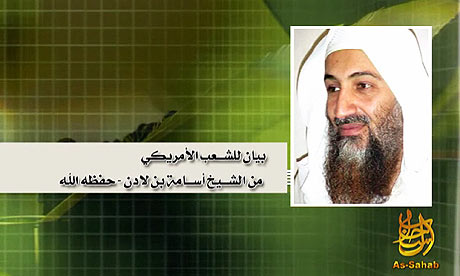
Osama bin Laden's latest defiant message comes amid signs that al-Qaida is under heavy US military pressure in its havens in Pakistan's tribal areas and facing a crisis of recruitment and morale.

Emerging two days after the eighth anniversary of the September 11 attacks, the 11-minute audio clip contained familiar rhetoric and would prove, if authenticated, that the terrorist leader is alive and able to record a message. But the fact that it contained no new image of Bin Laden may hint at logistical or communications difficulties or heightened security concerns.

It was his first message since June – that one sent out just before Barack Obama's speech reaching out to the Muslim world in Cairo – and it referred back to that speech, showing it had been made since then.

It appeared despite cyber attacks on several jihadi website forums in recent days, presumably by governments. The Islamist site where the message was posted – by As-Sahab Media, al-Qaida's production company – had promised a "present" to Muslims from Bin Laden on the occasion of the Muslim holy month of Ramadan.

The message reflected current al-Qaida concerns by taunting Obama that he was "powerless" to stop the war in Afghanistan, despite having withdrawn from combat operations in Iraq.

Continuing attacks on the US president who al-Qaida has excoriated as a "house slave", Bin Laden said Obama was following the strategy of George Bush and Dick Cheney to "promote the previous policies of fear to market the interest of big companies". America, he was saying, was incapable of changing its policies.

"Rather than fighting to liberate Iraq, as Bush claimed, it [the White House] should have been liberated," he said. When Obama became president and retained many of the Bush administration's military leaders, such as the defence secretary, Robert Gates, "reasonable people knew that Obama is a powerless man who will not be able to end the war as he promised".

Bin Laden emphasised US backing for Israel as a key reason for Arab and Muslim grievances, even as the Obama administration intensifies diplomatic efforts to restart stalled Israeli-Palestinian peace talks. "Prolong the wars as much as you like. By God, we will never compromise on it [Palestine], ever," he said.

In recent times the Palestinian territories have become a central theme of propaganda disseminated by al-Qaida, which has to overcome its ideological opposition to Hamas in the territories and to Hizbullah in Lebanon, both of which are widely admired for their resistance to Israel.

Most striking of all was Bin Laden's insistence that al-Qaida was in it for the long haul – perhaps implying that it would overcome recent setbacks. If the US-led wars were not ended, "all we will do is to continue the war of attrition against you on all possible axes, like we exhausted the Soviet Union for 10 years until it collapsed with grace from Allah the Almighty and became a memory of the past," he vowed.

Blago Advisor Dies Before Prison Term


(CBS/AP) A former chief fundraiser for ousted Illinois Gov. Rod Blagojevich told a police officer before he died that he overdosed on a prescription drug, the mayor of the south Chicago suburb of Country Club Hills said Sunday.

Mayor Dwight Welch did not say what drug Christopher Kelly told police he ingested, but he said authorities found a variety of drugs in Kelly's vehicle. Kelly, 51, died Saturday at John H. Stroger Jr. Hospital in Chicago, and Welch said police are investigating the death as suicide.

The Cook County medical examiner's office performed an autopsy but did not immediately disclose the results.

Welch also said police want to interview Clarissa Flores-Buhelos, 30, who identified herself as Kelly's girlfriend and told police she drove him to Oak Forest Hospital Friday night after finding him slumped over the steering wheel of his Cadillac Escalade at a Country Club Hills lumber yard.

Flores-Buhelos, of Chicago, told investigators Kelly called or text-messaged her to come to the lumber yard, Welch said.

Police also want to talk to a man who came to Oak Forest Hospital looking for Kelly's Escalade.

Kelly arrived at the hospital at 11:15 p.m. local time Friday and was transferred by ambulance six hours later to Stroger hospital for further treatment. He was pronounced dead Saturday at 10:46 a.m.

Kelly, who raised millions of dollars for Blagojevich's campaigns, was days away from having to report to federal prison to begin serving a three-year sentence for tax fraud. He had pleaded guilty to tax fraud charges that included writing off thousands of dollars in gambling debts as business expenses.

Kelly had pleaded not guilty to charges included in a federal indictment alleging Blagojevich sought to sell or trade President Barack Obama's former U.S. Senate seat.

Blagojevich has denied wrongdoing.

Kelly, who admittedly loved to gamble and ran up big debts at Las Vegas casinos and elsewhere, was part of Blagojevich's tight inner circle along with convicted influence peddler Tony Rezko. Rezko is believed to be cooperating with federal prosecutors after being convicted of taking part in a $7 million payoff scheme.

Kelly also pleaded guilty Tuesday to taking part in an $8.5 million fraud against United Airlines and American Airlines for work on their hangars at O'Hare International Airport. A plea agreement with federal prosecutors called for him to serve a five-year prison sentence on top of the three years for tax offenses.

He also faced charges in the sweeping Blagojevich indictment that alleged he plotted with Blagojevich to use the muscle of the governor's office to squeeze payments out of those seeking state business.

Prosecutors hoped Kelly would try to reduce his mounting federal prison time by agreeing to cooperate and tell them what he knew about corruption in state government under Blagojevich.

But he remained grimly silent as his situation got worse.

Kelly's chief defense attorney was not available for comment, according to a woman who answered the telephone at his home. A spokesman for the U.S. attorney's office, Randall Samborn, declined to comment.

Blagojevich was in New York when he learned of Kelly's death.

"I am deeply saddened to hear that Chris has died. My heart goes out to his wife Carmen, his three daughters Grace, Jacqueline and Claire and his entire family. They are in our prayers," Blagojevich said in a statement.

Neither of Kelly's guilty pleas called for any cooperation with the government.

"I rather doubt that it will have any impact on the government's case at all," said Allan A. Ackerman, who recently joined Blagojevich's legal defense team. "It's a tragedy and very sad for his family."

On Tuesday, Kelly admitted he paid $450,000 in kickbacks to an unnamed consultant who allegedly inflated cost estimates for repairs to hangars at O'Hare. Kelly admitted bids on the projects were rigged to make certain his BCI Commercial Roofing Inc. would land the contracts.

In all, the contracts paid Kelly $8.5 million. His profit was $2.5 million, according to the plea agreement. He was to be sentenced to nearly five years in prison.

U.S. District Judge Charles R. Norgle set Nov. 18 for that sentencing but ordered Kelly to start serving time next Friday.

The new sentence would have been on top of those three years, handed to him in June for obstructing the Internal Revenue Service by paying gambling debts with his company's money and illegally structured cash withdrawals to hide how much he was taking from the company.

Dangerous Staph Germs Found at West Coast Beaches


Dangerous staph bacteria have been found in sand and water for the first time at five public beaches along the coast of Washington, and scientists think the state is not the only one with this problem.

The germ is MRSA, or methicillin-resistant Staphylococcus aureus — a hard-to-treat bug once rarely seen outside of hospitals but that increasingly is spreading in ordinary community settings such as schools, locker rooms and gyms.

The germ causes nasty skin infections as well as pneumonia and other life-threatening problems. It spreads mostly through human contact. Little is known about environmental sources that also may harbor the germ.

Finding it at the beach suggests one place that people may be picking it up, said Marilyn Roberts, a microbiologist at the University of Washington in Seattle."We don't know the risk" for any individual going to a beach, she said. "But the fact that we found these organisms suggests that the level is much higher than we had thought."

She presented results Saturday at an American Society for Microbiology conference in California. Last year, her team reported finding a different type of bacteria, enterococci, at five West Coast beaches. And earlier this year, University of Miami researchers reported finding staph bacteria in four out of 10 ocean water samples collected by hundreds of bathers at a South Florida beach.

Many communities also commonly restrict bathing at beaches because of contamination with fecal bacteria.

In the new study, researchers tested 10 beaches in Washington along the West Coast and in Puget Sound from February to September 2008. Staph bacteria were found at nine of them, including five with MRSA. The strains resembled the highly resistant ones usually seen in hospitals, rather than the milder strains acquired in community settings, Roberts said.

No staph was found in samples from two beaches in southern California.

Democrats Want to Chastise Lawmaker Who Heckled Obama


House Democrats intend to pursue a formal resolution chastising Representative Joe Wilson for his outburst against President Obama during Wednesday’s Congressional address unless the South Carolina Republican apologizes on the floor.Senior aides said members of the leadership decided that Mr. Wilson’s behavior in shouting “You lie!” during Mr. Obama’s speech merited some action by the House even though the congressman issued a statement of apology and expressed his regrets to the president through Rahm Emanuel, the White House chief of staff.

“It is a clear violation of the rules of the House and it needs to resolved on the floor of the House either by an apology or by a resolution,” said Brendan Daly, a spokesman for Speaker Nancy Pelosi.
House rules and precedents provide substantial guidance on how a House member can and cannot refer to the president while speaking on the floor and the guidelines state that it has been found impermissible to call the president a liar.

Since Mr. Wilson interrupted the president to challenge him on the issue of health care for illegal immigrants, he has become a focal point in the health care debate.

While Ms. Pelosi on Thursday indicated she was ready to let the matter drop, other members of the Democratic leadership, including Representative Steny H. Hoyer of Maryland, the majority leader, and Representative James Clyburn of South Carolina, the party whip, argued the incident was too egregious to let pass.

China's exports, trade surplus fall in August


SHANGHAI -- China's exports languished in August, contracting 23 percent, increasing the onus on Beijing's massive stimulus spending to drive an economic recovery.

Customs data released Friday show August's exports were worth $103.7 billion compared with $134.9 billion in the same month a year earlier. Imports fell 17 percent to $88 billion, while the overall trade surplus plunged 45 percent from a year earlier to $15.7 billion, but rose from the month before, the report said.

The figures were worse than most economists' forecasts.

China's trade has been battered by the global downturn but Beijing's 4 trillion yuan ($586 billion) stimulus program has helped to insulate the world's third-largest economy by fueling industrial demand through heavy spending on building new highways and other public works.

Economic growth accelerated to 7.9 percent over a year earlier in the latest quarter, up from 6.1 percent the previous quarter, though is still far short of the 10 percent-plus growth rates of recent years. The government aims for 8 percent economic growth this year.

Although surveys show purchasing orders are beginning to rebound, trade has stabilized at a relatively low level, says JP Morgan chairwoman for China equities, Jing Ulrich.
ad_icon

"As the economies of China's major trading partners gradually strengthen, the export slump should gradually ease," she said in a report Friday.

In January-August, China's total trade with the EU fell nearly 21 percent, while its total trade with the U.S. dropped 16.4 percent and its trade with Japan slipped 22 percent, the government said.

Exports of almost all major industrial products saw double-digit declines, according to the customs data.

China's imports have also remained anemic, even more so now that they are no longer inflated by the massive stockpiling of commodities seen earlier this year.

Container throughput in August was lackluster at China's biggest ports - down 11 percent from a year earlier in Shenzhen, and down 15 percent in Shanghai, Ulrich said.

Nobel Prize Winner Norman Borlaug Dies at 95


Norman E. Borlaug, an American plant pathologist who won the Nobel Peace Prize in 1970 for starting the "Green Revolution" that dramatically increased food production in the developing nations, died Saturday at his home in Dallas. He was 95.

"More than any other single person of this age, he has helped provide bread for a hungry world," the Nobel committee said in honoring him. "Dr. Borlaug has introduced a dynamic factor into our assessment of the future and its potential."

A Texas A&M spokeswoman told the Associated Press Sunday that Bourlag, a distinguished professor there, died just before 11 p.m. Saturday from complications of cancer.

Borlaug's career was defined on the one hand by the ability of science to increase food production at an exponential rate and on the other by the Malthusian nightmare of an exploding population outstripping its ability to feed itself.

His pursuit of these matters took him from the farm where he grew up in Iowa to the primitively cultivated wheat fields of Mexico in the 1940s, the rice paddies of Asia in the 1960s and 1970s and to the savannas of Africa in the 1980s.

In his lecture accepting the Nobel Prize, he described an adequate supply of food as "the first component of social justice . . . for all mankind. If you desire peace, cultivate justice, but at the same time cultivate the fields to produce more bread. Otherwise there will be no peace."

Beyond food, he continued, a "decent and humane life" requires "an opportunity for good education, remunerative employment, comfortable housing, good clothing and effective and compassionate medical care."

He warned that the world could wind up with too many mouths to feed, and he offered only guarded hope that "since man is potentially a rational being. . . he will recognize the self-destructive course he steers along the road of irresponsible population growth and will adjust the growth rate to levels which will permit a decent standard of living for all mankind."
ad_icon

Throughout his career, Borlaug emphasized the importance of political stability, financial support, modern equipment, transportation and the ability to continue research on new strains of crops. A favorite target was "explosively pervading but well camouflaged bureaucracy" committed to short-sighted policies such as subsidizing food supplies for restless urban populations at the expense of farmers in the countryside.

From the 1970s until his death, Borlaug increasingly took the politically incorrect view that environmentalists were hampering world food production by indiscriminately attacking the use of chemical fertilizers and pesticides.

"Science and technology are under growing attack by noisy, extremist environmentalists, mainly from the affluent nations," he said in a typically outspoken speech in New Orleans in 1993. "They claim that the consumer is being poisoned out of existence by the current high-yielding systems of agricultural production and recommend we revert back to lower-yielding, so-called 'sustainable' technologies."

Unfortunately, he said, it is not possible to turn the clock back to the 1930s, when the population of the world was 2.2 billion. It was estimated at 5.6 billion in 1995 and was projected to rise to 8.3 billion by 2025.

China: Trade Penalties Will Hurt US Relations


President Barack Obama's decision to impose trade penalties on Chinese tires has infuriated Beijing at a time when the U.S. badly needs Chinese help on climate change, nuclear standoffs with Iran and North Korea and the global economy.

China condemned the White House's announcement late Friday as protectionist and said it violated global trade rules. At home, the punitive tariffs on all car and light truck tires coming into the U.S. from China may placate union supporters who are important to the president's health care push.

To the White House, it was "simply about enforcing the rules of the road and creating a trade system that is based on those rules and is fair for everyone," spokesman Robert Gibbs told reporters traveling with Obama on Saturday to a health care event in Minneapolis.

Chen Deming, China's minister of commerce, said the penalties would hurt relations with the U.S. A ministry statement said Obama had "compromised to the political pressure of the U.S. domestic trade protectionism."

"The Chinese government will continue to uphold the legitimate interests of China's domestic industry and has the right to take corresponding measures," Deming said.

Obama had until this coming Thursday to accept, reject or modify a U.S. International Trade Commission ruling that a rising tide of Chinese tires into the U.S. hurts American producers. The United Steelworkers blames the increase for the loss of thousands of American jobs.

The federal trade panel recommended a 55 percent tariff in the first year, 45 percent in the second year and 35 percent in the third year. Obama settled on 35 percent the first year, 30 percent in the second and 25 percent in the third, Gibbs said

"For trade to work for everybody, it has to be based on fairness and rules. We're simply enforcing those rules and would expect the Chinese to understand those rules," Gibbs said.

The decision comes as U.S. officials are working with the Chinese and other nations to plan an economic summit in Pittsburgh on Sept. 24-25 of the 20 leading rich and developing nations. China will be a major presence at the meeting, and the United States will be eager to show it supports free trade.

Andy Warhol artwork stolen from L.A. home


A multi-million dollar collection of Andy Warhol artwork depicting famous sporting figures was stolen from a West Los Angeles home, police said Friday.

The 10 pictures, each 258 square centimetres, were taken from businessman Richard Weisman's home sometime between Sept. 2 and 3, said Det. Mark Sommer of the L.A. Police Department's art theft detail. A $1-million US reward is being offered for information leading to the return of the artwork.

The pop art paintings were on display in Weisman's living room and his house was locked up. It wasn't clear exactly when the silkscreen paintings were taken or how the thieves got into the home.

The theft was discovered by the family's longtime nanny who arrived at the home to find the paintings missing from the walls. She immediately went to a neighbour's home to call police, Sommer said.

"This was a very clean crime," Sommer said. "[The home] wasn't ransacked."

The stolen pictures include images of O.J. Simpson, Muhammad Ali, soccer star Pele and tennis champion Chris Evert. It wasn't known exactly how much they were worth but Weisman tried to sell the collection in 2002 for $3 million US.

Weisman's home contained other valuable artwork but it was untouched.

"For some reason they had an interest in this collection," Sommer said.

A neighbour saw a maroon van in the driveway of Weisman's home around the time of the robbery, and police are seeking more information about that, Sommer said.

Weisman declined to comment about details of the theft when reached by The Associated Press on Friday.

Questions remain in H1N1 vaccine distribution


As the United States gears up for one of the largest vaccination programs ever conducted, the broad outlines of the campaign to vaccinate nearly 100 million Americans against pandemic H1N1 influenza virus by Christmas are beginning to fall into place.

Many key questions remain, however, including precisely when the vaccines will become available and exactly where the public will be able to get shots. The situation is further complicated by the need to vaccinate about the same number of people against seasonal flu during roughly the same period. One key question was cleared up Friday when it became apparent that only one dose of the swine flu vaccine will be required.

The seasonal flu vaccination effort will be handled as usual, but the "unprecedented" effort against H1N1 is "very complicated logistically," said Dr. Jonathan Fielding, Los Angeles County's health officer. The only reason it is possible at all, he added, is because the 2003 outbreak of severe acute respiratory syndrome, or SARS, and the subsequent fears of an avian flu pandemic led public health officials to prepare plans for a mass vaccination program such as that now being undertaken.

The key difference between the current H1N1 campaign and past immunization programs is that the federal government is paying for the vaccine this time, rather than sticking the consumer and local health departments with the bill. The U.S. Department of Health and Human Services has ordered the ingredients for 195 million doses of vaccine against the virus, commonly known as swine flu.

The government has also ordered corresponding quantities of syringes, needles, sharps disposal containers, alcohol swabs and other paraphernalia required for swine flu immunization. All "will be provided at no cost to those who will vaccinate," said Dr. Pascale Wortley, chief of the Centers for Disease Control and Prevention's health service research and evaluation section.

Who will vaccinate? Most everyone who normally provides seasonal flu shots, and a lot of other people as well.

The distribution chain for the vaccine is like a massive pyramid, with the CDC at the top and pharmacies, physicians, clinics, hospitals, schools and others below.

Those people and institutions will place their orders for vaccine with county and state health departments, which will triage the requests to make sure the vaccine is allocated fairly and to ensure that the most crucial vaccine targets receive it first. Those targets include pregnant women; healthcare providers; caretakers of young children; children and young people between the ages of 6 months and 24 years; and non-elderly adults with underlying medical conditions, such as heart problems and diabetes. Healthy adults will be able to get it after the target groups needs are met.

The high-priority group totals 159 million people. But no one expects all of them to show up for shots. In a normal flu season, about half those eligible for vaccination receive it, and that percentage is likely to be considerably smaller for the vaccination against the new flu strain because of unsubstantiated concerns about the safety and testing of the vaccine.

If there proves to be a shortage of the vaccine, the CDC has a priority list of about 40 million people who should go to the head of the line -- pregnant women; parents and caretakers of children younger than 6; healthcare workers with direct exposure to infected patients or to the virus; children between 6 months and 4 years of age; and those ages 5 to 18 with underlying risk factors.

Most hospitals in the area are providing the vaccine free to employees and strongly encouraging them to get it. Vaccination is typically voluntary, but UC Irvine Medical Center is mandating it for all employees, said media relations director Cathy Lawhon. Past experience at most hospitals indicates that 50% to 70% of employees receive flu vaccines. Those who don't must, by state law, sign a letter of declination.

Colleges and universities will offer the vaccine to students and, in many cases, to faculty as well, either free or for a nominal charge of perhaps $10 to $15 to cover administrative costs.

Most elementary and high schools will not offer the vaccines, however. "Schools have told us that it is too logistically complicated to send a permission slip home and have it returned," Fielding said. Some schools may serve as vaccination sites, but only as part of a broader community program. Orange County has not yet determined whether it will run school programs, said county health director Dr. Nancy Bowen.

Other vaccination sites in Los Angeles County may include fairgrounds, civic centers, community centers and other facilities that can handle a high traffic flow, provide security and have sufficient parking. They should also be near bus stops or Metro stations, Fielding said. At most sites, the vaccines will be free, but pharmacies and physicians will most likely charge a small fee for administration of the vaccine.

To administer the shots, the health department will mobilize all of its employees, each of whom has been trained as a first responder and can give vaccinations. The county also has a reserve group of physicians and nurses that it can call on, and it will enlist students at nursing schools and other county agencies. Moreover, it will need help from the police to help secure the facilities and from other agencies to help coordinate logistics, he said.