Beleaguered Honduras curtails freedoms


Reporting from Tegucigalpa, Honduras - The de facto government of Honduras suspended constitutional guarantees indefinitely late Sunday, outlawing public gatherings and making it easier for the army to make arrests.

The measure, announced on a nationwide simultaneous television and radio broadcast, came on the eve of a potentially enormous march by ousted President Manuel Zelaya's supporters. From his refuge at the Brazilian Embassy in Tegucigalpa, the Honduran capital, Zelaya called on people to take to the streets today to mark the three-month anniversary of his ouster.

The army took Zelaya from his home June 28 and put him on a flight to Costa Rica, after courts accused him of violating the constitution by trying to make it possible to serve a second term. He sneaked back into the country last week and holed up at the embassy. With universal international backing, he is fighting to reclaim his office.

Earlier Sunday, Honduras expelled diplomats from the Organization of American States, which has been attempting to mediate the crisis, and gave Brazil 10 days to turn over Zelaya or face unspecified retaliation.

Brazilian President Luiz Inacio Lula da Silva said his government would not be cowed by ultimatums from "coup plotters."

Acting Foreign Minister Carlos Lopez said OAS officials had failed to give advance notice of their arrival. He suggested that if Brazil doesn't recognize the de facto government, the embassy should remove its flag and shield and revert to a private office -- which presumably would eliminate the diplomatic status that protects Zelaya from arrest.

Zelaya and his followers are living in conditions that a visiting doctor described as deteriorating. Several in the embassy are ill with flu-like symptoms, the doctor told The Times.

Honduras' acting rulers have said that if they can, they will arrest Zelaya, a timber magnate who gradually turned to the left and alienated the nation's elite. The rulers have accused him of inciting violence from within the embassy.

Sunday's announcement went beyond the curfews that acting President Roberto Micheletti had imposed. The new measures make it easier for authorities to shut down radio or television stations deemed to be favoring Zelaya.

On Sunday evening, Channel 36, a pro-Zelaya television station, abruptly disappeared from the air.

Renderos is a special correspondent. Times staff writer Tracy Wilkinson in Mexico City contributed to this report.

The G20 must lay the foundations for bold action on climate change in Copenhagan


If necessity is the mother of invention, we should be looking forward to a breathtakingly innovative agreement on climate change in Copenhagen in December. Such an agreement would not only outline how we should curb greenhouse gas emissions, but also how we could realistically adapt to climate change, and help countries cope with its negative effects.

The increasing threat to life and livelihood posed by climate change is already palpable and the need for effective action agreed in Copenhagen is increasingly urgent. Yet the lack of progress in ongoing climate negotiations raises concern as to whether world governments will be able to reach meaningful agreement in December.

For those living on the frontline - the most vulnerable communities living in risk-prone parts of the world - every day wasted could mean a step closer to food or water insecurity; communities having to move to secure adequate and safe services; or even whole regions emptying as they become unable to sustain life.

Changes in the Arctic are accelerating global climate change. Scientists warn that if the Himalayan glaciers disappear, the impact would be felt by more than one billion people across Asia. What will African farmers do when floods wash away their crops as is happening these days in West Africa?

This might sound overdramatic. However, climate change is already increasing the frequency and intensity of extreme natural hazard events, especially floods, storms and droughts. Weather-related events are affecting or displacing more people every year. During the last decade on average 140 million people annually were affected by floods and storms, or two percent of the global population. All the scientific evidence suggests that these trends will continue and accelerate.

Of course the climate change issue is complex, and cannot be neatly separated from other factors such as population growth, urbanization and environmental decline – all of which are increasing risks to vulnerable communities. But those working in the humanitarian field – whether aid workers on the ground, high level advocates or those providing funds – understand all too well that climate change is now a major factor in the rising numbers of people affected by disasters and therefore in the increasing demand for lifesaving aid. Disasters driven by climate change cost lives here and now and they also have lasting effects that take us back to square one in the fight against poverty.

We are not helpless – far from it. Many of the humanitarian consequences of climate change can be averted or reduced. For example, cyclone preparedness programmes in Bangladesh and Mozambique have saved hundreds of thousands of lives and can be expanded to address the increased risk of heavy storms and floods.

Public hygiene campaigns which have improved health in many villages and cities can be upgraded to address climate change related risks like the spread of dengue and malaria. Upgraded care for the elderly during heat waves, planting trees against landslides and storm surges, fine-tuned water saving systems against droughts. There are a multitude of small and big solutions in our hands. We are committed to bringing these solutions to the places where adaptation programmes are needed.

But the humanitarian system will need an overhaul to adapt to this new reality. Better balance must be achieved between the imperative to respond to acute humanitarian need and far greater investment in disaster risk reduction and preparedness measures in risk-prone countries. At the global level, we need to improve our risk-management systems to anticipate and respond better to future climate impacts. We also need to explore more innovative ways of sharing risk, perhaps through insurance schemes, to better protect people in the future.

Time is short. There is a unique opportunity to put in place a comprehensive global approach for climate change mitigation and adaptation. World leaders meeting at the UN in New York and at the G20 in Pittsburgh this month should help to lay the basis for an agreement. Let’s hope so, as the interests of many vulnerable populations depend on a strong agreement signed by all Governments in Copenhagen. The agreement may not tie down every detail, but it needs to be in place to ensure that all the fine words we have heard are followed up by meaningful action.

Action trumps character in NBC’s ‘Trauma’


You don’t need to be an Obama tour groupie to know we’re a country preoccupied with health care. Even if you’re a scripted-only TV addict, afloat in a DVR-fueled bubble, you can’t miss it. This season, the already long list of medical shows that includes “House,’’ “Grey’s Anatomy,’’ “Nurse Jackie,’’ “Private Practice,’’ and “HawthoRNe’’ will take on three new dramas: NBC’s “Mercy,’’ CBS’s forthcoming “Three Rivers,’’ and NBC’s “Trauma.’’

TRAUMA Starring: Anastasia Griffith,

Derek Luke, Cliff Curtis

On: NBC, Channel 7

Time: Tonight, 9-10

These MDTV series provide us with a range of emotional specifics related to the health care debate, with story lines involving hospital politics, insurance shortcomings, and patients’ experiences. They illustrate how chronic illness (read: tomorrow’s preexisting conditions) can sneak up on even the healthiest of people, and, particularly in the case of “Trauma,’’ they show how medical disaster can ruin your life in one fell swoop. “Trauma,’’ which premieres tonight at 9 on Channel 7, follows a group of EMTs coptering over San Francisco and charging up and down the hilly streets to save the victims of car crashes, stray bullets, and, in tonight’s first scenes, electrocution.

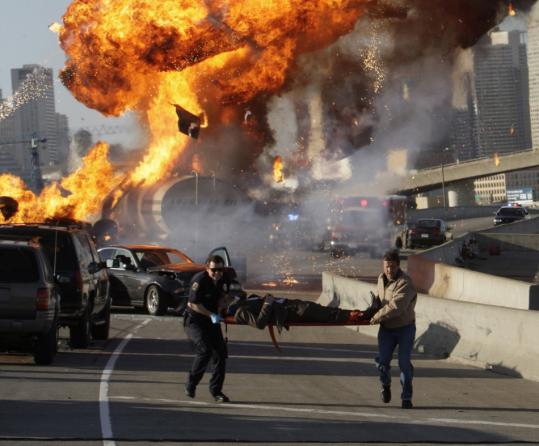
One thing I’ll say in favor of “Trauma’’: It explodes helicopters and oil trucks (“That tank is gonna blow!’’) like nobody’s business. This is action-packed television that, in the course of an hour, delivers a few accidents that rival those found on the big screen. “ER’’ occasionally used to give us a hint of the calamities that occurred outside the hospital; ‘Trauma’’ gives us a nonstop blow-by-blow. Overseen by the producing team behind “Friday Night Lights,’’ the show is as frenzied and hysterical as “FNL’’ is character-driven.

Oh - about that whole character thing. “Trauma’’ may impress with its pyrotechnics, especially if you’re watching it on HDTV, but the personal dramas may not be original and engaging enough to keep you watching for more than an episode or two. The familiar team of EMTs are all traumatized by an accident that killed a number of their colleagues, and each one grieves in his or her own way. There’s the adulterer, Cameron (Derek Luke), finding escape from pain in the arms of other women; there’s the tough medic, Nancy (Anastasia Griffith) who’s afraid to let people in after her boyfriend died. And there’s Reuben (Cliff Curtis), who miraculously survived the accident and now feels immortal and guilty.

This is all boilerplate melodrama, and I can’t imagine the writers twisting it into any new shapes. For a show that’s about life’s unexpected crises, “Trauma’’ is way too predictable.

Iran Tests Short-Range Missiles Before Nuclear Talks


By MARC CHAMPION in Brussels, JAY SOLOMON in Washington and CHIP CUMMINS in Dubai

Iran said it tested short-range missiles in a defiant gesture ahead of talks on its nuclear program, as diplomats noted Tehran is on the defensive over a hidden facility -- but the threat of international sanctions remains uncertain.

The missile exercise, which Iran labeled "Great Prophet 4," came on the heels of last week's revelation of what had been a secret uranium-enrichment plant near Qom, in north-central Iran.Diplomats familiar with preparations for talks in Geneva Thursday say the Qom facility has transformed the outlook for the talks. It has given negotiators from the U.S. and its allies greater leverage to persuade Tehran to accept a so-called freeze-for-freeze proposal that it previously rejected, the diplomats said. Under that proposal Tehran would temporarily halt expansion of its nuclear-fuel program in exchange for no new United Nations sanctions, while a new round of wide-ranging talks begins.

A week ago, diplomats had been downbeat about prospects for the talks, after Russia had said it would block any meaningful new sanctions. That appeared to give Iran little incentive to agree to freeze its nuclear expansion. But Russian President Dmitry Medvedev reopened the door to sanctions after the Qom facility's existence was revealed.

U.S. Defense Secretary Robert Gates said Sunday that Iran was now in a "very bad spot" internationally. Speaking on CNN's "State of the Union," he said there was an "opportunity for severe additional sanctions." On CBS's "Face the Nation," U.S. Secretary of State Hillary Clinton said she doubts Iran will be able to a peaceful nature for its program. "We are going to put them to the test on October 1st," she said.

But the stance of key players Russia and China remained murky over the weekend. Each holds a Security Council veto over sanctions.

U.S. officials rejoiced at the strong Russian rhetoric from Mr. Medvedev last week. But some Western diplomats noted the Kremlin has shifted its rhetorical tone in the past as well. "Russia's position fluctuates within a band, going in cycles," said Fyodor Lukyanov, editor of Russia in Global Affairs, a government-sponsored journal. "Now the pendulum has shifted toward more pressure. ... If it gets to discussion of actual sanctions, there will be all kinds of differences" with the U.S. and other Western powers.

Prime Minister Vladimir Putin, widely viewed as more powerful than Mr. Medvedev -- and more skeptical of U.S. intentions -- hasn't said a word on about Qom. That, according to diplomats, is unusual on a major foreign-policy issue. And even Mr. Medvedev used gentler language last week than his Western counterparts.

China's reaction has been muted thus far. In a statement, the foreign ministry reiterated its stance that nonproliferation should be achieved "peacefully through negotiations." But there also are signs that China's leaders could be willing to take a tougher stance. "We have to keep it clear, commitment to nuclear nonproliferation is China's bottom line," said Yin Gang, a scholar at the Institute of West Asian and African Studies of the government-affiliated Chinese Academy of Social Sciences. With Iran flouting previous United Nations efforts, patience is running thin, he said, and Iran shouldn't count on China's unconditional support if diplomacy fails. If "a military attack cannot be avoided, I don't think China has the power to stop such [a] military attack," said Mr. Yin. Though China and Iran are old friends, "it doesn't mean that Iran could expect that when it comes to the nuclear issues, [China's] interests are bound together with Iran's," he added.

Still, China is the world's second-biggest oil consumer after the U.S., and the Persian Gulf country is one of Beijing's biggest suppliers, making its agreement to significant energy-related sanctions problematic. Chinese imports of Iranian crude grew to 13 million metric tons in the first half of the year, about 15% of China's total, and up 22% from a year earlier, according to government data. With its growing middle class, China already depends on imports for half of its oil needs and that ratio will increase.

U.S. officials said Sunday the question of Tehran quickly allowing U.N. inspectors into the facility at Qom is now high on Thursday's agenda. Iran notified the International Atomic Energy Agency, the U.N.'s nuclear watchdog, of the Qom site on Monday, and has said it will allow inspectors in, though it hasn't said when.

Other Western diplomats involved in the process were more cautious. The freeze-for-freeze proposal remains Thursday's major goal, a diplomat familiar with the preparations said, adding that the meeting is likely to be just the start of a "phased process."

Sunday's missile launch -- which Iran said would be followed by tests of medium- and long-range missiles by Monday -- followed a familiar pattern. In July 2008, under pressure to accept the previous freeze-for-freeze proposal, Iran also announced a missile test, called "Great Prophet 3."

Iran state television said Monday the Revolutionary Guard fired one of the longest-range missiles in its arsenal in a third round of tests meant to demonstrate the country's preparedness for an attack.

English-language Press TV said the Guard successfully tested the Shahab-3 missile, which is capable of carrying a warhead. It has a range of up to 1,200 miles, capable of striking Israel and U.S. Mideast bases and parts of Europe.

State television said Iran test-fired Shahab-1 and Shahab-2 missiles overnight, following tests of short-range missiles early Sunday. The Shahab-1 and Shahab-2 have ranges of about 185 miles and 435 miles respectively.

Toll from Pakistan blasts rises to 27


The death toll from two suicide bomb attacks in Pakistan rose to 27 on Sunday, a day after the blasts shattered hopes that the militants were a spent force following the killing of their leader last month.

A suicide bomber rammed his explosives-laden truck into a police station in the town of Bannu, the gateway to the North Waziristan militant region on the Afghan border, early on Saturday.

Hours later, another attacker blew up a car in the centre of Peshawar, the main city in the northwest.

Pakistani Taliban militants claimed responsibility for both blasts and vowed more.

Authorities initially said 16 people had been killed in all, but the toll rose to 27 on Sunday with the discovery of more bodies in the debris of the Bannu police station and the death of some wounded, police said.

Pakistani forces made significant gains against the militants in an offensive launched in the Swat valley, northwest of Islamabad, in late April.

The offensive helped allay international fears about the stability of the nuclear-armed U.S. ally after militants made advances towards the capital, Islamabad.

Pakistani officials said the Taliban were in disarray and racked by infighting after the killing of their chief, Baitullah Mehsud, in a missile strike by a pilotless U.S. aircraft in early August.

Interior Minister Rehman Malik said the back of the Pakistani Taliban had been broken but the Saturday blasts appeared to have dispelled such optimism.

“Anybody who thought that the Taliban were close to defeat or on the run had better think again,” the News newspaper said in an editorial.

It is not just Pakistani Taliban factions that the government has to contend with but also Afghan Taliban factions operating out of its lawless northwest and creating havoc across the border in Afghanistan.

General Stanley McChrystal, the commander of U.S and NATO forces in Afghanistan, said in an assessment leaked to the media last week the Afghan insurgency was supported from Pakistan and Afghanistan needed Pakistani action.

Security analyst Mahmood Shah, a retired brigadier and former security chief in the ethnic Pashtun lands along the Afghan border, said the militants had demonstrated they can strike back.

“They were in disarray but it appears they've organised themselves and they're in a position to strike back,” he said.

Mr. Shah said al Qaeda could have organised the latest attacks, hoping to keep the security forces on the back foot and buy time for their Pakistani Taliban allies.

The attacks are also likely to increase calls for the army to go into the Pakistani Taliban's South Waziristan stronghold on the Afghan border where thousands of militants are based.

The government in May ordered the military to go on the offensive in South Waziristan. Since then, regular air strikes have been launched but no ground assault has been carried out.

A senior army commander said in August it would take months to prepare for a ground offensive in South Waziristan, partly because the army lacked equipment including helicopters and night-vision equipment.

The English-language Dawn newspaper said the country faced a long battle. “We have no choice but to take the war against the rebels to its logical conclusion,” it said in an editorial.

US columnist William Safire dies


Safire also worked as speechwriter and aide to President Richard Nixon during the Watergate scandal that ultimately drove him from office in 1974.

For the last 30 years of his life, he was best known for his famous New York Times magazine column "On Language".

Safire is survived by his wife and two children.

Born in New York in 1929, Safire worked as a journalist and in public relations before serving as a special assistant to President Nixon during the 1970s.

The former college dropout set up what became known as the "kitchen debate" meeting between Nixon and the former Soviet leader Nikita Khrushchev.

He oversaw Nixon's visit to China and the gathering storm of the Watergate scandal that ended his presidency in disgrace.

William Safire joined The New York Times as a Washington-based columnist in 1973 and won a Pulitzer Prize for commentary five years later.

He published numerous books on writing and language. His most recent, How Not to Write: The Essential Misrules of Grammar, was published in 2005.

Japan 'opposes yen intervention'


Hirohisa Fujii said currency intervention was not necessary as long as the yen moved gradually, and added other countries would not support it.

Mr Fujii also said a strong yen had merits - which is unusual, considering Japan is such a large exporter.

The yen is up 6.7% against the dollar since June. A stronger yen makes Japanese exports less competitive.

Japan has in the past intervened in the currency markets to weaken the yen when the government thought its rise was threatening growth in the world's second-largest economy.

But the authorities have not intervened since 2005.

New direction

"We can't conduct intervention because the current foreign exchange markets won't move without a joint intervention," Mr Fujii said.

"I can't think other countries will conduct joint intervention even though the yen rises slightly."

Japan's parliament has confirmed Yukio Hatoyama as prime minister, handing power to his untested Democratic Party of Japan (DPJ) and ending more than 50 years of almost unbroken rule by the Liberal Democratic Party.

Mr Hatoyama will appoint key members of his cabinet over the next few days.

His comments about a strong yen reflect the DPJ view that a strong yen can be in the country's interest, and are a marked departure from the former ruling party's long-standing view.

Philippine storm leaves 106 dead and missing


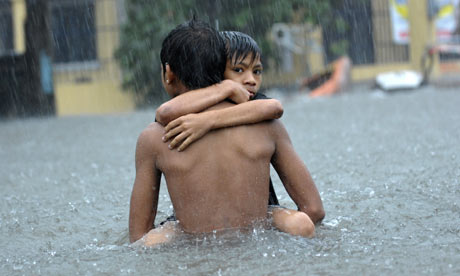
Many Filipino villagers managed to save only the clothes on their backs but began to rebuild Sunday as the flood waters receded from a tropical storm that set off the worst flooding in the Philippine capital in 42 years and left about 80 dead.

Army troops, police and civilian volunteers plucked dead bodies from muddy flood waters and rescued drenched survivors from rooftops after Tropical Storm Ketsana tore through the northern Philippines a day earlier, leaving at least 106 people dead and missing.

Some residents began to clean up as the flood waters receded. Still, many parts of the capital remained flooded. A brief period of sunshine showed the extent of the devastation in many neighbourhoods — destroyed houses, overturned vehicles, and roads covered in debris and mud.

Ketsana dumped more than a month's worth of rain in just 12 hours, causing the government to declare a “state of calamity” in metropolitan Manila and 25 storm-hit provinces. The declaration allowed officials to use emergency funds for relief and rescue.

The rains swamped entire towns and set off landslides that have left at least 83 people dead and 23 others missing, Defence Secretary Gilbert Teodoro said. Garbage-choked drains and waterways, along with high tide, compounded the flooding, officials said.

Governor Joselito Mendoza of Bulacan province, north of the capital, said it was tragic that “people drowned in their own houses” as the storm raged.

Meteorologists say the Philippines' location in the northwestern Pacific puts it right in the pathway of the world's No. 1 typhoon generator. Doomed by geography and hobbled by poverty, the Philippines has long tried to minimize the damage caused by the 20 or so typhoons that hit the sprawling archipelago every year. Despite a combination of preparation and mitigation measures, high death tolls and destruction persist.

“We're back to zero,” said Ronald Manlangit, a resident of Marikina city, a suburb of the capital, Manila. Floodwaters engulfed the ground floor of his home and drowned his TV set and other prized belongings. Still, he expressed relief that he managed to move his children to the second floor.

“Suddenly, all of our belongings were floating,” the 30-year-old said. “If the water rose farther, all of us in the neighbourhood would have been killed.”

President Gloria Macapagal Arroyo toured the devastated areas and prodded villagers to move on. She said the storm and the flooding were “an extreme event” that “strained our response capabilities to the limit but ultimately did not break us.”

TV footage shot from a military helicopter showed drenched survivors still marooned on top of half-submerged passenger buses and rooftops in suburban Manila Sunday. Some dangerously clung to high-voltage power lines while others plodded through waist-high waters.

In Marikina, a rescuer gingerly lifted the mud-covered body of a child from a boat. An Associated Press photographer saw rescuers carry away four other bodies, including that of a woman found in a church in a flooded neighbourhood.

Authorities deployed rescue teams on boats to save survivors.

More than 330,000 people were affected by storm, including some 59,000 people who were brought to about 100 schools, churches and other evacuation shelters, officials said. Troops, police and volunteers have so far been able to rescue more than 5,100 people, Teodoro said.

The 16.7 inches of rain that swamped metropolitan Manila in just 12 hours on Saturday exceeded the 15.4-inch average for all of September, chief government weather forecaster Nathaniel Cruz said. He said the rainfall also broke the previous record of 13.2 inches, which fell in a 24-hour period in June 1967.

Ketsana, which packed winds of 85 kilometres per hour with gusts of up to 100 kilometres per hour, hit land early Saturday then roared across the main northern Luzon island toward the South China Sea.

It's the 15th of about 20 typhoons and storms that forecasters expect will lash the country this year.

Britain's Brown vows to lead Labour into elections


BRIGHTON, England -- British Prime Minister Gordon Brown insisted he won't quit his post as his governing Labour Party met Sunday for its annual convention before a national election the party is expected to lose.

Brown's party trails far behind the main opposition Conservative Party in opinion polls, and has suffered heavy defeats in recent local council and European elections.

Brown himself has weathered sharp criticism of his leadership, not just from opposition politicians but also from within his own ranks. His clumsy handling of anger over Scotland's decision to release the Lockerbie bomber, and an embarrassing admission that his government would need to cut public spending - despite earlier denials - have fueled new doubts about Brown's prospects of leading Labour into the election.

Some critics, including ex-interior minister Charles Clarke, also have claimed that Brown is in poor health and should step aside to make way for a more popular leader.

"I do not roll over," Brown told BBC television. "Leadership is fighting for what you believe in."

Brown, who will address the five-day conference in seaside Brighton on Tuesday, must by law call an election before June 2010, and his Labour Party will be seeking a fourth consecutive term in office. Labour won the three previous elections with Tony Blair as party leader. The next vote is expected in April or May.
ad_icon

The 58-year-old Brown, who was awarded a world statesman of the year honor in New York last week, hopes that by the time Britons vote, he will have earned similar praise at home for his handling of the economic crisis.

"Leadership is about the strength to take the tough decisions, but sometimes when you take the tough decisions, it takes time for people to see the benefit," Brown told the BBC.

The latest opinion polls give the Conservatives a lead of more than 15 percentage points over Labour, and suggest the public no longer trusts Brown - a former Treasury chief - to lead the country's economic recovery.

"The worst case scenario is a really bad defeat. We have got to start fighting to win, instead of keeping our heads down heading for defeat," said Welsh Secretary Peter Hain as delegates were gathering for the Brighton conference.

Unlike Labour's rise to office in 1997 - when Blair promised sweeping social reforms - Britain's next election will be fought amid deep pessimism.

The three main political parties acknowledge the government must cut spending and limit services to reduce mounting debts. Lawmakers are also battling to rebuild public trust following a damaging scandal over legislators' excessive expense claims.

Johnson takes 4th win at 2nd Chase race at Dover


DOVER, Del. — Jimmie Johnson dominated again in winning a crucial Chase race.

It's become about as routine this time of year on the sports calendar as the start of the NFL season or the baseball playoff stretch drive. If he keeps driving like this, NASCAR can expect another regular fixture in November: Johnson hoisting the series trophy and celebrating a championship.

Johnson thumped the competition in the second Chase for the championship race, sweeping the season races at Dover International Speedway to accelerate his bid for an unprecedented fourth straight Sprint Cup title.

"I'm pretty sure that dude is Superman," runner-up Mark Martin said.

He was pretty super on the concrete in the No. 48 Chevrolet. If three championships weren't enough to intimidate the rest of the Chase field, the way he won on Sunday should send another message: He's just really getting going on a fourth.

"As far as sending a message, I hope it does," Johnson said. "I hope people are worried."

Johnson cut Martin's points lead with the victory — his fourth of the year and 44th overall — in the second of 10 races in the Chase for the championship.

"I've seen that dude up close and I see why he's so successful," said Martin, Johnson's Hendrick Motorsports teammate. "He works harder at it than anybody else, I think, on the circuit."

No winner of the second Dover race has ever gone on to win the Cup championship. If any driver can reverse that trend, it's Johnson. Much as he did in May, Johnson's No. 48 Chevrolet was out in front for the majority of the 400-mile race.

"I certainly hope that our performance today scares some people and affects them in a way that benefits us," Johnson said.

Chase drivers took nine of the first 11 spots. Martin followed last week's win at New Hampshire with a second-place finish. Juan Pablo Montoya was fourth and Kurt Busch fifth.

Matt Kenseth was the highest non-Chase driver at third.

Martin holds a 10-point lead over Johnson heading into next week at Kansas Speedway.

"This team is really on a roll right now," Martin said.

Other Chase driver results saw Jeff Gordon finish sixth, Kasey Kahne was eighth, Tony Stewart ninth and Ryan Newman 10th. Carl Edwards was 11th, Greg Biffle 13th, Brian Vickers 18th and Denny Hamlin 22nd.

"It's just two races," Martin said. "I still say that there's 12 in and 12 can win. It might be a challenge for a couple of the ones toward the end of the back."

Johnson, who tire-tested in August at Dover, won from the pole. He led 298 laps when he won at Dover in May and added another 271 on the 1-mile concrete track Sunday. Johnson won for the fifth time at Dover.

"That's right boys, maximum points! Thank you!" Johnson said over the radio.

Johnson and crew chief Chad Knaus also won their 15th Chase race. No one is better down the stretch and it's the main reason why the No. 48 team is going for its record fourth straight title.

"Our team is pretty easily motivated," Knaus said.

Easy to see why. Cale Yarborough is the only other driver to win three straight championships and Johnson can move past him with more winning performances like this one over the final eight races.

Johnson was so far in front, he had no idea Joe Gibbs Racing driver Joey Logano was involved in an early accident that saw his No. 20 barrel-roll eight times down the concrete and result in the race being red-flagged. It looked scary, but the teenage Logano walked away and was fine.

"It just goes to show how safe these cars are," Logano said.

Johnson, who won for the first time since July at Indianapolis, crushed Kenseth and the rest of the contenders off the double-file restarts and was never seriously challenged.

He's in great position, but he's still not in first. Even with the 10 bonus points for winning, Martin still holds a slim lead.

The 50-year-old Martin is the sentimental favorite for his first Cup championship and he's in no rush to yield his spot atop the standings. His 1-2 finish in the first two Chase races proved he'll be a major factor in the No. 5.

"I'm happy with the result," Martin said. "We just missed it a little bit."

It's way too early in the Chase to rule out any driver as a contender for the championship, but the Hendrick powerhouse sure looks like it fields the teams to beat.

"They're strong everywhere," Hamlin said. "There's no weakness to their race team at all."

There not be a detectable weakness, but Biffle griped again that Johnson and Montoya had an unfair advantage because they were picked for the tire test. Biffle wanted all 10 Chase drivers to have a shot at testing, or none of them.

"Look at the guys that didn't tire test. We ran terrible," Biffle said. "It was a completely different tire (from May). It had us off our game right when we unloaded off the truck."

Johnson's tip to the rest of the field? Bring on the complaints.

"I hope people are talking about the fact that we tire tested and it's wrong," Johnson said. "All these people can get wound up about stuff that really doesn't matter. We'll keep our heads down, keep our blinders on and we'll go to work."

Ontario delays fall flu shots over H1N1 threat


Ontario has become the first province to delay seasonal influenza vaccines to most residents because of the threat posed by swine flu.

The decision, announced Thursday, comes as public health officials across the country are reconsidering their immunization plans in light of unpublished Canadian studies that suggest earlier seasonal flu shots raise the risk of contracting the pandemic H1N1 flu virus.

“Is it typical that we adjust our programs?” said Arlene King, Ontario's chief medical officer of health. “No, it isn't typical, but we are not dealing with a typical flu season this year.”

Ontario's program is based on a calculation that swine flu will sicken more people than seasonal influenza this fall and winter. Despite hopes for a pan-Canadian vaccination strategy, the province's approach is different than those in other provinces.

Alberta, Saskatchewan, Manitoba and New Brunswick are planning to widely offer seasonal flu shots next month, before swine flu vaccines, expected in November, become available.

“We are going to try to do it very fast and then focus on H1N1,” said John Tuckwell, an Alberta Health spokesman.

In New Brunswick, the seasonal flu vaccine is already being sent to doctors and should arrive in the next week. Once supplies run out, no more will be produced as the focus shifts to preventing swine flu.

“We want to avoid having both vaccines circulating at the same time in total confusion at the level of the public,” said Dr. Paul Van Buynder, New Brunswick's deputy chief medical officer of health.

Other provinces, including British Columbia and Quebec, have not yet decided how to roll out their vaccination campaigns.

“We have all the scenarios on the table,” said Karine White, a spokeswoman for the Quebec Health Ministry. “Right now, it seems like H1N1 is the major flu virus.”

The provinces' plans come amid signs that the flu season has started several weeks before a swine flu vaccine is ready. Hundreds of students in B.C. were absent from school this week, either because they are sick or their parents want to protect them from falling ill. The H1N1 virus has been confirmed in students in two Vancouver schools and one on Vancouver Island, and test results from a fourth school are expected as early as Friday.

Ontario's plan involves three waves of vaccinations. Seasonal flu shots will be offered starting next month to people aged 65 and older and to residents of long-term-care homes, who have largely been spared by swine flu. Once available, H1N1 vaccines will be provided to at-risk groups, including young children, pregnant women and people with chronic health problems, followed by the general population. Finally, seasonal flu shots will be offered to all Ontarians in December or January.

The approach is borne out of several considerations, including the epidemiology of the H1N1 virus and the unpublished research from B.C., Ontario and Quebec that appears to suggest that people who received a flu shot last year are about twice as likely to contract swine flu. The studies are undergoing fast-tracked peer review. Researchers in the United States, Britain and Australia have not found the same link.

In addition, immunity to both seasonal and swine influenza will require up to three separate vaccinations. Ongoing clinical trials are determining whether H1N1 immunity can be achieved in one or two doses.

Allison McGeer, an infectious diseases expert at Toronto's Mount Sinai Hospital, said Ontario's compromise makes sense.

“It's a reasonable balance,” she said. “[But] it has some obvious logistical challenges.”

With reports from Caroline Alphonso in Toronto, Katherine O'Neill in Edmonton, Patrick White in Winnipeg, Oliver Moore in Halifax and The Canadian Press

Polanski lives through dazzling highs, dire lows


LOS ANGELES -- Roman Polanski has lived through a striking collection of bizarre, triumphant and tragic events, his calamity rivaling some of the darkest horrors he has depicted on screen.

Here's a look at the highlights of the filmmaker's history of accomplishment and affliction.

A CHILDHOOD OF HORROR:

Polanski is born to Polish-Jewish parents in Paris on Aug. 18, 1933, the family moving back to Poland when he is 3. He escapes Krakow's Jewish ghetto after the Nazi invasion, surviving off the kindness of strangers who help hide him in the countryside during World War II. His mother dies at Auschwitz, though his father survives the Mauthausen death camp. Six decades later, his survival is echoed in his film "The Pianist," based on the real-life story of musician Wladyslaw Szpilman, another Polish Holocaust survivor. "Obviously, the whole film is about survival," Polanski says via satellite at a Los Angeles gathering of 2002's Directors Guild of America nominees. "For me, it was the preponderant theme of my childhood and youth."

AUTEUR IN THE MAKING:

Settling on a career in the arts, Polanski studies at the Lodz Film School and lands some small acting roles, including a part in fellow Polish director Andrzej Wajda's 1955 World War II drama "A Generation." (Nearly 50 years later, Polanski reunites in front of Wajda's camera to co-star in his countryman's 2002 film, the 19th century farce "The Vengeance." Polanski calls it a "great pleasure to meet Andrzej on the film set after all those years.") Polanski breaks in as a director on short films before making his feature debut with the 1963 psychological thriller "Knife in the Water," which is nominated for an Academy Award as best foreign-language film. He then leaves Poland for England, where he makes three more acclaimed films, "Repulsion," "Cul-de-Sac" and "The Fearless Vampire Killers."
ad_icon

HOLLYWOOD TRIUMPH AND TRAGEDY:

In the late 1960s, Polanski moves to Hollywood, making an immediate impact with 1968's creepy sensation "Rosemary's Baby," starring Mia Farrow as a woman whose pregnancy is awash in horror and satanic doings. The film wins the supporting-actress Oscar for Ruth Gordon and earns Polanski a screenplay nomination. Hollywood success gives way to personal horror a year later when Polanski's pregnant wife, "Fearless Vampire Killers" and "Valley of the Dolls" co-star Sharon Tate, is murdered in the killing spree by followers of cult figure Charles Manson. Going back to Great Britain for his next film, Polanski is preoccupied with bloody and tragic themes as he shoots an acclaimed, very violent adaptation of Shakespeare's "MacBeth." Polanski lightens up with the X-rated Italian sex romp "What?" before returning to Hollywood for another seesaw of achievement and adversity.

EXCELLENCE TO EXILE:

In 1974, Polanski teams with Jack Nicholson, Faye Dunaway and John Huston for one of cinema's great detective stories, "Chinatown," both an homage and a down-and-dirty reinvention of classic film noir. The film picks up 11 Oscar nominations, including best picture and director for Polanski, though it wins only one award, for screenwriter Robert Towne. The film catapults Polanski to the forefront of Hollywood filmmakers, but he squanders much of his professional goodwill with an odd followup, directing and starring as a paranoid nutcase in the moody French thriller "The Tenant." The film turns off critics and audiences, though it later achieves status as a cult favorite. In 1977, Polanski is accused of raping a 13-year-old girl he photographed during a modeling session at Nicholson's home in Los Angeles. In a deal with prosecutors, Polanski pleads guilty to one of six charges against him, unlawful sexual intercourse, and is sent to prison for 42 days of psychological evaluation. Faced with the prospect of further prison time, Polanski flees the country in 1978, living as an exile in France.

PROFESSIONAL WILDERNESS:

A year later, Polanski does an about-face from his often-explicit subject matter and mounts an epic, lavish costume drama starring Nastassia Kinski in the title role of "Tess," an adaptation of Thomas Hardy's novel. The film picks up six Oscar nominations, including best picture and Polanski's second directing honor. But Polanski's film career grows fitful as financing becomes harder to secure. He remains busy with theater and opera productions throughout Europe, finally returning to the screen after a seven-year absence with the 1986 commercial dud "Pirates." The buccaneer comedy starring Walter Matthau helps give pirates a reputation as box-office poison until future Polanski star Johnny Depp salvages the genre with his "Pirates of the Caribbean" blockbusters. Polanski continues to land major stars for his films, among them Harrison Ford on 1988's "Frantic" and Sigourney Weaver and Ben Kingsley on 1994's "Death and the Maiden." In 1989, Polanski marries "Frantic" co-star Emmanuelle Seigner, with whom he has two children. Twenty years after charges were filed against him, the woman he's accused of raping goes public for the first time. A married mother of three, Samantha Geimer says she wishes Polanski could reach a deal with the courts and end his years as a fugitive. Though Polanski has called Geimer a sophisticated teen who willingly had sex with him, she says he coaxed her with drugs and champagne. Geimer says she would not call it rape but that the sex was not consensual. "The word `rape' for me always brings to mind for me a level of ... violence that wasn't there," she says.

COMING FULL CIRCLE:

After working with Depp on 1999's thriller "The Ninth Gate," Polanski revisits his childhood trauma with the Holocaust drama "The Pianist," starring Adrien Brody as musician Szpilman. Based on Szpilman's memoir, it is the first film Polanski shoots in Poland since his feature debut 30 years earlier. The exciting thing about discovering Szpilman's story "is that it wasn't TOO personal - it was something I know about, remember very well, something that could help me recreate the events without talking about myself," Polanski says at the 2002 Cannes Film Festival, where "The Pianist" picks up the top award. Come Oscar night the following year, "The Pianist" is up for best picture and six other awards, winning Brody the best-actor honor, Ronald Harwood a screenplay trophy and Polanski the directing prize. While Harwood calls Polanski a "great director and a wonderful colleague" and many in the Oscar crowd give the absent filmmaker a standing ovation, a spokeswoman for the Los Angeles County district attorney says the filmmaker remains a "convicted felon and a fugitive," adding that, "You don't get a pass for longevity."

WANTED AND DESIRED:

Polanski follows "The Pianist" with the 2005 Charles Dickens adaptation "Oliver Twist" and the recently completed thriller "The Ghost." In 2008, the Emmy-winning documentary "Roman Polanski: Wanted and Desired" debuts at the Sundance Film Festival, reigniting the debate over the case against Polanski. The documentary uncovers new information about actions by the late Judge Laurence J. Rittenband, suggesting he inappropriately consulted with a prosecutor not assigned to the case. Armed with those revelations, Polanski's attorneys early this year seek to have the case dismissed. Superior Court Judge Peter Espinoza in Los Angeles says there was "substantial misconduct" in the handling of the original cast but dismisses Polanski's bid to throw out the case because the director fails to show up in court to press his motion. The judge says he might reconsider if Polanski returns to the United States. With his arrest in Switzerland, where he traveled to receive an honorary award at the Zurich Film Festival, Polanski faces possible extradition that may put him in front of the judge to ask face to face that the case be dropped.

German poll shows tiny center-right majority


BERLIN -- A poll published Wednesday indicated that German Chancellor Angela Merkel's preferred center-right coalition has a razor-thin majority going into this weekend's general elections.

Merkel is hoping to end her "grand coalition" with the center-left Social Democrats and instead form a new government with the pro-business Free Democrats after Sunday's vote.

The Forsa agency's poll, conducted Sept. 15-21, reinforced expectations of a close race, with 35 percent of those surveyed showing support for Merkel's conservative Christian Democratic Union and its Bavaria-only sister, the Christian Social Union. That was down two percentage points from a survey conducted Sept. 14.

The survey showed support for the Free Democrats up one point at 13 percent - which would give the potential center-right alliance a total of 48 percent, compared with 47 percent for their rivals combined.

Support for the Social Democrats of Foreign Minister Frank-Walter Steinmeier was up two points to 26 percent. The opposition Greens and Left Party were unchanged at 11 and 10 percent, respectively.

Steinmeier, Merkel's challenger for the top job, has focused his campaign on preventing a center-right government. Though considered unlikely to become chancellor himself, he benefited from a confident performance in a Sept. 13 television debate with Merkel.

Merkel has pledged tax relief to help spur economic growth and wants to halt a plan to shut down Germany's 17 nuclear power plants by 2021.

If her party and allies are unable to secure a center-right majority, a repeat of the "grand coalition" looks likely.

Forsa chief Manfred Guellner told Stern magazine, for which his agency conducted the poll, that he doesn't expect voters to switch between right and left at this stage.
ad_icon

"The race will be tight again," he said, but added that the center-right may be helped by a quirk of the electoral system that gives Germans two votes: one for a directly elected constituency representative and one for a party list. The system allows for parliamentary seats to be added if a party wins more direct seats than it would under the proportional party distribution.

Germany's highest court has ordered the system to be changed by 2011, and the Social Democrats have questioned how legitimate a government that depended on them would be.

Merkel has vowed to form a coalition with the Free Democrats even if the center-right has only a one-seat majority.

Germany's biggest industrial union, IG Metall, urged people to vote against the center-right, which it argued could be bad for workers' rights.

"We want to prevent a coalition that is hostile to employees on Sunday - every vote is needed for that," deputy union leader Detlef Wetzel said.

Forsa's findings were largely in line with those of three polls released Friday by other agencies. One indicated the center-right parties were level with their rivals; the other two gave them a lead of up to three percentage points.

Forsa surveyed 2,503 people and gave a margin of error of plus or minus 2.5 percentage points.

U.K. Premier's Former Rival Plans Labour Strategy


Peter Mandelson has rebounded from political exile twice in the past 12 years to claim a powerful place among the elite of Britain's ruling Labour Party. Now, Lord Mandelson is taking on what may be an even more daunting turnaround mission: saving the political life of his onetime rival, Prime Minister Gordon Brown.Lord Mandelson, the head of the U.K. government's business ministry, has emerged in recent months as Mr. Brown's top political operative -- a role that will thrust him into the spotlight this week as the Labour Party holds its annual conference in Brighton, England, the last such party gathering before a general election that must be called by June.

It's a daunting challenge: The opposition Conservative Party is ahead in opinion polls by as much as 17 percentage points; the economy is in recession; the country is mired in record debt; and Mr. Brown's party is troubled by internal strife.

Yet despite the economic problems that have befallen the U.K., and the world, Lord Mandelson plans to place the economy at the heart of the campaign -- and claim that moves made by Mr. Brown and his government averted greater disaster and stabilized the financial sector. "The battleground in the election will be fought on the economy," he said in an interview. This week in Brighton, the party will "bark back and fight back."

He acknowledges that Labour is the underdog in the coming election, though he complains that much of the U.K. media have tried to "decide the outcome of the next general election over the head of the British people by assuming that the result is a foregone conclusion." Few in Britain know more about political resurrection than Lord Mandelson. Once dubbed "The Prince of Darkness" -- a moniker hung on him by satirical magazine Private Eye but soon adopted by others -- he has repeatedly returned to power after being written off by the political intelligentsia.

"There hasn't been a British political comeback like Mandelson since Winston Churchill," says Rodney Barker, professor of government at the London School of Economics. Churchill made major mistakes as a minister during World War I, changed parties twice and spent a period in the political wilderness before bouncing back to head the government during World War II.

Alongside former Prime Minister Tony Blair and Mr. Brown, Lord Mandelson is credited with transforming Labour from an unelectable party rooted in doctrines of state intervention into the free-market-friendly "New Labour" that has enjoyed over a decade of power.

It wasn't a smooth ride. In the early 1990s, Lord Mandelson allied himself with Mr. Blair, opening a high-profile feud with Mr. Brown. A year after Labour came to power in 1997, Lord Mandelson was forced to resign as a government minister after taking an interest-free housing loan from fellow Labour member Geoffrey Robinson, whose business dealings were subject to an inquiry by Lord Mandelson's then-department.

Within 10 months, he was a minister again. Two years after that, in 2001, he resigned once more after making phone calls on behalf of an Indian businessman requesting U.K. citizenship. Independent inquiries cleared him of wrongdoing, but the scandals tarnished his political reputation, and fresh controversies over Lord Mandelson's connections with rich businessmen continue to plague him.

Nonetheless, Lord Mandelson has bounced back yet again. At the height of the financial crisis and internal party strife last October, Mr. Brown surprised everyone -- including Lord Mandelson -- by asking his onetime rival to leave his post as the European Union's top trade official and head the U.K.'s business department. A Cabinet minister who declined to be named said it took no time for Lord Mandelson to display "an astonishing ability to reassert his authority" at the Cabinet table.

Last June, a rising government minister named James Purnell embarrassed Mr. Brown by calling for the prime minister to resign, just as polls closed in U.K. local elections. The move appeared to top off a rebellion from a group of Labour ministers that, momentarily, looked like it might topple Mr. Brown. Within minutes, Lord Mandelson launched a furious round of intraparty lobbying that helped stave off further defections and tamp the uprising.

Lord Mandelson was rewarded with two new designations, first secretary of state and lord president of the council, and an expanded business ministry. The British press, meanwhile, awarded him a new title: deputy prime minister.

Now, Lord Mandelson is at the heart of all strategy, and one of the most regular visitors to Downing Street, people familiar with the matter say. Even some on Labour's left have warmed to Lord Mandelson, a man they had seen as pushing what they saw as the party's rightward drift and obsession with "spin."

"When he came back, you could see how rattled the Tories were, and I thought, 'they must dislike him even more than me,'" said Ronnie Campbell, a veteran left-wing Labour member of Parliament who called Lord Mandelson an effective politician who will help Labour fight for the election.

Still, his plan to sell off part of the state-owned Royal Mail was widely attacked by the left of his own party and has been postponed. He also faces a resurgent Conservative Party led by media-savvy David Cameron.

Lord Mandelson says Labour needs to hone its campaigning skills. "As the election draws nearer we have to rebalance our focus and energy and devote more time and effort to getting our arguments across and challenging our political opponents," he said, a message he will deliver in his conference speech Monday.

Labour will talk up its "successes" in rescuing Britain's battered banks and "preventing recession turning into depression" and will contrast what it believes will be indiscriminate budget cuts from the Conservatives against targeted cuts that preserve front line public services, he says.

Mr. Brown and Lord Mandelson's problem, in part, is that it may be difficult to engage in this debate without acknowledging that the policies they made helped lead to it, some analysts say.

"In the absence of a more compelling vision, voters will conclude that Labour has run out of ideas. Even many Labour sympathizers have come to that conclusion," said David Clark, a former senior adviser to the Labour government. "And that even the Prince of Darkness has so far failed to address."

West demands access to Iran's secret underground nuclear site


The West warned Iran today that it will face fresh sanctions by December unless it can persuade the world of a “profound change” in its nuclear stance after the existence of its secret underground uranium enrichment plant was uncovered.

President Obama, flanked by Gordon Brown and President Sarkozy of France at the G20 summit in Pittsburgh, called the hidden facility a direct challenge to international nuclear non-proliferation rules and demanded that Iran act immediately by agreeing to full international inspections of its nuclear facilities.

Mr Brown accused Iran of “serial deception” and insisted that Britain was “at one” with the US and France in its willingness to implement new and tougher sanctions.

Mr Sarkozy said: “If, between now and December, there is not a profound political change on the part of the Iranian leadership, sanctions must be imposed for the sake of peace and stability." Mr Obama, determined to pre-empt the accusations of double standards to which Tehran often resorts, said: “Iran has a right to peaceful nuclear power that meets the energy needs of its people. But the size and configuration of this facility is inconsistent with a peaceful programme.”

Iran informed the International Atomic Energy Agency (IAEA) on Monday that it has been building the secret site – its second nuclear facility – inside a mountain near the holy Shia city of Qum.

Although the CIA and National Security Agency have been tracking its construction for several years, Mr Obama decided it was time to put maximum pressure on Tehran by revealing its existence.

Reports from Washington indicate that Iran had learnt of the West’s move and declared the site formally to the IAEA.

The dramatic development transforms next week’s talks on Iran’s nuclear programme in Geneva from another chapter in a failed negotiation process into a critical test of President Ahmadinejad’s resolve.

Mr Obama made nuclear disarmament a central theme of his speech in Prague in April, and put non-proliferation at the top of the agenda for the UN Security Council meeting he chaired this week in New York. In doing so he cleared the way for today’s move.

“All nations have a right to peaceful nuclear energy,” he said, adding that those with nuclear weapons “must move towards disarmament".

Iran wrote a brief, cryptic letter to the IAEA saying that it had a “pilot plant” under construction, whose existence it had not revealed. Iran’s first officially declared facility is at Natanz in southern Iran.

An IAEA spokesman, said: “I can confirm that on September 21 Iran informed the IAEA in a letter that a new pilot fuel-enrichment plant is under construction in the country. The letter stated that the enrichment level would be up to 5 per cent.”

Uranium enriched to around 5 per cent can be used as nuclear fuel, but has to be enriched to around 90 per cent to be effective in a nuclear weapon. The United States, Britain and other Western countries believe that Iran has been attempting, at its plant at Natanz, to achieve a higher enrichment of uranium, although the plant has been subject to IAEA inspections.

Iran has enough low-enriched uranium but has yet to develop the higher grade for a weapon.

The IAEA spokesman said: “Iran assured the agency in the letter that further complementary information will be provided in an appropriate and due time. In response, the IAEA has requested Iran to provide specific information and access to the facility as soon as possible. This will allow the agency to assess safeguards verification requirements for the facility.”

He said the IAEA was told by Tehran that no nuclear material had been introduced into the facility.

The revelation of the second plant further complicates the chances of any meaningful progress at the scheduled talks on October 1 between Iran and six world powers, the first in more than a year.

The five permanent United Nations Security Council members and Germany will be pressing Iran to scale back on its enrichment activities. But Tehran has declared that it will not bargain on enrichment.

Philippines rescue workers step up search for storm survivors


Rescuers in the northern Philippines today increased their efforts to rescue people left stranded after a tropical storm brought the area's worst flooding in more than four decades.

The government declared a "state of calamity" in metropolitan Manila and 25 storm-hit provinces after tropical storm Ketsana brought more than a month of rain in 12 hours yesterday.

The decision allowed officials to utilise emergency funds for relief and rescue, the defence secretary, Gilbert Teodoro, said.

Army troops, police and civilian volunteers have so far rescued more than 4,000 people since Ketsana brought landslides and flooding, killing at least 51 people and leaving 21 others missing, Teodoro said.

Ketsana swamped towns and closed Manila's airport for several hours.

Military chief General Victor Ibrado, accompanied by journalists, flew over several suburban Manila towns and saw many people waiting to be rescued on the roofs of their houses.

Mary Coloma, a housewife, told the DZBB radio station: "My son is sick and alone. He has no food and he may be waiting on the roof of his house. Please get somebody to save him."

Many neighbourhoods have been devastated, with houses destroyed, vans and cars overturned and streets left awash with debris and mud.

"The flooding was so grave it inundated many communities for the first time," Loel Malonzo, a provincial disaster response official, said in Rizal province, where more than 40 people drowned or were killed by landslides.

"People were trapped in their houses. Some who tried to escape were swept away by the flood," Malonzo told the Associated Press.

The 42cm of rain that hit metropolitan Manila in 12 hours exceeded the 39.2cm average for September, Cruz said, adding that the rainfall broke the previous record, of 33.4cm in a 24-hour period, recorded in June 1967.

The ABS-CBN television channel showed video footage of more than a dozen people on the roofs of damaged houses being swept away by the Marikina river.

The buildings were smashed against the pillars of a bridge, and it was unclear whether the people were rescued.

The Philippine president, Gloria Macapagal Arroyo, had to take an elevated commuter train to the disaster council office to chair a meeting because roads were clogged by vehicles stuck in floodwater.

Discovering Iran's secret nuclear plant has wiped off Mahmoud Ahmadinejad's smile


Until the Obama administration dropped the bombshell that it knew what the Iranian regime was up to, Mr Ahmadinejad had been enjoying himself, provoking mass walkouts from the United Nations General Assembly in New York after his claims the Holocaust was a myth.

He had even managed to persuade some of the more gullible delegates that Iran would take a constructive approach to this week's scheduled talks over the future of its nuclear programme, which are due to take place in New York on Thursday.Holding court at his hotel, Mr Ahmadinejad said he was looking forward to "free and open" discussions during this week's meeting with six world powers on Iran's nuclear programme.

But by Friday, Mr Ahmadinejad's composure looked shaken when he appeared at a news conference shortly after President Barack Obama had disclosed that Iran had been developing a second uranium enrichment facility near the holy city of Qom without bothering to inform the UN's International Atomic Energy Agency what it was up to.

Given Iran's previous track record of concealing vital details of its nuclear programme from the UN, the disclosure that Iran had been forced to admit it had embarked on another undeclared nuclear site has severely damaged Mr Ahmadinejad's credibility at a crucial moment in the international stand-off over Iran's nuclear ambitions.

The origins of the current crisis date to the disclosures seven years ago that Iran had built an industrial scale, underground uranium enrichment facility at Natanz that could ultimately provide Tehran with the capability to build an atomic bomb. Despite intense diplomatic efforts by the EU3 – Britain, France and Germany – to get Iran to freeze its enrichment activities, Mr Ahmadinejad has managed to string out the negotiations while at the same time maintaining the pace of Iran's nuclear programme. Many experts now believe Iran will have enough fissile material to build a warhead within a year.

To judge by his relaxed demeanour last week, Mr Ahmadinejad was confident that he would be able to lure the Obama administration into the same diplomatic trap. Since coming to power last January, Mr Obama has gone out of his way to extend the hand of friendship to Tehran.

Mr Obama is so keen to make a break with the hostility that has characterised US-Iranian relations for the past 30 years that he has agreed to participate in direct negotiations with Iran for the first time since the 1979 revolution.

But if Mr Ahmadinejad thought that, when the talks finally begin on Thursday, he could once more indulge in the politics of procrastination that have served the development of Iran's nuclear programme so well, he has received a rude wake-up call.

Far from being seduced by Mr Ahmadinejad's hints that Tehran is interested in forging better relations with the West, Mr Obama has shown that he is rapidly losing patience with Iran's grandstanding.

Apart from disclosing details of the Qom project, Mr Obama made it clear during his UN address that he wants to make nuclear proliferation a key component of his foreign policy. If the US and other Western powers, such as Britain, are prepared to make concessions on their stockpiles of nuclear weapons, then why not Iran?

But rather than appearing as an honest broker with whom Washington can do business, Mr Ahmadinejad, in his various US television interviews, came across as shifty and disingenuous. Interviewed by the veteran CNN presenter Larry King, Mr Ahmadinejad provided a strong hint as to how Iran intends to approach Thursday's talks when he launched a personal attack on Mr Obama. He claimed that the US president's accusations regarding Iran's nuclear programme were "baseless", and a violation of his commitment to work for a peaceful resolution of the conflict with Iran. But it is Mr Ahmadinejad who is likely to find himself under sustained pressure when Iran gives its response to an offer from six world powers – the EU3, plus America, China and Russia – to end the international stand-off. With David Miliband, the British Foreign Secretary, refusing to rule out military action against Iran, and Dmitry Medvedev, the Russian president, making noises that Moscow is prepared to support a new round of sanctions against Tehran, international opposition to Iran's nuclear programme is undoubtedly hardening. Mr Ahmadinejad might try to play down the impact sanctions are having on Iran, but with unemployment at more than 30 per cent and inflation in double figures, further sanctions would increase the government's woes.

Public disquiet with Mr Ahmadinejad's economic performance was the driving force behind the pro-reform protests that brought the country to a standstill last summer. Mr Ahmadinejad can expect more of the same unless he can demonstrate he is serious about making peace with the West.

Con Coughlin is the author of Khomeini's Ghost, published by Macmillan

40 dead after storm triggers flooding in Philippines


MANILA, Philippines -- More than a month's worth of rain fell in just 12 hours as Tropical Storm Ketsana slammed ashore in the Philippines, killing at least 40 people and stranding thousands on rooftops in the capital's worst flooding in more than 42 years.

The government declared a "state of calamity" in metropolitan Manila and 25 storm-hit provinces on Saturday, said Defence Secretary Gilberto Teodoro, who heads the National Disaster Coordinating Council. That allows officials to withdraw emergency money for relief and rescue.

A landslide and flash flooding in nearby Rizal province killed 35 people, said provincial government spokesman Tony Mateo. Most of the fatalities in Rizal drowned, said Loel Malonzo, chairman of the Provincial Disaster Coordinating Council.

Three people were also reported killed in Manila's southern suburb of Muntinglupa and two others in Quezon city, said Anthony Golez, deputy presidential spokesman and acting head of the Office of Civil Defence.

Mateo said that 27 people were missing.

President Gloria Macapagal Arroyo had to take an elevated commuter train to the disaster council office to preside over a meeting because roads were clogged by vehicles stuck in the floodwaters.

The mayor of Cainta, also in Rizal, who was stranded atop a dump truck on a road that was neck-deep in water, told ABS-CBN television by phone that many residents climbed onto roofs to escape.

"The whole town is almost 100 per cent underwater," Mayor Mon Ilagan said.

About 16.7 inches (42.4 centimetres) of rain fell on metropolitan Manila in just 12 hours on Saturday, exceeding the 15.4-inch (39.2-centimetre) average for September, said chief government weather forecaster Nathaniel Cruz. The rainfall on Saturday also broke the previous record of 13.2 inches (33.4 centimetres), which fell during a 24-hour period in June 1967, he said.

"However good your drainage system is, it will be overwhelmed by that amount of rainfall," he told The Associated Press.

He said poor maintenance of drains and waterways clogged with garbage compounded the problem.

ABS-CBN television showed a dramatic video of more than a dozen people perched on roofs of damaged houses being swept away by the suburban Marikina River. They smashed against the pillars of a bridge and were separated from each other in the rampaging river. It was unclear whether they were rescued.

Cruz said seasonal monsoon rains were intensified by Ketsana, which packed winds of 53 mph (85 kph) with gusts of up to 63 mph (100 kph) when it hit land early Saturday. By the evening, the storm maintained its strength as it moved over the coast of western Zambales province and headed west toward the South China Sea.

Manila airport operations chief Octavio Lina said the runway had been flooded, delaying international flights for hours. Floodwaters also caused some electrical outages.

Hundreds of vehicles were stalled in flooded streets around the capital, and nearly 2,000 passengers were stranded in ports in several provinces south of Manila after the coast guard suspended ferry operations.

Defiant Iran insists there’s no secret as inspectors invited to Qom nuclear site


The Islamic regime responded to international condemnation that it clandestinely built a facility in mountain tunnels near the holy city of Qom by saying that international monitors would be allowed to visit the site.

The gesture by the country's atomic chief Ali Akbar Salehi seemed designed to head off calls for new economic sanctions as world powers prepare to meet Iranian negotiators for talks in Geneva this week on its disputed nuclear programme. But he offered no timetable for the visit, leaving open the possibility that Iran might remove incriminating evidence from the installation, which is on military land, before the nuclear inspectors visit.

President Barack Obama and David Miliband, the foreign secretary, raised the spectre of fresh sanctions after the US, UK and France disclosed the existence of the plant which could produce material for an atomic bomb or nuclear energy.

Mr Salehi said that Iran was constructing the facility as a "precautionary measure" in case of a military strike against its exisiting uranium enrichment plant at Natanz. That location had also been built in secret but was uncovered in 2002.

As the fall-out from the revelations intensified, The Sunday Telegraph has learned that Western intelligence is focussing on five other suspected clandestine sites that officials believe could be part of a hidden nuclear fuel cycle.

"For the secret uranium enrichment plant at Qom to be put into action, there would also have to be a source of converted uranium to provide the feedstuff," said a Western intelligence official.

The existing conversion plant at Isfahan, which supplies Natanz, is under monitoring by the International Atomic Energy Agency (IAEA). It would be extremely risky and difficult for the Iranians to seek to divert supplies from Isfahan when Qom became operational.

"So it is clear that Iran must also be working on a clandestine conversion facility," the official said. "It would make no sense to have one without the other. It was the same thinking that resulted in us identifying the Qom site after Natanz was uncovered."

In a series of interviews in New York after his trip to the United Nations, President Mahmoud Ahmadinejad insisted Iran had not needed to inform the world atomic agency about Qom as it was more than six months from coming on line. He repeated that the nuclear programme was for civilian energy purposes.

But in more threatening rhetoric, Mohammad Mohammedi-Golpayegani, who heads the office of Supreme Leader Ayatollah Ali Khameini, declared: "The new plant, God willing, will soon become operational and will make the enemies blind."

In his weekly presidential address, Mr Obama said the discovery of a secret nuclear plant showed a "disturbing pattern" of evasion by Tehran which "added urgency" to its talks this week with the US, Britain, France, Germany, Russia and China.

Russia has also signalled a greater willingness to go along with sanctions but China remained the major obstacle, saying it favoured a "dual track" approach of pressure and talks.

Mr Miliband underscored what was at stake in Geneva. "The Oct 1 meeting was always going to be important, it is now doubly so," he told The Sunday Telegraph. "The world will be watching to see whether Iran is serious about engaging with the international community.

"If they want to be treated like a responsible member of that community, they need to behave like one. We have made it very clear that this is not a question of whether Iran has the same rights as other members of the international community, but whether it accepts its responsibilities."

Before Friday's announcement by President Barack Obama, flanked by Gordon Brown, the prime minister, and President Nicolas Sarokozy, at the G20 summit in Pittsburgh, three days of behind-the-scenes drama and diplomacy played out at the UN.

More than 100 world leaders had gathered for the annual General Assembly when US officials learned that Iran had written a short and cryptic letter to IAEA revealing a previously undeclared small "pilot" nuclear facility.

US intelligence had learned about the underground site in 2006. And working with their British and French counterparts, they compiled a detailed picture of what was being built there, with information from a Iranian nuclear scientist's smugggled laptop, defectors and satellite imagery.

Iran, they learned, was constructing a plant that could house 3,000 centrifuges for enriching uranium - material that can be used for civilian energy purposes or for atomic warheads.

On Monday, Tehran wrote to the IAEA with partial and misleading information about the Qom facility after learning that the West knew of its existence. So Mr Obama's team decided to go public with what it knew, to outflank Iran.

Over a two-day period, US, British and French officials briefed their Russian, Chinese, Israeli and UN counterparts. Mr Obama personally told President Dmitry Medvedev during one-to-one talks, after which the Russian leader emerged sounding tougher on sanctions.

This was followed by harsh words on Iran from Mr Brown and Mr Sarkozy at a meeting on nuclear disarmament on Thursday, and then the showpiece announcement on Friday morning in Pittsburgh.

"It was always an option to go public on this at some stage soon," a senior Western official told The Sunday Telegraph. "We wanted to see if they would come even half-clean about this. But when they wrote to the IAEA to announce a small so-called pilot project, we decided to go for it. They were clearly completely taken by surprise."

He dismissed Iranian suggestions that the site could have a non-military use. "The killer argument is the size and scale of this facility. It is much to big to be a pilot and much too small to be of any civilian use," he said.

Alleged secret sites for another stage of the bomb-making process - weaponisation - were identified by an Iranian opposition group last week. The National Council of Resistance of Iran, which the regime calls a terrorist organisation, said it has identified two sites in and near Tehran where scientists are developing detonators for nuclear weapons.

Israel greeted the Qom revelations as a vindication of its insistence that Iran is developing a nuclear bomb, but also a sign that time is running out to act..

"It's almost certain that there are other clandestine sites so we really don't know what stockpiles they already have," Dore Gold, a former advisor to prime minister Benjamin Netanyahu and [a former] ambassador to the UN, told The Sunday Telegraph.

"But we do know that the timeline is very tight and Iran may be much further down the road to the bomb than some people thing," said Mr Gold, author of the newly-published The Rise of Nuclear Iran. "This really is five minutes to midnight."

Avigdor Lieberman, the foreign minister, demanded harsh new sanctions, saying: "Without wasting time, we must work towards the overthrow of the mad regime in Tehran."

But despite the hawkishness of Mr Netanyahu's government, the disclosure appeared to reduce the likelihood of an Israeli attack on Iran's nuclear installations.

"This is going to push back any possibility of a unilateral strike," said Meir Javedanfar, a prominent Iranian-Israeli analyst and author of a book of Iran under Mahmoud Ahmadinejad.

"Israel will be far more integrated into the negotiations. The more Israel is included, the less likely the Israeli leadership is to act unilaterally."

Obama Aides: White House Unlikely to Close Gitmo By January Deadline


WASHINGTON -- President Obama is unlikely to close the much-maligned detention facility at Guantanamo Bay in time to meet the self-imposed deadline of January, as his administration runs into daunting legal and logistical hurdles in moving the more than 220 detainees still being held there.

The difficulties in completing the lengthy review of detainee files and resolving other thorny questions mean the president's promised January deadline may slip, senior administration officials acknowledged for the first time Friday to FOX News.

The White House hopes to regain momentum -- Obama's aides have stepped up their work toward closure and the president remains as committed to closing the facility as he was when, as one of his first acts in office, he pledged to shut it down, officials told FOX News.

The White House in recent months has also shuffled its staffing for who will oversee the closure of the facility. White House Counsel Greg Craig has been replaced by senior advisers Pete Rouse, Tom Donilon and John Brennan.

But legislative difficulties and legal snares have made it inevitable that the facility will remain open for some inmates after the deadline passes.

The U.S. military prison in Cuba was created by former President George W. Bush after the Sept. 11, 2001 terrorist attacks as a landing spot for suspected Al Qaeda, Taliban and foreign fighters captured in Afghanistan and elsewhere. But it has since become a lightning rod of anti-U.S. criticism around the globe. There are approximately 225 detainees still being held at the prison.

Obama promised soon after taking office -- and many times since -- that he would close the prison, arguing that doing so would be a crucial step in restoring America's image in the world and creating a more effective anti-terror approach.

But eight months after Obama's initial pledge -- and with only four months to go before the January deadline -- a number of difficult issues remain unresolved. They include establishing a new set of rules for military trials, finding a location for a new prison to house detainees and finding host countries for those who can be released.

This has prompted top Republicans in Congress to demand that the prison stay open for the time being, saying it is too dangerous to rush the closure. Even Democrats defied the president, saying they needed more information about Obama's plan before supporting it. For the moment, Congress is denying Obama funds to shut down Guantanamo.

Senate Minority Leader Mitch McConnell, R-Ky., said Saturday Congress won't reverse its stance.

"Americans and a bipartisan majority in Congress will continue to reject any effort to close Guantanamo until there is a plan that keeps Americans as safe or safer than keeping detainees in the secure detention center," he said in a written statement.

After Obama's promise, administration officials and lawyers began to review the files on each detainee. At issue: which prisoners can be tried, and whether to do so in military or civilian courts; which can be released to other nations; and -- the hardest question -- which prisoners are too dangerous or their cases too compromised that they must be held indefinitely.

A major complaint surfaced immediately -- that the Bush administration had not established a consolidated repository of intelligence and evidence on each prisoner. It took longer than expected to build such a database, the officials said, because information was scattered throughout agencies and inconsistent.

Those files have now been completed, and prosecutors have also concluded their initial review of the detainees and recommended to the Justice Department an unspecified number who appear eligible for prosecution, the officials told the AP. The Justice Department and the Pentagon will now work together to determine which prisoners should be tried in military courts and which in civilian ones, the officials said. They would not provide a number recommended for prosecution since it could change.

The decision on which prisoners will be prosecuted had been expected by Nov. 16, and the officials said they are on track to meet -- or beat -- that goal. Navy Capt. John F. Murphy, the chief military prosecutor, had said previously that about 65 cases are viable for prosecution.

In the meantime, Obama has kept pending several war-crimes trials that were already in progress when he took office. The administration has asked judges to suspend all proceedings to give it time to complete its review of cases.

Also, Obama has adopted some changes to the military tribunals, but wants Congress to enact more to address criticism that the courts favor the prosecution and will not withstand constitutional challenges. That legislation is moving forward on Capitol Hill, but is not complete.

The government also must decide where inside the U.S. to move the detainees, and that highly fraught choice still has not been made, the officials said. A maximum security prison in Standish, Mich., and the military penitentiary at Fort Leavenworth in Kansas are under consideration as possible locations. Whatever facility is chosen, the Pentagon will have to make improvements necessary to safely house the prisoners.

The officials noted that the U.S. prison system already holds 216 people convicted as international terrorists.

Another hurdle in the effort to close the prison is the problem of finding countries willing to take in those detainees deemed eligible for release. The administration so far has transferred 14 prisoners to other countries, the officials said.

The administration will not "voluntarily release" any detainee inside the United States, the officials said. But this does not address what might happen if any of the detainees who are tried are found innocent -- a subject of considerable angst about Obama's plans, both in Congress and among the public. However, the U.S. could -- and likely would -- seek to transfer those people to other countries in that case, as none is a U.S. citizen.