Singapore GP: Brawn GP's Jenson Button relishing battle with Rubens Barrichello


Button leads Barrichello by 14 points in the drivers' championship with four races remaining, although it is the latter who is in the best form at the moment with two wins from the last three races.

Button, meanwhile, is without a win since capturing his sixth of the season at the Turkish Grand Prix in JuneConsequently, Barrichello has made up significant ground on his team-mate in recent races, although the challenge of Red Bull drivers Sebastian Vettel and Mark Webber has faded.

And Button revealed he prefers to be challenging with Barrichello due to his better understanding of the Brazilian's tactics.

"I understand Rubens a lot more than Sebastian and Mark, and obviously he has the same equipment as me," said the 29-year-old.

"I need to finish as close to Rubens as I can in every race if I am thinking about the championship.

"As long as I qualify well and finish close to him then it is fine.

"However, as every driver will say, they don't want to do that, they want to go out and win and I have come to Singapore to challenge."

Button stressed the title battle has not damaged his relationship with Barrichello.

"The only way of going about it is fairly and we both understand that," he added.

"We both have the same tools so it is whoever does the best over the season that comes out on top.

"We both respect each other and it is exciting within the team. The atmosphere is good at the moment."

Despite his strong position at the top of the standings, Button is refusing to entertain thoughts of a world title just yet.

In 2007 fellow Briton Lewis Hamilton looked certain to claim the championship with a dominant lead heading into the final two races of the season only to be pipped to the title by Kimi Raikkonen at the final race.

"As Lewis said a couple of races ago, he had 17 points going into the last two races and lost it by a point," Button added.

"We just have to stay positive and take it as it comes.

"I am not going to drive slower or anything this weekend, I just have to do my own thing and get a good result."

Ousted Honduran president: 1st talks a failure


TEGUCIGALPA, Honduras -- Ousted Honduran President Manuel Zelaya says initial talks with the government that booted him out of power have gone nowhere. But others see a willingness on both sides to push forward for a resolution to the country's protracted political crisis.

An official with the administration of interim President Roberto Micheletti took "an extremely hard" stand when the two met late Wednesday night, Zelaya told TV Channel 36.

The comment late Thursday was a direct reversal of Zelaya's earlier remarks to Radio Globo that the talks were "the beginning to find peaceful solutions."

In contrast, Zelaya told Channel 36 that the government's positions are "totally outside of any possibility of agreement."

The ousted president also reiterated his insistence that any agreement with the interim government include his reinstatement.

The interim government did not immediately respond.

Zelaya also met with the four leading candidates competing in the presidential election this fall and said that he plans to meet with business and social leaders this week. Zelaya has said that the Nov. 29 election won't be legitimate unless he is restored to office.

The presidential candidates also met with Micheletti, who did not comment publicly.

Elvin Santos, presidential candidate for the Liberal Party to which both Micheletti and Zelaya belong, said both sides are willing to start moving forward.

"We have had an intense day and we were able to motivate them to go back to the negotiation table soon," Santos said.

Zelaya had been demanding to talk with Micheletti since Monday when he sneaked back into the country and took shelter at the Brazilian Embassy.

On Thursday, troops still surrounded the embassy, where an increasingly exhausted Zelaya, his family and about 70 supporters remained.

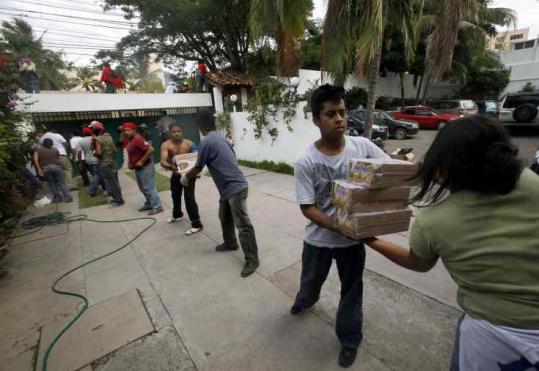
But life outside the gates of the two-story compound was almost back to normal: After days of paralyzing curfews, most children returned to school, planes began landing at the airport, borders were open and downtown streets were again crammed with taxis, buses and vendors hawking newspapers, snacks and bubble gum.

The government, however, declared a partial curfew for border areas and the northern industrial city of San Pedro Sula, the country's second-largest city, from late Thursday until Friday morning.

Zelaya was kicked out of Honduras on June 28 after the Supreme Court endorsed charges of treason and abuse of authority against the leader for repeatedly ignoring court orders to drop plans for a referendum on whether the constitution should be rewritten.

Micheletti has pledged to arrest Zelaya if he leaves the embassy.

International leaders, including Brazilian President Luiz Inacio Lula da Silva and U.S. President Barack Obama, have called for Zelaya's reinstatement ever since he was ousted, and his surprise arrival in Honduras has prompted new calls for Micheletti to step down.

The UN Security Council scheduled consultations for Friday on a letter from Brazil seeking an emergency meeting on Honduras.

Rene Zepeda, the interim government's information minister, said Honduras has no intention of breaking ties with Brazil so it can go after Zelaya inside the compound.

But he added: "Brazil should make Zelaya be quiet and provide the conditions so that he can dialogue with our government instead of unleashing violence in Honduras."

About 3,000 Micheletti supporters marched toward the Brazilian Embassy and stopped in front of soldiers guarding the compound Thursday. Pro-Zelaya protesters held marches in working-class neighborhoods.

Micheletti has said the conflict will be resolved when Hondurans elect their next leader Nov. 29, although the U.S. and other countries have said they may not recognize the vote if Zelaya is not reinstated.

Former U.S. President Jimmy Carter, whose nonprofit center in Atlanta is dedicated to resolving conflicts, has been in touch with the Honduran government to express concern about the current situation, Carter Center spokeswoman Deanna Congileo told The Associated Press in an e-mail.

Micheletti invited the Nobel Peace laureate to mediate new talks but Congileo said Carter is simply supporting efforts made by the Organization of American States and Costa Rican President Oscar Arias -- another Nobel Peace laureate who moderated previous U.S.-backed talks.

Those negotiations broke down after Micheletti's government refused to accept a plan that would allow Zelaya to return to the presidency with limited powers and prohibit him from attempting to revise the constitution. Zelaya's term ends in January.

Home Sales Fall After 4 Months of Increases


Home resales dipped unexpectedly last month, falling 2.7 percent from a month earlier, the National Association of Realtors said Thursday, reversing steady monthly gains since April. Most economists, however, called the drop temporary and said they expected sales to strengthen later this fall.

"It doesn't change the underlying trend of improvement," said Dean Maki, chief U.S. economist at Barclays Capital.

But even if sales do turn upward again, Maki and other economists don't predict prices will follow. Though prices have stabilized this summer, many economists are forecasting a downward turn over the fall and winter and expect prices to finally hit bottom early next year.

Compared with a year ago, home sales are up 3.4 percent, and the inventory of unsold homes has been whittled down to an 8.5 month supply at the current sales pace. That's the lowest level in more than two years.Fewer foreclosures have been coming on to the market in Phoenix, for example, cutting down the number of homes for sale from around 54,000 last year to about 31,000 today, said Floyd Scott, broker-owner of Century 21 Arizona-Foothills.

Sales this month should be ahead of August, Scott says. But he wonders whether they will drop after the Nov. 30 sunset of a tax credit of up to $8,000 for first-time homebuyers.

"It will be interesting to see what happens sometime around the first or second week of October," he said.

In Washington, real estate agents and home builders are lobbying hard for an extension of the credit. Without it, they argue, the housing market will take a sharp turn for the worse.

First-time buyers purchased almost one in three homes in August. Together with investors snapping up foreclosures, they have provided most of the momentum in the market this year.

"Prices have just gotten so low in some places that investors can't resist," said Dave Denslow, an economics professor at the

Fed Slows Housing Market Plan; Rates to Stay Low


Signaling confidence in a recovery, the Federal Reserve decided Wednesday to stretch out the pace of a program intended to lower mortgage rates and prop up the housing market.

Even so, rates on home loans are expected to remain low.

To foster the recovery, the Fed also decided to hold the target range for its key bank lending rate at a record low of between zero and 0.25 percent.

Stocks fell as a brief rally followed the Fed's statement and then faded. The Dow Jones industrial average came within 82 points of crossing 10,000 for the first time since October but ended with a loss of 81.

Stocks often trade erratically on days when the Fed issues policy decisions as investors pore over the statement. Some analysts said the Fed's statement was anticipated and didn't give the market enough reason to go higher — especially with stock indicators up more than 50 percent from their March lows."The market got exactly what it was expecting," said Thomas Wilson, a managing director at Brinker Capital in Berwyn, Pa.

Wilson cautioned, though: "I think there is a real concern out there that this is just a head fake and the stimulus out there is temporary," pointing to the Fed's slowing of its purchases of mortgage-backed securities.

With the economy on the mend, the Fed said it now plans to reach its goal of buying $1.45 trillion in mortgage-backed securities and debt by the end of March, rather than by the end of this year as originally scheduled. It's the second time since August that the Fed has opted to slow emergency programs designed to encourage spending and boost the economy.

Those decisions show Fed Chairman Ben Bernanke and his colleagues are shifting from managing the financial and economic crises to nurturing a budding recovery.

In a far brighter assessment, Fed policymakers said: "Economic activity has picked up following its severe downturn." In August, policymakers had said economic activity was "leveling out."

Obama Economic Adviser Doubts President's Plan


White House adviser Paul Volcker today criticized the Obama administration's sweeping financial regulatory reform proposals, specifically one that he warned could lead to future bailouts by designating certain firms as "too big to fail." In testimony prepared for a hearing Thursday morning before the House Financial Services committee, the former Federal Reserve chairman expressed doubts about the administration's proposal to designate certain firms that pose a threat to financial stability, subject them to stricter supervision, and make them submit resolution plans in the event of failure. "The clear implication of such designation whether officially acknowledged or not will be that such institutions, in whole or in part, will be sheltered by access to a Federal safety net in time of crisis; they will be broadly understood to be 'too big to fail'," Volcker said.

This designation, Volcker said, will only serve to encourage more risk-taking, thereby leading to even worse crises in the future. "What all this amounts to is an unintended and unanticipated extension of the official 'safety net,' an arrangement designed decades ago to protect the stability of the commercial banking system," Volcker stated. "The obvious danger is that with the passage of time, risk-taking will be encouraged and efforts at prudential restraint will be resisted. Ultimately, the possibility of further crises – even greater crises – will increase."

This approach, he predicted, will adversely affect both the firms that fall into the "too big to fail" category as well as the firms that do not.

"In fair financial weather," Volcker said, "the important institutions will feel competitively hobbled by stricter standards. In times of potential crisis, it would be the institution left out of the "too big to fail" club that will fear disadvantage."

Iran running second uranium enrichment facility


Iran is under three sets of UN Security Council sanctions for refusing to freeze enrichment. The officials said that Iran revealed the existence of a second enrichment plant in a letter sent on Monday to International Atomic Energy Agency chief Mohamed ElBaradei.

It had previously said it was operating only one plant, which is being monitored by the IAEA.The Islamic Republic insists that it has the right to the activity to generate fuel for what it says will be a nationwide chain of nuclear reactors.

But because enrichment can make both nuclear fuel and weapons-grade uranium, the international community fears Tehran will use the technology to generate the fissile material used on the tip of nuclear warheads.

The revelation further burdens the chances of progress in scheduled Oct 1 talks between Iran and six world powers.

At that planned meeting – the first in more than a year – the five permanent UN Security Council members and Germany will be pressing Iran to scale back on its enrichment activities. But Tehran has declared that it will not bargain on enrichment.

The officials said that the letter contained no details about the location of the second facility, when it had started operations or the type and number of centrifuges it was running.

The government officials – one speaking from his European capital outside Vienna, the other a diplomat in Vienna from a country accredited to the IAEA – demanded anonymity Friday because their information was confidential. One said he had seen the letter.

The other told the AP that he had been informed about it by a UN official who had seen it.

While Iran's mainstay P-1 centrifuge is a decades-old model based on Chinese technology, it has begun experimenting with state-of-the art prototypes that enrich more quickly and efficiently than its old model.

UN officials familiar with the IAEA's attempts to monitor and probe Iran's nuclear activities have previously told the AP that they suspected Iran might be running undeclared enrichment plants.

The existence of a secret Iranian enrichment program built on black market technology was revealed seven years ago. Since then the country has continued to expand the program with only a few interruptions as it works toward its aspirations of a 50,000-centrifuge enrichment facility at the southern city of Natanz.

The last IAEA report on Iran in August said Iran had set up more than 8,000 centrifuges to churn out enriched uranium at the cavernous underground Natanz facility, although the report said that only about 4,600 of those were fully active

Iran 'has second enrichment site'


Tehran made the announcement earlier this week in a letter to International Atomic Energy Agency (IAEA) chief Mohammed ElBaradei.

Iran has previously acknowledged it has one enrichment plant at Natanz, which IAEA inspectors are monitoring.

The US, UK and France are set to accuse Iran of concealing the plant later on Friday, media reports say.

They and other Western nations have long feared that Iran is planning to develop an atomic weapon.

Tehran has always insisted its programme is for peaceful means.

Iran is supposed to have stopped all enrichment under threat of sanctions from the UN Security Council.

News of the Iranian letter comes days before Iran is due to enter fresh talks over its controversial nuclear programme.

'Comprehensive' talks

The IAEA confirmed it received a letter from Iran on Monday informing it that "a new pilot fuel enrichment plant is under construction".

Iran told the agency that no nuclear material had been introduced into the plant, and enrichment levels would only be high enough to make nuclear fuel, not a bomb.

In response, the IAEA has requested Iran to "provide specific information and access to the facility as soon as possible", an IAEA statement adds.

Earlier, the New York Times quoted US officials as saying that the secret site - built inside a mountain near the ancient city of Qom - is not yet complete, but could be ready for operation next year.

It said the facility is believed to be capable of holding some 3,000 centrifuges, the machines that enrich uranium for electricity or, at higher levels of enrichment, for a bomb.

This development will encourage fears that Iran has other secret facilities that could be used to make a nuclear bomb, the BBC's Tehran correspondent, Jon Leyne, says in London.

Natanz, some 250km (150 miles) south of Tehran, had been kept secret until its existence was revealed by exiled groups several years ago, he adds.

In a report of its visit to Natanz in August, the IAEA said the site was operating 4,592 centrifuges and a further 3,716 were installed.

It said work on the first of two production halls for centrifuges, Iran had previously told inspectors it was planning, was nearly complete.

Iran has been under months of pressure to accept US President Barack Obama's offer of talks on its nuclear ambitions.

Earlier this month, Tehran agreed to "comprehensive" talks on a range of security issues - but made no mention of its own nuclear programme.

The talks are due to be held in Geneva on 1 October with Tehran and the five permanent UN Security Council members - US, UK, Russia, China and France - plus Germany.

President Obama has hinted at pursuing tougher sanctions against Tehran if progress over the crisis is not made.

Russia recently signalled it might be prepared to soften its opposition to further sanctions against Iran, although China has said such pressure would not be effective.

Analysis: Movement but no grand bargain with Iran


NEW YORK -- In diplomatic parlance, it's called "movement" - a small step here and there in the direction of a deal but with an uncertain end. Those stirrings of motion may be what are now emerging with international efforts to ensure that Iran does not build a nuclear bomb.

After a week of meetings aimed at thwarting Iranian nuclear ambitions, there are hopeful hints of movement between the U.S. and its partners and even signs of openness from Iran. But it's hard to see that yielding a grand bargain anytime soon.

Among the positive steps: After years of resisting negotiations, the Iranians have agreed to meet with officials of the U.S. and five other world powers in Geneva next week. Nuclear issues are on the agenda, but Iran says that doesn't include its own nuclear program.

President Barack Obama also won a new measure of Russian support - at least rhetorically - for imposing tougher international sanctions to squeeze Iran in the months ahead if the Geneva talks lead to a dead end.

A week after Obama pleased Russia by scaling back a Bush-era missile shield proposal for Europe, Russian President Dmitry Medvedev responded by suggesting his government might look favorably at stiffening sanctions if Iran proves unreceptive.

China, however, whose cooperation on sanctions enforcement also would be important, remains publicly opposed to threatening penalties and threw a damper on any support.

"China always believes that sanction and pressure should not be an option and will not be conducive to the current diplomatic efforts over the Iran nuclear issue," said Chinese Foreign Ministry spokeswoman Jiang Yu.
ad_icon

China and Russia are essential for sanctions to succeed because of their large and growing trade and investment interests in the Gulf region. China, which depends on foreign imports for about half its oil, counts Iran as its third-largest supplier. It also sells weapons to Iran, and the Pentagon said earlier this year that some were ending up with terrorist groups in Iraq and Afghanistan.

Even with support for sanctions still uncertain, Iran seemed to set a softer tone during the U.N. General Assembly this week. President Mahmoud Ahmadinejad told The Associated Press his government will not stand in the way of "free and open" discussion of nuclear issues at the Geneva talks.

The next day, he indicated for the first time that Tehran would be willing to have its nuclear experts meet with Western scientists. Protests outside Ahmadinejad's hotel hinted at a strong factor in Iran's sudden flexibility - the regime may be more inclined to deal in light of the domestic upheaval still simmering after the disputed June presidential election and the government's crackdown.

Time is a crucial factor for all the parties. The longer a stalemate or standoff continues, the closer Iran is likely to get to having the capacity to build a nuclear bomb - although the Tehran government insists the U.S. and others are wrong in claiming it intends to go nuclear.

The New York Times reported Friday that Obama, along with the leaders of Britain and France in Pittsburgh for the G-20 economic summit, will accuse Iran of building a covert underground plant to produce nuclear fuel.

Ontario has become the first province to delay seasonal influenza vaccines to most residents because of the threat posed by swine flu. The decision,


Ontario has become the first province to delay seasonal influenza vaccines to most residents because of the threat posed by swine flu.

The decision, announced Thursday, comes as public health officials across the country are reconsidering their immunization plans in light of unpublished Canadian studies that suggest earlier seasonal flu shots raise the risk of contracting the pandemic H1N1 flu virus.

“Is it typical that we adjust our programs?” said Arlene King, Ontario's chief medical officer of health. “No, it isn't typical, but we are not dealing with a typical flu season this year.”

Ontario's program is based on a calculation that swine flu will sicken more people than seasonal influenza this fall and winter. Despite hopes for a pan-Canadian vaccination strategy, the province's approach is different than those in other provinces.

Alberta, Saskatchewan, Manitoba and New Brunswick are planning to widely offer seasonal flu shots next month, before swine flu vaccines, expected in November, become available.

“We are going to try to do it very fast and then focus on H1N1,” said John Tuckwell, an Alberta Health spokesman.

In New Brunswick, the seasonal flu vaccine is already being sent to doctors and should arrive in the next week. Once supplies run out, no more will be produced as the focus shifts to preventing swine flu.

“We want to avoid having both vaccines circulating at the same time in total confusion at the level of the public,” said Dr. Paul Van Buynder, New Brunswick's deputy chief medical officer of health.

Other provinces, including British Columbia and Quebec, have not yet decided how to roll out their vaccination campaigns.

“We have all the scenarios on the table,” said Karine White, a spokeswoman for the Quebec Health Ministry. “Right now, it seems like H1N1 is the major flu virus.”

The provinces' plans come amid signs that the flu season has started several weeks before a swine flu vaccine is ready. Hundreds of students in B.C. were absent from school this week, either because they are sick or their parents want to protect them from falling ill. The H1N1 virus has been confirmed in students in two Vancouver schools and one on Vancouver Island, and test results from a fourth school are expected as early as Friday.

Ontario's plan involves three waves of vaccinations. Seasonal flu shots will be offered starting next month to people aged 65 and older and to residents of long-term-care homes, who have largely been spared by swine flu. Once available, H1N1 vaccines will be provided to at-risk groups, including young children, pregnant women and people with chronic health problems, followed by the general population. Finally, seasonal flu shots will be offered to all Ontarians in December or January.

The approach is borne out of several considerations, including the epidemiology of the H1N1 virus and the unpublished research from B.C., Ontario and Quebec that appears to suggest that people who received a flu shot last year are about twice as likely to contract swine flu. The studies are undergoing fast-tracked peer review. Researchers in the United States, Britain and Australia have not found the same link.

In addition, immunity to both seasonal and swine influenza will require up to three separate vaccinations. Ongoing clinical trials are determining whether H1N1 immunity can be achieved in one or two doses.

Allison McGeer, an infectious diseases expert at Toronto's Mount Sinai Hospital, said Ontario's compromise makes sense.

“It's a reasonable balance,” she said. “[But] it has some obvious logistical challenges.”

Timeline of Events


Feb. 18 White House counsel Gregory B. Craig becomes the first high-level administration official to visit Guantanamo. The same day, a federal appeals court blocks the transfer of Uighur detainees there into the United States.

Feb. 23 Administration transfers first detainee, sending Binyam Mohamed to Britain.

May 15 Pentagon seeks continuance in several military commission proceedings. The White House announces that it will reform the military commissions process, including revising rules for hearsay and evidence obtained through torture. The same day, detainee Lakhdar Boumediene, an Algerian national, is transferred to France.

May 20 Senate votes 90 to 6 to forbid any transfers of detainees to the U.S. mainland. The legislation also rejected Obama's request for $80 million to build a holding facility for detainees inside the United States. The same day, in congressional testimony, FBI Director Robert S. Mueller III warns against moving detainees to the United States. May 21 In an address at the National Archives, Obama says that the Guantanamo prison has weakened national security and that the cost of keeping it open exceeds the complications of closing it.

Late May Obama taps senior adviser Pete Rouse to begin coordinating efforts on Guantanamo for the White House.

June 3 Washington Post-ABC News poll finds 50 percent of those surveyed do not approve of closing the facility, up significantly from a Pew poll in February.

June 9 Detainee Ahmed Khalfan Ghailani is transferred to New York to face terrorism charges stemming from his involvement in 1998 bombings in East Africa.

June 11 Four Uighurs are transferred from Guantanamo to Bermuda; one detainee is sent to Chad and another to Iraq. The next day, three detainees are transferred to Saudi Arabia.

June 25 Obama signs an appropriations bill forcing the administration to report to Congress before moving detainees and preventing the White House from using available funds to move detainees onto U.S. soil. The provisions expire Oct. 1 but can be renewed.

July 22 Justice Department announces that it will delay recommendations on new detention policy by 180 days.

Aug. 24 One detainee is transferred to Afghanistan.

Aug. 28 Two Syrian detainees are transferred to Portugal.

Sept. 23 Senior administration officials say they are close to completing a review of all remaining 226 detainees. As many as 60 could be held indefinitely without charge or trial.

G20 to police new world economic order


The move means the G20 supplants the G7 and G8 - institutions dominated by rich Western economie, which will now remain forums for discussing geopolitical issues, diplomats said.

In another boost for countries such as China, the G20 unexpectedly reached a deal on reshaping the International Monetary Fund to shift more voting power to some developing countries. The deal recognized their growing economic clout and the vital role they must play in helping the world economy climb out of the the worst recession in generations.

Currently, China wields 3.7pc of IMF votes compared with France's 4.9pc, although the Chinese economy is now 50pc larger than that of France.

G20 leaders pledged in a draft statement to keep some stimulus supports in place until a recovery is clearer.

They also agreed to rein in financial industry excesses that led to the credit crisis, which first erupted in 2007, and to work together to tighten rules on how much capital banks must keep on hand to absorb losses.

The final version of the communique will be issued when the leaders wind up their meeting on Friday evening.

Man charged with conspiracy in US terrorism investigation


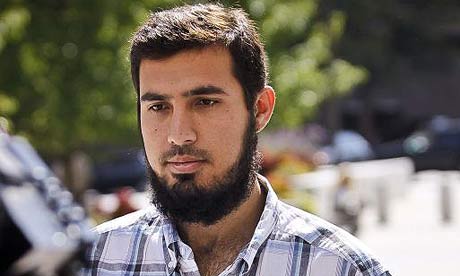
A young Afghan immigrant, Najibullah Zazi, has been charged with conspiracy to use weapons of mass destruction in what investigators suspect was a plot to bomb New York's transport system.

According to the indictment against Zazi issued today, the 24-year-old airport bus driver spent the past year plotting the attacks but in the past fortnight began "urgently" looking for help to manufacture explosives and had recently bought bomb-making supplies from beauty stores. He is also alleged to have obtained instructions on how to make explosives and made notes on them that included the specifications for the bombs used in the 2005 attacks on the London Underground and the attempt by the alleged "shoe bomber", Richard Reid, to blow up a transatlantic flight.

Zazi, who had lived in the US for 10 years, has denied the accusations. He faces up to life in prison if convicted.

According to court papers, Zazi "and others" travelled to Pakistan a year ago.

"Zazi received detailed bomb-making instructions in Pakistan, purchased components of improvised explosive devices, and travelled to New York on 10 September 2009 in furtherance of his criminal plans," court papers say.

On returning from Pakistan earlier this year, Zazi moved to Colorado where he is alleged to have rented a hotel suite this month and used the kitchen to attempt to mix explosives. FBI tests found residue of bomb-making ingredients in the vent above the stove but searches of several properties have not turned up any explosives.

Zazi and unnamed associates are alleged to have bought unusually large amounts of hydrogen peroxide and acetone products from beauty supply stores around Denver over several weeks. The papers also say that Zazi searched the internet for home improvement stores in Queens, a New York borough, and then looked to see if the store stocked another explosive component, muriatic acid.

Shortly afterwards, Zazi rented a car and drove to the city. Bomb-making notes were also found on the accused man's laptop in the car, according to the court document, including information about heating bomb components to make them highly concentrated. The court papers say that on 6 and 7 September, Zazi attempted to communicate with another person "seeking to correct mixtures of ingredients to make explosives".

"Each communication," the papers say, was "more urgent than the last."

The court papers do not specify the targets Zazi is alleged to have planned to attack but the US press has reported FBI agents as saying they believe that the New York subway train system was a likely target. They say the discovery of backpacks and mobile phones suggest that Zazi was planning an attack similar to the bombings of the London Underground and trains in Madrid.

Zazi was originally arrested in Denver with his father, Mohammed, 53, and a New York City imam, Ahmad Wais Afzali, on charges of lying to federal anti-terrorism investigators about bomb-making literature.

The New York Times reported today that investigators were forced to move against Zazi earlier than they had wished after a second anti-terrorist force indirectly tipped him off that he was being monitored by approaching the imam for assistance.

The arrests were followed by warnings of possible attacks on transit, sports and entertainment complexes.

In a memorandum prosecutors filed in court seeking to deny Zazi bail they say that he was intent to the last on carrying out an attack.

"The evidence at trial will show that Zazi remained committed to detonating an explosive device up until the date of his arrest," the prosecutors say.

The US attorney general, Eric Holder, said today that "any imminent threat" from the plot has "been disrupted".

"We are investigating a wide range of leads related to this alleged conspiracy, and we will continue to work around the clock to ensure that anyone involved is brought to justice," Holder said.

"We believe any imminent threat arising from this case has been disrupted, but as always, we remind the American public to be vigilant and to report any suspicious activity to law enforcement."

The heart and soul that made the 1980 original so compelling has been shredded in this version.


Call the coroner. Then call in the top teams from "CSI," and that sexy pair from "Bones" while you're at it, because if ever there was a crime scene that should be yellow-taped and relentlessly investigated this is it.

Someone has driven a stake through the heart and ripped out the soul of the 1980 original. The responsible parties, make that irresponsible parties, should be found, thrown in movie jail and not allowed within 50 feet of a set again. Ever.

Gone is almost every shred of the gutsy, gritty script that Christopher Gore wrote. It would earn him an Oscar nomination, one of six that "Fame" would get, which should have been a clue to the team on the remake that maybe, just maybe, he had something there. (The film would go on to win two for song and score and launch the career of singer-songwriter Irene Cara.)

Gore's script distinguished itself with angst-filled back stories of the kids who made it into the highly competitive New York City High School of Performing Arts, stories that would, sadly enough, still have been relevant today: the brilliant dancer who can't read; the gay actor's painful coming out; the domineering stage mother; the interracial romance; the ballerina's unwanted pregnancy; the dignity stripped, literally and figuratively, from a young hopeful in a dirty hotel room in front of a camera; the stand-up wannabe seduced by fame, betrayed by drugs.

Though the remake uses the same blueprint -- starting with the auditions and then chaptering the story from freshman year through graduation -- the sense of change and evolution that should come with those years has gone missing here.

Whether it was the PC police working to ensure that PG rating or too many notes from the suits who couldn't distinguish between the baby and the bathwater, Allison Burnett's watered-down screenplay offers up a vacuous teenage wasteland rather than a rich coming-of-age story.

Instead, the performing arts school whose seething talent spilled out of the classrooms and onto the streets with such force in director Alan Parker's hands is left gasping for breath. The friendships, the friction, all the painful figuring out who you are of high school has apparently been stuffed into a third-floor locker and forgotten. The lesson here? Performance is not enough, we have to care about the characters, something even the countless spawn of "Fame" -- including "American Idol" and "Project Runway" -- learned early on.

Sadder still, first-time director Kevin Tancharoen, 25, and director of photography Scott Kevan have given us a great-looking film, albeit a Rudy Giuliani vision of New York City. Everything is pristine, from the kids to the classrooms to the subways. Even the streets have been emptied. Though the grime, the taxis and the crowds are gone, it is a spare beauty that the filmmaker uses well.

Tancharoen has a real feel for the performance pieces too, and it is in the dance scenes that the film ignites. Modern dancer Kherington Payne is even more mesmerizing on the big screen than she was last year in "So You Think You Can Dance." The director makes the most of that extraordinary body in motion with a stripped-down staging.

But it is Naturi Naughton as Denise, a classical pianist turned rocker over the protests of her father, who is the showstopper. Put a piano in front of her or a microphone in her hand and you believe that a star is being born right in front of you, which is exactly the emotional note the film is supposed to play from start to finish. If you happened to catch Naughton earlier this year as Lil' Kim in the biopic "Notorious," an under-the-radar film that traced the short life and violent death of rapper Biggie Smalls, her turn in "Fame" will serve only as confirmation of a talent who will hopefully be around for a very long time. For everyone else, she is "Fame's" brightest star.

There are other kids who emerge out of the ether -- Collins Pennie as actor-rapper Malik brings a kind of dramatic resonance to the role that leaves you feeling the film just scratched the surface of his potential. And Asher Book, not one of the five featured actors, may well turn out to be the sleeper surprise of the bunch with an appealing, low-key Zac Efron vibe about him.

Unfortunately, the other central characters prove to be forgettable, with performances that would have gotten them kicked out of the real NYC school. As for the faculty, with the exception of drama teacher Charles Dutton and one song by Megan Mullally, which is a lot of fun but makes absolutely no sense at all as part of the story, the teachers, especially Kelsey Grammer and Bebe Neuwirth, feel like day players -- such a waste.

So unless you are one of those types who always slows down at accident scenes, consider leaving it to the detectives to solve the sad case of "Fame." If there's a trial, we'll let you know.

Pressure grows on Iran as UN passes 'historic' nuclear resolution


Pressure mounted on Iran yesterday to halt its nuclear programme as world leaders at the United Nations warned of the threat posed by Tehran to a global consensus on disarmament.

President Obama praised the unanimous passing of a “historic” UN Security Council resolution aimed at ridding the world of nuclear weapons — but the spectre of the unsolved crisis over Iran’s nuclear ambitions loomed over the meeting, prompting President Sarkozy of France to caution against symbolic gestures at the expense of tough action.

“We’re living in the real world,” Mr Sarkozy said, turning to face Mr Obama, the first US president to chair the Security Council. “President Obama has said himself, ‘I dream of a world without nuclear weapons’. But two countries are doing the exact opposite right now. There will come a moment when we’ll have to agree and take sanctions.”

Gordon Brown said that the Iranian nuclear crisis was coming to a head and indicated that “far tougher sanctions” must await Iran if it failed to answer international concerns at a pivotal meeting with Western powers next week. The calls to action came a day after Russia finally conceded that sanctions may be inevitable, after intense lobbying by the Americans. Iran reacted angrily to the British and French statements, saying the assertion that it was covertly developing nuclear weapons was “totally untrue and without any foundation”. Earlier this month, however, the UN nuclear watchdog admitted it could not rule out a military dimension and said Western intelligence on an Iranian weapons programme was “compelling”.

Russia’s apparent shift robs Tehran of one of its most entrenched supporters. Israel, which has warned that it will attack Iran if the international community’s efforts prove ineffective, hailed the Russian shift. “This may be the day that marks the beginning of the United Nations and the people gathering together to stop the Iranians,” Daniel Ayalon, the Deputy Foreign Minister, said.

In his Assembly address, however, Binyamin Netanyahu, the Israeli Prime Minister, bluntly challenged the international community to stop Iran acquiring nuclear weapons. “Is the Security Council up to that?” he asked.

China remains the last of the five permanent members of the Security Council opposed to sanctions — and it voiced that position from Beijing yesterday. It might, however, be reluctant to veto a vote backed by Russia and could yet be persuaded to simply abstain.

The aligning of world powers behind tough action on Iran sets the scene for a showdown in Turkey on October 1, when representatives of the “E3 plus 3” — the five veto-wielding powers and Germany — meet Iranian officials in the first direct talks between the US and Iran in 30 years.

The E3 plus 3 issued a statement after Wednesday’s meeting saying that they expected a “serious response” to their questions over military dimensions to Tehran’s nuclear programmes and that the answers would determine the course of action ahead — including possible tough sanctions.

Iran, however, is “giving very little away” about how it intends to respond, David Miliband, the British Foreign Secretary, told The Times after a meeting with his Iranian counterpart.

Yesterday the Iranian mission to the UN announced that it was committed to talks and global nuclear non-proliferation but said that negotiations would fail if its interlocutors persisted with “illegal demands”. Iran regards the demand for it to stop enriching uranium as a breach of its right to develop a civilian nuclear programme for the production of energy.

“The Islamic Republic of Iran reiterates its readiness to engage in serious and constructive negotiations with interested parties,” the mission said after the Security Council debate. “At the same time, we believe that as a prerequisite for success in future negotiations, futile and illegal demands of the past years that have proven to be of no avail should be abandoned.”

In an interview on the Assembly sidelines, however, President Ahmadinejad indicated that he planned to stretch the negotiations by demanding that Western powers supply him with highly enriched uranium. The E3 plus 3 say they will help Iran with its civilian nuclear energy programme if it stops enrichment and satisfies concerns over nuclear weapons.

Mr Ahmadinejad insisted that he wanted uranium enriched to 20 per cent only — well below the 90 per cent required for weapons — for a small research reactor. Current UN sanctions forbid the sale or transfer of nuclear goods or technology to Iran and until now it has produced only low-enriched uranium. A refusal to bend the sanctions rules could be used as a pretext for Iran to produce its own highly enriched material.

Advocates of non-proliferation warned that a failure to confront Iran and North Korea over their nuclear programmes could derail the larger global disarmament effort passed with such fanfare yesterday. The largely symbolic resolution endorses a global effort to lock down vulnerable nuclear materials and strengthens the Non-Proliferation Treaty. Russia and the US are also expected to agree, by the end of the year, on reductions to their nuclear arsenals.

Dialogue commences in Honduras crisis


TEGUCIGALPA, Honduras - Ousted President Manuel Zelaya of Honduras said yesterday that he has met with an interim government official and begun a dialogue aimed at ending the country’s protracted political crisis.
Discuss
COMMENTS (0)

Zelaya told Radio Globo that he met Wednesday night with an official of the temporary government that forced him out of Honduras at gunpoint June 28, but he wouldn’t name the official.

In an interview with the radio station yesterday, Zelaya said the two sides made no progress, but he called the meeting “the beginning to find peaceful solutions.’’ He plans to meet with business and social leaders this week.

Zelaya had been demanding to talk with interim President Roberto Micheletti since Monday, when he sneaked back into the country and took shelter at the Brazilian Embassy.

Micheletti’s government did not immediately comment yesterday.

Troops still surrounded the embassy, where an increasingly exhausted Zelaya, his family, and about 70 supporters remained sheltered. But life outside the gates of the two-story compound was almost back to normal yesterday: As the government lifted curfews that had paralyzed the capital for nearly three days, most children returned to school, airplanes began landing at the airport, borders were open, and downtown streets were again crammed with taxis, buses, and vendors

Some schools remained closed, but the busy streets were a dramatic shift from the period beginning late Monday, when Hondurans had to scramble through looted stores for food and police blasted water cannons and tear gas at violent demonstrations.

“It feels excellent,’’ said Dagoberto Castillo, 27, a mechanic who opened his body-repair shop for the first time this week.

Zelaya was kicked out of Honduras after the Supreme Court endorsed charges of treason and abuse of authority against him for repeatedly ignoring court orders to drop plans for a referendum on whether the constitution should be rewritten.

A report by the US Library of Congress, released yesterday by Representative Aaron Schock, an Illinois Republican, found that Zelaya’s removal from office was legal but his expulsion from the country was illegal.

Schock said at a news conference yesterday in Washington that the interim government should allow Zelaya to leave the embassy, forgoing further punishment, and allow him to live as a regular citizen. He called on the Honduran government to issue a general amnesty for Zelaya and everyone else involved in the crisis.

Micheletti has pledged to arrest Zelaya if he leaves the shelter of the diplomatic mission.

Zelaya told Radio Globo in Honduras that “calm will not return to the country as long as its president is locked up.’’

International leaders, including President Luiz Inácio Lula da Silva of Brazil and President Obama, have called for Zelaya’s reinstatement ever since he was ousted, and his surprise arrival in Honduras has prompted new calls for Micheletti to step down.

Rene Zepeda, the interim government’s information minister, said Honduras has no intention of breaking ties with Brazil so it can go after Zelaya inside the compound.

But he added, “Brazil should make Zelaya be quiet and provide the conditions so that he can dialogue with our government instead of unleashing violence in Honduras.’’

Micheletti has said the conflict will be resolved when Hondurans elect their next leader Nov. 29, although the United States and other countries have said they may not recognize the vote if Zelaya is not reinstated.

G20 to become world's main economic forum


World leaders have announced that the Group of 20 developed and developing nations would become the top economic forum, spreading influence to emerging powers such as China and India.

The dramatic shift was announced by the White House as President Barack Obama hosted his first major summit in Pittsburgh, which was marred by occasional violence as anti-capitalist protesters clashed with police.

"Today, leaders endorsed the G20 as the premier forum for their international economic cooperation," said a statement which was realeased earlier today.

"This decision brings to the table the countries needed to build a stronger, more balanced global economy, reform the financial system, and lift the lives of the poorest." The G8, which included only wealthy nations Britain, Canada, France, Germany, Italy, Japan, Russia, and the United States, has served as the premier economic forum for decades and held closely watched annual summits.

The announcement came as G20 leaders closed in on a deal to tighten financial regulations after last year's meltdown, with China signalling emerging countries would be granted more clout on the IMF.

At the two-day summit in Pittsburgh, there was broad agreement on curbing bankers' bonuses and a Chinese central bank official even predicted a move on International Monetary Fund voting rights.

Xie Duo told journalists that developing countries had for too long been under-represented in international financial institutions like the IMF.

"We believe that at tomorrow's summit a very important political decision will be made on this matter," he added, on the sidelines of the summit.

G20 leaders have pledged to work for a comprehensive IMF reform and there is a long-term consensus on the need to address imbalances in voting power, but some European nations have balked at losing their influence.

For Brazil, China, India and other emerging countries, it is crucial to achieve a breakthrough in negotiations in Pittsburgh so the IMF can endorse the reform at its annual meeting on October 6 to 7 in Istanbul.

President Barack Obama and First Lady Michelle Obama opened the two-day summit with a gala dinner in Pittsburgh - chosen as host city to showcase its stunning economic transformation from down-at-heel steel town to high-tech hub.

The start of the gathering was marred by isolated incidents of violence as small groups of anti-capitalist protesters defied police warnings not to march on the summit venue.

Police fired pepper spray and non-lethal rounds and deployed loudspeakers blasting piercing sound waves to repel the mostly young protesters. Fifteen people were arrested, police said.

The G20 is a forum for the world's biggest developed and emerging economies and its meetings are a magnet for anti-capitalists opposed to what they see as an undemocratic body promoting globalization and free market policies.

The summit of the world's 19 biggest developed and emerging economies plus the European Union comes just over a year after a US credit collapse triggered a global economic slowdown.

It also comes six months after the same G20 chiefs met in London to coordinate their response to the crisis, and their performance in Pittsburgh will be judged in part on whether they have lived up to their earlier vows.

After a series of bilateral meetings with Japanese and Chinese officials, US Treasury Secretary Timothy Geithner said Europe and the United States were close to agreeing tough new rules on limiting bankers' bonuses.

In the run-up to the summit there was friction between Washington and some European capitals, with France and Germany in particular pushing for stricter caps on the pay-outs, which they say encourage excessive risks in trading.

"We actually are very close and I believe we are in the same place," Mr Geithner told reporters. "We want to have very strong standards to limit the risk."

Prime Minister Fredrik Reinfeldt of Sweden, who holds the rotating presidency of the European Union, took a similar line.

"I expect the G20 will make a clear statement about the need for global rules on bonuses and compensation, and I also expect broad agreement on how to strengthen supervision in general," he said.

Summit delegates have all pledged to take tough and lasting measures to bring order back to the markets, shore up failing institutions, save jobs and rekindle growth, but each arrives in Pittsburgh with their own priorities.

Chilling plot: suspect hit beauty stores for bomb supplies


An Afghan immigrant who received explosives training from al-Qaeda went from one beauty supply store to another, buying large quantities of hydrogen peroxide and nail-polish remover, in a chilling plot to build bombs for attacks on US soil, authorities said.

Najibullah Zazi, a 24-year-old shuttle driver at the Denver airport, was indicted in New York on charges of conspiracy to use weapons of mass destruction.

Investigators found bomb-making instructions on his computer's hard drive and said Zazi used a hotel room in Colorado to try to cook up explosives a few weeks ago before a trip to New York.

Over the past few days, talk of the possible plot set off the most intense flurry of national terrorism warnings in the US since shortly after the attacks in New York and Washington on September 11, 2001.

Prosecutors said they had yet to establish exactly when and where the Zazi attacks were supposed to take place. But Attorney-General Eric Holder said in Washington: "We believe any imminent threat arising from this case has been disrupted."

A law enforcement official said that Zazi had associates in New York who were in on the plot.

Zazi was arrested in Denver. He, his father and a New York City imam were charged with lying to investigators.

Authorities said in the past few days that they feared Zazi and others might have been planning to detonate home-made bombs on New York trains, and warnings went out to transit systems, stadiums and hotels nationwide.

Explosives built with hydrogen peroxide killed 52 people in the London transit system four years ago. They are easy to conceal and detonate and last week's warnings asked authorities to be on the lookout for them.

A law-enforcement official said on Thursday that authorities had been so worried about Zazi - and that his September 10 trip to New York City coincided with a visit by US President Barack Obama - that they considered arresting him as soon as he reached the city.

Zazi left a Denver court on Thursday without commenting and will be transferred soon to New York. He and his lawyer have denied he is a terrorist.

In two unrelated terrorism cases elsewhere around the US on Thursday:

- Michael Finton, a 29-year-old man who idolised American-born Taliban soldier John Walker Lindh, was arrested after attempting to detonate what he thought was a bomb inside a van outside a federal courthouse in Springfield, Illinois, officials said. FBI agents had infiltrated the alleged plot months ago.

- Two North Carolina men under arrest since July on international terrorism charges were also accused by prosecutors of plotting to kill US military personnel.

In the Zazi case, a government motion seeking to deny bail laid out a chronology of the alleged scheme, which prosecutors said had been in the works for as much as a year. The court papers filed in Brooklyn federal court also refer to "others" who bought bomb materials with Zazi.

According to prosecutors' account, Zazi - a legal US resident who immigrated in 1999 - began plotting as early as August 2008 to "use one or more weapons of mass destruction". That was when he and others travelled from Newark, New Jersey, to Pakistan, where he received the explosives training, prosecutors said.

Within days of returning from Pakistan in early 2009, he moved to the Denver suburb of Aurora, where he used a computer to research home-made bomb ingredients and to look up beauty supply stores where he could buy them, prosecutors said.

During the summer, Zazi and three unidentified associates bought "unusually large quantities" of hydrogen peroxide and acetone - a flammable solvent found in nail-polish remover - from beauty supply stores in the Denver area, prosecutors said.

A law-enforcement official said associates of Zazi visited Colorado from New York to help him buy the chemicals. The official, who spoke on condition of anonymity because the investigation continues, said they used stolen credit cards to make the purchases and then returned to New York.

Security video and receipts show that some of the purchases were made near a Colorado hotel, according to court papers. On September 6 and 7, Zazi checked into a suite at the hotel with a kitchen and a stove, the papers say.

He tried to contact an unidentified associate "seeking to correct mixtures of ingredients to make explosives".

"Each communication," the papers say, was "more urgent than the last ... Zazi reportedly emphasised in the communication that he needed the answers right away".

FBI explosives testing later found residue in the vent above the stove, authorities said.

On September 8, court papers say, Zazi searched the internet for home improvement stores in Queens before driving a rental car for a two-day trip to the city. The visit triggered a series of searches in Denver and New York City over the past two weeks.

Authorities seized backpacks, mobile phones and a scale in recent raids on a Queens neighbourhood that Zazi visited. And beauty supply store employees in New York and the Denver suburbs said authorities had been there recently asking whether anyone had come in buying a lot of hydrogen peroxide or acetone.

Zazi's father, Mohammed Wali Zazi, and the imam, Ahmad Wais Afzali, also appeared in court on Thursday.

Mohammed Zazi, 53, was ordered to be freed under court supervision in Denver until an October 9 hearing. Afzali, who was accused of tipping off the Zazis to the federal probe against them in a tapped telephone call, was released in New York on bail of $US1.5 million ($1.7 million).

Afzali's attorney, Ron Kuby, denied his client knew anything about a plot.

"Obviously, the Government would not be consenting to bail if it thought he was involved in a terrorism conspiracy," he said.

California Gubernatorial Hopeful Vows to Reverse Emissions Rules


Margaret C. Whitman, the former chief executive of eBay who declared her candidacy for the California governorship on Tuesday, hopes to roll back California’s law requiring deep cuts in the state’s greenhouse gas emissions.

“As governor, I would work hard to protect our environment,” Ms. Whitman said Wednesday, according to The San Diego Union Tribune. “But the needs of our environment have to be balanced with the needs of our people and the needs of our economy. We have too many overreaching environmental regulations that have left us at an economic disadvantage to our neighboring states.”

Ms. Whitman, a Republican, is in the race to replace the current governor, Arnold Schwarzenegger, whose term is expiring.

Mr. Schwarzenegger signed the law requiring the emissions cuts in 2006.

Ms. Whitman’s chief Democratic opponent at the moment, Gavin Newsom, the mayor of San Francisco, wrote in CleanTechnica today that Ms. Whitman’s proposal amounted to “backwards thinking.”

On the third anniversary of the new emissions rule’s passage, Mr. Newsom wrote, “we should acknowledge that its oft-vilified targets are not only achievable but also actually good for California’s economy.”

Mr. Newsom’s environmental initiatives include requiring a sharp increase in recycling and composting in San Francisco. He also praised the San Francisco Airport’s installation last week of carbon offset kiosks, which enable travelers to invest in tree-planting and other projects intended to offset the greenhouse gas emissions associated with their flights.

Papas star 'slept with daughter'


Mackenzie Phillips, a former child TV star, alleges the incestuous liaison - disclosed in her recently published memoir - began in 1979 when she was 19.

Speaking on The Oprah Winfrey Show, she said the relationship was a "betrayal".

Phillips' claims have been disputed by Genevieve Waite, her father's wife at the time of the alleged abuse.

In a statement read out by Winfrey, she said John Phillips was "incapable, no matter how drunk or drugged he was, of having such a relationship with his own child."

Mackenzie Phillips starred in 1970s sitcom One Day at a Time and appeared in George Lucas's 1973 film American Graffiti.

The 49-year-old has a long history of drug abuse and was arrested for possession of cocaine and heroin last year.

'Abuse of power'

In her book, entitled High on Arrival, she alleges she first had sexual intercourse with her father on the night before she was to be married to a member of the Rolling Stones' entourage.

"I woke up that night from a blackout to find myself having sex with my own father," she writes.

Phillips describes those first sexual encounters as rape - but says the relationship later became consensual and ended when she fell pregnant. She was unsure who had fathered the child and claims to have had an abortion paid for by her father.

"I never let him touch me again," she told Winfrey, calling the alleged incest "an abuse of power".

But she said she forgave her father on his deathbed in 2001, describing him as "very tortured man".

John Phillips married four times, having Mackenzie - his oldest daughter - with his first wife Susan Adams.

He formed the Mamas and the Papas with his second wife Michelle, whom he divorced in 1970.

In a statement, Michelle Phillips said her stepdaughter's public disclosure was "an unfortunate circumstance" and "very hurtful for our entire family".

One of the most popular bands of the 1960s, the Mamas and the Papas are best known for their hits California Dreamin' and Monday, Monday.

Mackenzie Phillips' half-sister Chynna had pop success with 1990s group Wilson Phillips.

$35B Air Force tanker competition set to reopen


The Pentagon has tried and failed twice to award a contract to replace its Eisenhower-era fleet of tankers that refuel military planes in flight. The last attempt in early 2008 was overturned on appeal and led Pentagon leaders to temporarily revoke the Air Force's authority to award a contract. The 2004 award to Boeing was undone by an ethics scandal that resulted in prison terms for a former company executive and a former high-ranking Air Force official.

"After eight years, we can finally get on with this program," Rep. John Murtha, D-Pa., said Thursday.

Murtha chairs the House Appropriations subcommittee on defense. He was one of several lawmakers briefed by Air Force Secretary Michael Donley and other Pentagon officials on the latest request for bids -- due out Friday -- on the tanker competition.

The Pentagon's briefing materials said the Air Force is seeking to reduce the number of requirements to replace its aging tankers to 373 from 800, in a bid to make the process more transparent.

"This time we will be crystal clear about what we want and what the bidders need to do to win," according to the briefing.

The department also changed course on two other issues. The winner will be based on "best value" and not price, and the deal will be a fixed-price contract. The switch from a cost-plus pact means the contractor will be paid a negotiated amount regardless of extra expenses.

"At this point, neither (company) knows enough about the selection process to figure who is better off with the new terms," said Loren Thompson, a defense consultant for the Lexington Institute.

Richard Aboulafia, aerospace analyst for the Teal Group, said despite a strong start, the Air Force's efforts won't be enough to shield the contract from political bickering on Capitol Hill.

"It's tough to be optimistic of avoiding yet another political firestorm, but this is the best chance they've got to start with," said Aboulafia.

Rep. Norm Dicks, D-Wash., a Boeing supporter, said the service's plan appeared to be "a much fairer approach."

Washington, Kansas, and other states stand to gain jobs if Boeing lands the award, while Alabama is anticipated to get a new plant in Mobile should Northrop win.

Los Angeles-based Northrop and partner Airbus parent European Aeronautic Defense and Space Co. N.V., won the deal to replace 179 aging planes in February 2008. Boeing later successfully protested the award after congressional investigators found the Air Force failed to evaluate both proposals on the same merits.

Representatives from Northrop and Chicago-based Boeing declined to comment until the companies receive a draft of the request for bids.

EADS North America Chairman and CEO Ralph Crosby said the company is looking forward to working with Northrop in evaluating the tanker request.

The Pentagon still anticipates awarding a single contract next summer, according to lawmakers. Some, including Murtha, had pushed for awards for both companies, but Pentagon leaders say that would be far more costly to taxpayers.

One area of concern to Dicks and Sen. Patty Murray, D-Wash., was the exclusion of language in the contract that would require the Air Force to consider the World Trade Organization's interim ruling earlier this month that European loans for Airbus were illegal subsidies. A separate ruling on a European Union counter-complaint against the U.S. is expected in about six months.

Northrop supporter, Alabama Republican Sen. Richard Shelby welcomed the service's decision to exclude the WTO's results from the competition. Sen. Jeff Sessions, also an Alabama Republican, said it was too early to tell whether the draft request includes more objective criteria.

The tanker deal -- one of the largest in Pentagon history -- is the first of three contracts worth up to $100 billion to replace nearly 600 aircraft over the next 30 years.

Defense Secretary Robert Gates last week restored the Air Force's authority to select a new winner after stripping the service's ability to award a deal in the wake of the congressional investigators' report. Gates' office will continue to oversee the competition.